‘Just a slip of the tongue’ or influencing choices

When I was younger I read a lot of science fiction from the 1960s and 1970s. I remember reading some stories which looked at the idea of different decisions creating alternate dimensions. If the central character in the story made one choice it would result in, for example, destruction of the world and if they made a different choice at that moment of decision, then the world was spared. I loved the concept of different dimensions shaped by our choices. Reality is in fact similar to that model although I don’t this there are infinite universes crrlatign to the thousands of different decisions made by the countless multitudes of humans who have walked the earth. Anyway I shall stop daydreaming and get to the point.

Many years ago, I lived a shadow life far removed from the good things I now know. I made many poor choices but this post is not really about my for choices but the choices made by those in  caring roles working to assist me (or manage me, depending on which sort of institution I was in at the time).

I spent around three years on and off in prison and forensic psychiatric wards. I have a kind of schizophrenia which used to be largely resistant the the treatments I was given. These treatments basically consisted of very large doses of Largactyl, one of the first anti-psychotic drugs which came onto the market in the 1940s or 50’s. As I was a prisoner and ’a management problem’ I didn’t have a lot of say in the treatments I was given. Largactyl is sometimes called a chemical straightjacket as it strips you or energy and will, at least it did in the doses I was given. I existed in a fog, my body felt heavy and I had little interest in anything. In the three years I was in orison I saw the psychiatrist who prescribed this drug once. He was a large bearded man and he didn’t seem very engaged in his work.

When I was released from prison for the final time in 2000 I was sent to a therapy program for people  who (actually) had the condition I had been misdiagnosed with, borderline personality disorder. This program was a very new thing indeed, and considered innovative. I was its seventh ‘customer’. The staff were very different to workers I had been cared for by, well ever. They listened and respected the women in the service, included recently released ex-prisoner me. Within a few weeks, the psychiatrist at this service – who all the clients saw at least once a week – asked me if I was aware that my tongue flicked out of my mouth, rather like a lizard. I was worried by this and said I had not been aware of this. The psychiatrist thought I might have a movement disorder caused by the medication I had been given for the past four or so years,

It just so happened that the preeminent movement disorder specialists in Melbourne worked in a building adjoining the one where our program was housed,. I was given an appointment and met the two doctors who specialised in things like my lizard tongue thing. I was acutely embarrassed by this issue. It made me more reserved and I didn’t want to meet new people. The specialist doctors diagnosed me with a condition called Tardive Diskqynesia  which is frequently caused by some of the older anti-psychotic drugs. These doctors consulted with the program psychiatrist and she changed my medication to a more recent drug. After a while my tongue stopped flicking about. I was happy and figured this issue must be a fairly simple thing to treat.

Years later I mentioned my movement disorder and how it had been effectively treated through a change in medication to a psychiatrist  who was treating me at the time. He was visibly amazed and told me that disorder is almost always permanent. This got me reflecting about the decisions people make on behalf of others.

I can’t vouch for everything my twenty-something  self would have done, but I’m fairly certain that had my movement disorder not been treated I would have felt acute embarrassment. This would have limited my path in life and probably have made all the things I do now impossible. I think it would have kept me away from social contact. For someone as self-conscious and insecure as I was then this apparently little thing would likely have had a huge impact only  experience of life.

A few things came together which enabled this and the main catalyst as I see it was having medication staff who cared about my welfare and saw me as a valuable person with potential. Sadly prisons don’t often do that very well. Had I not been fortunate enough to find my way into a service for a condition I was only diagnosed with due ti a huge lack of understanding of female Autism. Had I not had consistent care from a the same psychiatrist who saw me more then once in three years, had those movement disorder specialists not been just down the road….who knows.

Those things happened and I was not limited by being self conscious and embarrassed to exist. One thing to know is that I was hight socially devalued. I had no job, no education, no power or status of any kind, I was a recent ex-prisoner with a mental illness who was in the autism spectrum at a time where neurodiversity barely existed, I was homeless and poor and had low self esteem. One characteristic of low social value is that a person is often largely reliant on the mercy of strangers. In my case it was mostly the mercy of mental health workers which was relevant. I was fortunate that the strangers on whose mercy I was reliant were decent kind people.

When we meet people who are devalued, maybe we should all be thinking of little recent ex-prisoner Jeanette. Jeanette had her lovely family in her corner which was great and facilitated social recovery but she didn’t have many others. From my perspective, the amazing recovery from the movement disorder was in and of itself a protective factor. So those strangers caring for me enabled me to live my life now and all it includes.

  • Gain a Masters degree
  • Work full-time
  • Write books about Autism which help others
  • Mentor and support people
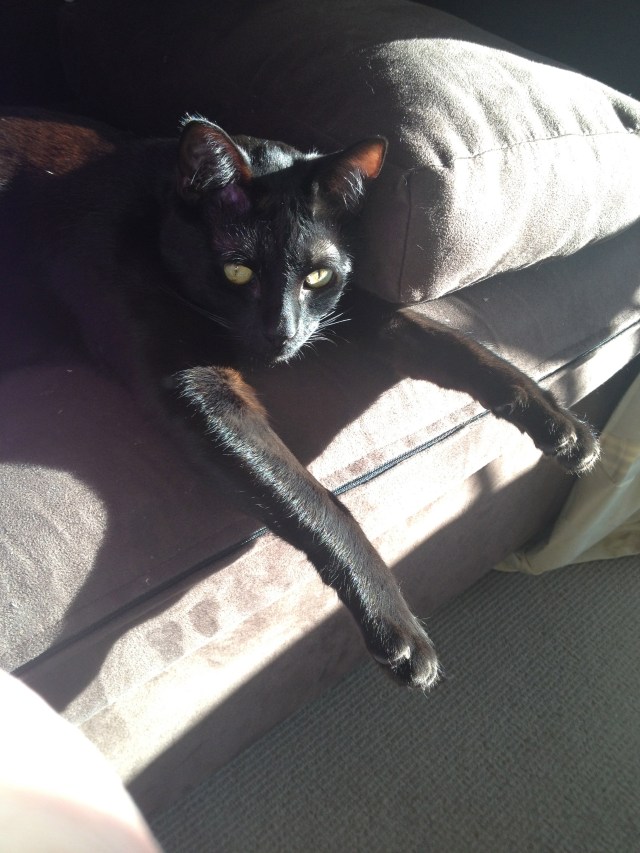
  • Look after a beautiful black cat
  • Own my own home
  • Be a role model for others on the Autism spectrum and those with mental illness
  • Be happy from time to time
  • Pay lots of tax to help society
  • Express my love and gratitude to family and friends for being lovely
  • Be a good friend
  • Give presentations about a number of good things to many thousands of people over the years
  • Grow older
  • Help challenge stereotypes about all manner of groups of people who are disadvantaged.

If you care for people who are socially devalued, or even if you just come across people, I reckon maybe reflect on the fact that my recent life was made possible by a psychiatrist noticing something in her client and being concerned.  The way workers and support people care for people and the choices they take is often critical in which path they take and which ‘dimension’ they find themselves.

Mr Ronnie 3 October (1)


Perspectives on revolution (or ‘what I did on my holidays…’)

Anyone who knows Terry Pratchett’s alternate multiverse will see that the subtitle of this post is a little tongue in cheek (and for those who haven’t had the pleasure of meeting Mr Pratchett’s wonderful characters in his many books, I will explain that ‘what I did on my holidays’ is the title of a book by the Discworld’s first tourist, TwoFlower, which almost causes a revolution due to its depiction of a world vastly different to the of TwoFlower’s home country, the Agatean Empire.) OK, nerd points racked up so here i go…

Late last year I was asked to deliver a seminar presentation along wth three other speakers at Griffith University. I happily agreed to do this. Griffith University is in that wonderful subtropical city with many bridges and curly streets, Brisbane. I realised that someone I had recently reconnected with was researching at Bond University which is on the Gold Coast. My sense of geography is appalling at the best of times and I assumed – given how close the two places are to one another on the map – that the Gold Coast was a ten minute drive form Brisbane (I got lost in my own house once as a kid so this is on the minor end of the ‘Jeanette’s crimes against geography’ scale). I should give some background about the friend at Bond University. The friend is professor Vicki Bitsika, head of the Autism Centre at Bond Uni. I met Vicki when I was twenty. She came to visit me and I think we were both quite wary of one another. I was a prisoner and Vicki was a psychologist who was  one of a handful of clinicians at the time who knew about this thing I had never heard of before called Asperger syndrome. Vicki got me to answer lots of questions and decipher cartoons with no words which I can still feel my sense of deep frustration I puzzled over this seemingly impossible task. Vicki gave me a diagnosis. I regret to say I gave her an evil stare and a lot of attitude. My parents paid for me to see Vicki. I think I may have gone to three appointments. I hated that Autism label as I thought it condemned me to living out all the insults and taunts that bullies had applied to me all through high school. I wasn’t about to accept that!

Of course anyone who reads this blog regularly will know that I am now very happy with my ‘A’ word and identify very strongly as a proud Autistic woman and encourage others to embrace their unique Autistic ‘them-ness.’ My former psychologist Vicki and I have been working independently as Autism professionals for some years but we only connected recently, I suppose psychologists probably aren’t supposed to go and seek out their former clients. There is probably a rule about that somewhere. I saw Vicki’s name in a  couple of places and it piqued my interest. Then last year I saw that I was presenting at the same conference as Vicki. I got in touch and she was really happy to catch up with me. We have been in touch ever since. Vicki is one of the most significant people in my life. She is also a great and very generous person.

When I got the details of my Griffith Uni talk sorted out, I suggested to Vicki that maybe I could visit her for lunch on the day before the seminar at Griffith, This turned into an gala dinner with all the senior academics, sponsors of the university and the Vice Chancellor. “Cool!’ I thought (I am a bit of a fiend at networking and was looking forward to introducing myself to influential  people and making sure they all got at least one  Jeanette business card). Given this generous offer of dinner and potential networking, I offered to give a talk as well. The talk went well and the dinner was amazing. It was ironic to be a guest at a schmooze-fest dinner at Bond university as Bond is a privately-run university, reliant on students’ fees, sponsorship and  and donations. My teenage socialist self spent most of the past month yelling rude words at me at this betrayal of my 16 year old need to turn the world upside down. Thankfully my current self favours ‘gentle power’ and using influence and education to change things. Not a lot of revolution happens atWhimsy Manor but a lot of support and friendship and mentoring and gently calling people on their unhelpful beliefs and showing them a better way – that is my preferred method of making change.

The morning after my Bond Uni visit, I had breakfast with Vicki at a little French patisserie. I then had a chauffeur driven car collect me and take me the hour and a half to Brisbane from the Gold Coast. I listened to music on my phone and enjoyed seeing the driver doing something he plainly enjoyed. I was in good time for my presentation and enjoyed listening to the end of the first speaker’s talk.

There was another Autism advocate who is also a psychologist and PhD candidate presenting at the Griffith talk. I felt so supported and was pleased that we could both respond to questions from our respective Autistic perspectives. At one point, someone asked me a question about a topic my colleague was better equipped to answer. I started to answer it and then realised that a much greater expert then me in that area was sitting right next to me.  I happily threw the question to her, appreciating her presence. I reflected that things are changing. When I started out doing public speaking around Autism in 2005, an Autistic keynote speaker was pretty much unheard of. The focus was always on deficits. Yet yesterday a room full of clinicians and parents of Autistic kids carefully took notes when my colleague, Jacky, and I spoke about neurodiversity and why we are against the sorts of therapies which aim to make Autistic kids seem ‘less Autistic’.

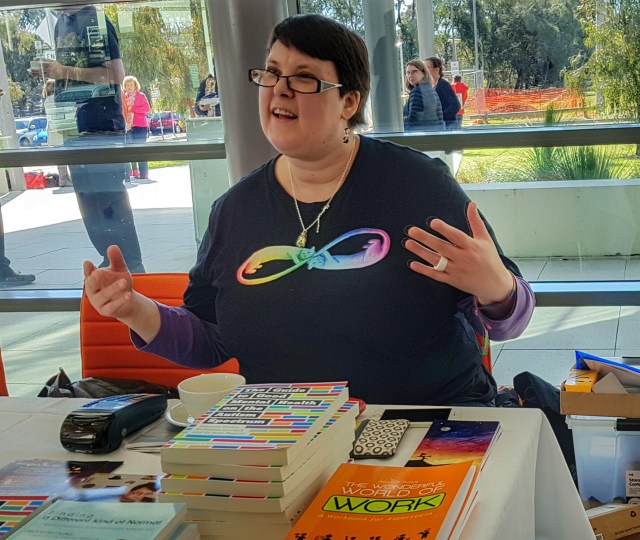
I had a great day presenting and meeting new people and selling books and things. I got a lift to the airport with two of the other speakers who were on an earlier flight. I bought some impressively unhealthy dinner at the airport and then found the gate I needed to be at. I got some odd looks from the other people as I was wearing my rainbow neurodiversity infinity symbol T-shirt with the symbol made up of pictures of cats and my wonderfully lurid blue and pink tie-die shoes. Apparently forty-something women aren’t supposed to dress like that. I happily reflected that I am me, just as I am and will never let some narrow ‘rules’ of fashion and age dictate how I present myself to the world. I smiled as I realised I was someone that  many people would discount on first look – overweight, middle-aged and female, dressed in wacky and colourful  clothes ad shoes and doing unexpected things with my body language and eye contact. All those have never seen me on stage, they have never seen my awards around leadership and volunteering, They have never read my books, blogs or articles or received strategies and tips form me but I sit confident in the knowledge of my work and my community.

As is so often the case, a trip to give presentations on Autism results in me feeling bigger and better than before, carrying within me the knowledge that I and my advocate and ally colleagues are doing our bit to change the world. I love being involved in the ongoing revolution and rethinking around Autism. We still have quite a long way to go but we are further along the path to a better world.

20160826_133303-01.jpeg


Why I want to be redundant and for other people to get awards

I posted a statement about mental health week today. One of my social media friends commented that it would be  great if my experience of being an employed home-owning person with schizophrenia was the norm and not the exception. I wholeheartedly agreed This exchange got me thinking about a  few of my career considerations and things which drive my advocacy work. Here goes…

‘The only Aspie in the village’ – recognition and other kinda unhelpful things

I attended a conference a while back and got talking to someone before the first session. We were joined by another someone shortly afterwards. I couldn’t quite read what was going on but I could tell I had done something wrong. I had never met this person before but they acted like we knew each other and I had wronged them in some horrible way. I was utterly puzzled until a friend said ‘oh, they just have a fame thing’. My friend was basically explaining that the unhappy person didn’t like me because I have a bit of a profile. I was baffled. Shortly afterwards another friend described another advocate as wanting to be ‘the only Aspie in the village’ and feeling threatened by the success of others.

I wish I could stay virtuously ‘oh but I never think like that…’ Sadly I am far from saintlike on this issue. I spent many years being very competitive and feeling intimidated by other speakers and author and their impressive profiles. It actually took me getting some recognition of my own to make me realise how silly it is to envy others. These days I think the more Autism advocates from different backgrounds and experiences there are, the better. I can only really speak from my own experience as one individual. If different people share their different experience and wisdom it becomes a more inclusive message. I love having colleagues and friends I can refer speaking or writing gigs to. I also feel that as someone who has been around for a while, I can share things I have learned with others and support their advocacy work. Rivalry is often counterproductive. In the Autism world, cooperation is a better form of leadership than competition.

Why I don’t really want awards

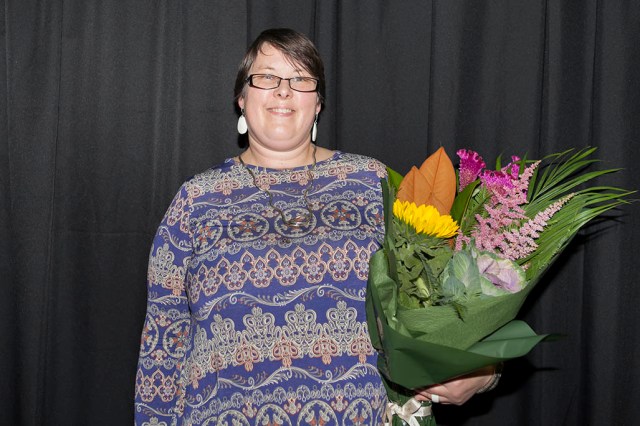
I was at an event recently and someone suggested I would have been a more worthy recipient of an award than the person who got it. It thought this was a bit of an odd sentiment. The purpose of awards as I see it is to encourage people to continue doing the good things they are doing. I have been writing and advocating around Autism for eleven years and have a fair number of certificates and spiky glass things with my name and some achievement engraved on them. Awards are lovely but they don’t motivate me. I don’t need them. I am always happiest when someone closer to the start of their career than me gets and award because I think it will encourage them to keep going. I will probably do advocacy forever, regardless of what awards I might gather in the process.

My main concern about feeling rivalry for opportunities and awards is that if I am going to want to win something and get all competitive, I am basically wishing another Autistic person disappointment. I don’t really want to do that. One thing I like to do is to nominate others for awards and then when they win, I am really happy.

Why I speak for organisations who don’t always pass my test for inclusiveness

I speak at a lot of conferences and events for all sorts of different organisations. I have some pretty strict views on appropriate behaviour for Autism organisations but I often find myself speaking for organisations which don’t quite pass muster. This is not because I am a ravenous public speaking beast who needs to get on stage every week. There are actually a few reasons for this,

Firstly, I could gather the people who agree with everything I do around Autism in a medium sized room. If I spoke to the 80 or so people who fit this description, we would all be really happy agreeing with one another and nobody else would get the benefit of the message. Secondly I see my role in the Autism community as one of education and leading by example. I do not start from the premise that there is no hope for an organisation which professes ideas of practices I have an issue with. As a Autistic speaker I have a great opportunity to educate Autism organisations. And finally, I am not really speaking for the organisation anyway, unless I am giving their staff an an in service. The people sitting in the audience are the ones I am most interested in. Often they are not part of the Autism advocacy community. They are there to gain information for themselves or their partner or their kids or their professional role. I would rather they got the benefit of my message. If I was taking the moral high ground and only speaking for the roughly three organisations which align exactly with my views then these people looking for information would miss out on hearing what I have to say. This would be a shame because I have an inclusive and positive message built in my own lived experience of Autism. I am practical and I’m not going to wait for the perfect Autism organisation to come along before I speak to those audiences that can gain so much from what other  self-advocates and I have to offer.

Why I want to be redundant

I absolutely love my life at the moment. My extrovert bits are delighted at getting to hop up on stage as often as I do these days. My altruistic and activist bits are delighted at getting to help others and make a difference and my intellect is loving the challenge of my work but what I really want is not to do it any more. Of course on a personal level I would be sad to leave this life behind but as an advocate I would be so happy if all the things that my colleagues and I do is no longer needed. So please, let me and my work become unnecessary. Let us do ourselves out of our jobs as advocates and rejoice in the world future generations of Autistics have a life where the horrors that I and my contemporaries experienced and continue to experience is condemned to – as my socialist comrades in the 1990s used to say – the dustbin of history.Awards pic 2

‘Let’s agree to disagree’ – Learning conflict, assertiveness and limits

The other day I wrote a post on Facebook which I knew would cause a lot of conversation and probably debate amongst my Facebook friends. This was something I have been doing recently as I like to pose questions for people to consider and discuss. The problem is that I am terrified of the response. I am an activist of sorts, but the rarest sort of activist because I struggle with conflict, disagreement and argument. There are a number of reasons for this

My parents – who are amazing and wonderful and I owe my life to – had one difficulty when I was a kid in that they never argued. I can only remember seeing them argue once when I was about 14. I was horrified and thought the world would probably end if they didn’t make up right away. It was threatening to see them argue as I couldn’t recall ever having seen it before. My parents avoided conflict like the plague so this became my default setting too.

As I grew to adulthood, assertiveness and boundaries were things other people did. I spent four years as a teenage socialist standing on the street corder selling the socialist newspaper terrified someone would disagree with me! Of course a lot of people did disagree with me. The whole thing was very stressful. When I was twenty – for reasons which you would probably be best off reading in my autobiography is you want detail – I found myself in prison. My life – like all prisoners’ lives – was very cheap and in constant danger. Even minor disagreements between prisoners often escalated to physical violence. I learned very quickly that disagreeing with my criminal ‘housemates’ was not a good idea so I spent that whole period of my life appeasing everyone and being ‘nice.’ I did this by giving others cigarettes and other things bought at the canteen with the money my parents put in my account every month. It was a time where I completely lost my sense of self. I didn’t know who I was. I was the ‘nice girl’ who everyone liked but I had no idea of what my wants and needs were because I was so busy keeping over 100 women happy and not saying the ‘wrong’ thing.

All those things were a very long time ago but they are etched in my brain and inform my character today. I struggled with assertiveness and setting limits until quite recently. The only reason I can now ‘do’ assertiveness is my absurdly busy schedule for my advocacy work. As of a year or so ago, I am asked to speak at, write or have some involvement in something every day. I work full-time and there is no way I can agree to do everything I am asked to do so I learned to decline things politely. My ability to set limits with friends and acquaintances has also increased. I have so many people who want my support that I need to keep some distance. Social media is wonderful but blurs the line between friend, supporter and acquaintance. In the past I would stretch myself very thinly emotionally and supported everyone who asked but now I know I can’t do that or I will almost certainly become really unwell myself. So I (hopefully) kindly explain this and suggest some services people can access for assistance (that aren’t me!)

I suppose the triad of managing relationships in this way is being able to assert one’s needs, being able to set limits and boundaries and being able to disagree with others. So I have the first two of these pillars working well for me at the moment. I’m working on the final – conflict and disagreement – as best as I can. Posting potentially controversial things on social media is still terrifying. I check my friends list whenever I post something people disagree with to see if my ist of thousands of friends has gone down to tens (this hasn’t happened yet). It is good though because it cements my relationship with a lot of people, even when we disagree. Disagreement does not need to be disrespectful. It can also help me to clarify my thinking – or change my thinking – on a topic. It helps me to keep my thinking current and relevant. It is a great realisation that I can disagree with people and they won’t disown me as friends and if they do it probably says more about their intolerance  than anything I have said or done.

I actually think these sorts of issues are common for those of us on the Autism spectrum. Experiences of things like  being bullied, abused, hated and invalidated makes us scared to express our thoughts publicly or even to our friends, family or partner. For me I learned assertiveness and boundaries incrementally and very slowly over time. I am happy I am at the place I am with this.It is a big thing to address. Building skills in that area has great flow on effects to other parts of life. Based in my experience, I think the two key places to start are learning to value yourself and understanding the issues you face which might be stopping you being assertive etc – An act of self love and an act of self-awareness. This is definitely not easy but it is certainly possible. Noble franchise meme

The  curse of the thoughtless thought

Narrative One:

“An autistic schizophrenic overweight middle aged woman is sitting in her tiny, chaotic home, talking to her black cat with the infatuation Gollum has for ‘his Precious.’ Hunched over a laptop with a fair share of crumbs and evidence of spilled things she is stimming and buzzing, writing feverishly. She talks out loud to Spotify, complaining as if the software had a soul and understood her need to listen to music which isn’t ‘terrible’. She is frightened of ghosts in the shadows. She is childless and single, alone in her world“

Narrative Two;

“The ACT Volunteer of the Year sits at her laptop, writing words which may help thousands of people. She has spent the day at her professional job and is now relaxing with some writing. She is driven to make change. She may be quirky but she is also brilliant and passionate. Her small home is devoted to her disability and mental health advocacy work. Her small but tasteful flat has its own name – Whimsy Manor. It is decorated in eclectic styles with beautiful artworks. The woman has a flair for the artistic which must be from her Masters degree in fine art.”

If you are a regular  reader of this blog you will probably realise that both these statements are about the same person – me. One is from a pathologising  viewpoint, and the other one – well, it felt a bit weird to write it because it is rather gushy, but it is obviously from a more sympathetic viewpoint. The two narratives demonstrate the concept that what we say and think about people colours our view and our relationship with them. For Autistic people and people with mental illness – and many other groups in society – there are a bunch of unhelpful stereotypes and assumptions that we often get lumped with. I thought it might be an idea to unpack a few I have come across and how they made me feel and what I did about them.

  1. I take medication for my mental illness, I have taken this medication since 1995 (with a few tweaks for effectiveness). I moved into my own home in 2008, my tiny, chaotic and wonderful Whimsy Manor. I located a chemist close by so I could pick up my medication. I take six different things so use a Webster pack where the pharmacist puts the required dose at the required time so I don’t forget to take any of them. In 2010 I became very unwell and spent some time in hospital for my illness and also in mental health respite. I had to transfer my scripts to a different chemist as the respite place was in a different suburb. I went into the chemist in my home suburb and explained the change. I had my support worker next to me. The pharmacist said ‘oh., so your mum is going into respite?’ I have to admit I was baffled. It turned out that in the three years I had been collecting my medication from this business they had assumed it was for my mum as supposedly someone with an Australian Public Service lanyard who wore a suit every day could not possibly be taking high doses of antipsychotic medication! Amazingly this misconception took a few tries to address. Eventually the pharmacist said to me ‘Jeanette? Do you work for the government?’ To which I replied ’Yes.’ She considered this apparently radical idea for a bit and said ‘Most people who take these medications don’t work for the Government’. I replied ‘You would be surprised.’ Since then I receive a lot of respect from all the staff  at the chemist but it still amazes me the level of assumptions involved. My mum doesn’t have schizophrenia and she lives in another state, five hours’ drive away! I hope my experience has helped the staff to realise that not everyone fits into a stereotypical ‘box’.

2. A woman got in touch with me a couple of years ago. She professed friendship but seemed more interested to ask me to promote a sort of self-actualisation thing she worked for which apparently gave participants financial incentives for gaining new members. She wanted me to promote this thing to Autistic people and was very insistent. I felt uncomfortable being around her. The woman came to the launch of my second book. I had proudly taken the stage and professed my firm belief and understanding that Autistic experience is ‘different, not less’. After the speech I signed books along with the illustrator, a wonderful local artist called Andrew Hore. The woman came up to me and said ‘Jeanette, you know you don’t have to say you have Autism.’ Immediately I could see that things were probably heading in a horrible and quite offensive direction. Curtly I said ‘Why?’ The woman responded ‘Well, you could pass for ‘normal’”. I found it hard to respond to this highly offensive statement, particularly as I had spoken for a good twenty minutes about empowering young Autistic people to be their own amazing selves and support them through getting work. I don’t actually remember the exact words I said but Andrew, seated next to me said I handled it well. I know I refuted her statement and explained why I had no great desire to be ‘normal’. In context, I spect my teens and early twenties trying to belong and fit in. It was an unmitigated disaster and cost me my identity for many years and could have cost me my life. The biggest insult was that the woman did not understand why I unfriended her on Facebook after the incident!

3. I was at a conference a couple of years ago and had gone to the quiet room because I found the first keynote presentation triggering. The only other people in the quiet room were conference volunteers, mostly non-autistic people. We got talking. This was when not many people had come across me and my work. I was a little vulnerable because I was quite unwell (but was determined to go to the conference and deliver my presentation about Autism and employment). I found the conference volunteers in the room to be a little patronising, The conversation got to living arrangements and one woman asked ‘Do you like at home with your mummy?’ I am really proud of how I responded to this surprising statement. I looked her in the nose (I am Autistic after all and looking at eyes is scary) and said ‘No. I live in a house I am paying off with the wages form my permanent, full-time job in the public service!”.

I think all three of these encounters demonstrate assumed knowledge and stereotypes. I hope I did a good job of dispelling the myths so that others in a similar position to me don’t have the same experience. I think it is always best not to assume. Treat everyone as an equal because we are equals. We are all human. We are born and we live and we die. We need air, food water and love. Assumptions create misunderstanding, distance and anger between people.

IMG_0446

Some poetry on Autism, mental health and life in general

Hi good people of blog land.

I thought it might be nice to put some of my favourite poems into blog format so anyone who likes my poetry can see a good amount.  know I pop the occasional poem in things but this will be more af a Jeanette’s recently poetry anthology. Ooh, I can;t wait….

Here’s a few of my Autism-specific ones, I actually was named a ‘distinguished finalist’ in the Local Gems National Poetry Writing Month (NaPoWriMo) 2015 competition on the strength of some of these. I choose Autism advocacy as my topic and wrote one poem a day for the month of April. It was challenging especially as April tends to be a busy month for me, but I got it finished and it yielded some lovely poems.

My past and me

Now

I am your success story

Your example

Your role model

You pay to hear my wisdom

How can this be?
Then

I am broken

Afraid

A lost cause

Example of what not to be

A cautionary tale

A mistake

A fallen thing

A tragic thing

Hopeless

Futureless

Yet here I am.
I look back

I find that other I

There she is

There I am

‘Come with me’

I reach out my hand down the years

Connecting, just.
I hold her

I am you

You are me

She buries her sorrow in my chest

And we become whole.

Tragedy and triumph together

She is with me and I am with her

Reconciled.

Not fixed but learning.

I don’t want your cure

I don’t want your cure

I am not broken

I don’t not belong condemned to the genetic dustbin

I am not less

My world is not ‘wrong’

My communication not ‘lacking’

My interests not ‘obsessive’.

I am not a tragedy

Not the product of a cruel God

Not something to be fixed.
I am myself

I am proud and beautiful

My reality as valid as your reality

My experience my own.

I love my world

This world I share with others like me

The only tragedy in my life is hatred

People too small to see my value

To sad to delight in my quirks
You want a cure

Which part of mine will you cure?

Will you cure my talent?

The brilliance of my pen

The clarity of my wit?

Will you take my life and remove all the ‘broken’ bits?

All the life I have lived

The wisdom gained through horror and loss?

The love and kindness left when the fires of abuse and terror died?

Will you take my compassion

My empathy

My love for the Other?

What of me would you leave behind from your cure?
No. I don’t want your cure.

I want your understanding, your ear, free of judgement.

I am human

There is no cure for humanity save death

And that is hardly a cure.

Mum

My mum is not the average mum

She never gossiped with her girlfriends at the school gate

She never wore heels

or make-up.

She did have three lipsticks from the 1970s – a pink one and orange one and and sort of melted brown blob

She didn’t ever watch rom-coms

She stopped buying music in about 1963.

She never talked about being a lady

or using your feminine wiles

(whatever those were).

She tromped around the garden in gumboots

and a jumper from he dark ages.
When I was little there were lots of books

Little kid books

Christian books

then books we could read by ourselves.

One day my mum read a magical book from her childhood.

It was precious. a treasure.

She only read it to us once to keep the pages from falling out.

It was from the ancient history that was my mum’s own difficult childhood

She read it as if preserving her fragile childhood

Stopping its few good memories from disintegrating into crumbs.

Mostly my mum’s idea of calming reading was the book of Revelation.

At 10 I knew all about the whore of Babylon

But I’d never watched Mary Poppins.
My mum had a word for every occasion

a logophile

(ironic that one needs to be a logophile to know what one is).

In a sea of Englishness she sported an Australian twang.
England was always too cold.

too windy

she’d set up a vivid orange tent on every English beach

We never got lost

We’d see the tent’s toxic hue and come whirring back like homing pigeons

If pigeons liked dribbly ice cream and seaside rock.
As I got older my mum transformed

She was now my best friend

In the absence of friends my age

I could tell her anything

I’d stand behind her and brush her hair

Hundreds of times

Thousands when measured in days and months and years.

Whenever I was in trouble she’d be there

Ready

Amazing.
Some time after I gained for myself a label

‘Jeanette:Aspie’

I went through adulthood the lone labelled person in our quirky Purky world.

It was almost a sleight – why just me when others in our midst may benefit from a swipe from the label machine.

One Christmas I was home

My mum comes up with unknown intent

She thrusts a card into my hand

‘I want the assessment. Give me the label’ it read

Clinician visited

Label attached.
My mum, my friend, my champion all along is now in the club

we are in it together

The same

Our perfect club of two within the larger club we’ve been in all these years.

Our labels bear the same name

‘Thank you mum’

This one is a reflection on a recent trip to my ol d hometown Melbourne

After sparkles

A trip to Melbourne

My former home.

Conferences and book sales give way to tourism.

At the Victoria markets

I spy stalls amidst the fishy funk

A shop with felted hats and a hippie lady

We start to talk

If I took up her time I should buy something I think

I find a deep red yak wool scarf – it will be warm in Canberra’s winter chill and wind

I bid her farewell, clutching a little plastic bag overflowing with my new scarf.
I head down the hill

There’s a jewellery shop

Sparkly bling and a quiet girl hunched at the register, reading a book.

I search about, disappointed by the selection of things but wanting to buy

And then as I’m leaving a sparkly bracelet catches my eager eye

‘How much?’ I ask

The quiet girl’s delicate features light up

‘Ten dollars’ she says.

Ten dollars for an endless amount of sparkles seems a very good deal.
I happily go back to my hotel

past a lanky young boy dancing to his headphones

A twenty-something lass with maroon ringlets

A family from the country, bumping into the unfamiliar crowds.
I have warm things, sparkles and joy.

My love for Melbourne is unabated.


This one was published in the Canberra Times earlier this year in a slightly edited form. Enjoy

All that I want

Affluenza and entitlement dictate a list,

Things one is supposed to want if one is successful and urbane:

A house (big, ostentatious)

A car (probably Italian and stylish) and all those other things I neither want nor need.
I want a cat to cuddle

For people to listen before they judge

Full bookcases

Music to lift my soul

Respect of the Other, whatever Other they may be

Safety in my home

Safety in my mind
Influence in things that matter

Wisdom

People and things to love

Just enough self awareness

Ethics and values not rules and dogma

A modest place to call my own with walls for all my art

A friend to tell me when I am getting ahead of myself

Talent and skills sufficient to achieve my goals

Work all the day long

A comfortable and warm bed and sympathetic characters to inhabit my dreams

A body fit for purpose

Friends to laugh with. To cry with. To share success and defeat

To have children in my life to keep me young

Family – my hereditary one and the one I choose

And maybe some chocolate.


Here;s a lovely one about mr Kitty and how he is my little black kitty therapist

I have a little panther. He shares my home

With sleek black fur

Golden eyes and ready purrs

I feel a thump each night as he leaps on the bed

I see him coming towards me

Purposeful

On a mission for a cuddle

He flops  down next to me and I hold his little paw

He talks

And talks

Announces his presence at times in plaintive meows

or deep reverberating purrs

He asks for cuddles

Taps me on the shoulder as I work

‘I’m here mummy’

If I keep on at my work the tap gets more insistent until I scoop him up and bury my face in his soft fur

He steals my spot on the couch

‘helps’ with laundry

and gift wrapping

and cooking.

When I make the bed he insists on assisting

In his previous life he was a stray

He seems like a rich boy fallen on hard times

When I cuddle him he cuddles back

An urgency of love

I was his saviour

And he was mine.

His entry to my world spelled the exit of my blighted existence

Since he has shared my hearth there have been no stays in modern day bedlam

No self-destructive dance of defeat

And when my fractured mind turns him into a demon

He walks up with his patented panther stride

And reminds me who he is,

My mind’s demon become reality’s cat

I hold him and he purrs

Yes, I have a little panther who shares my home.

I can scarce imagine life without him

This one won the 2011 ACT Mental Health Week poetry competition. It was written when I was very unwell and staying at a mental health rehabilitation house. It was before i git Mr Kiyty, when i didn’t like living at Whimsy Manor. I think its quite a powerful poe,.

Monday

Monday

I put on my suit – armour against the sword of daily life

I took the bus to work

Thoughts passed through my mind

of awful and inappropriate actions.

I swiped my card. The perspex doors gave way at its bidding and I was in the lift

I got out at Level 5, walked to my desk and logged on

The emails made no sense
I took myself to a private room and called Kathy, my capable clinical manager

“Go home” she said

but I was determined.

After what seemed no time my Manager was driving me to see Kathy, concerned.

The world seemed to close in – there was no future

Kathy was concerned as well – worry etched in her features.
A trip to the hospital

Waiting

I escaped. Kathy gave chase.

Police walked by

I looked longingly at their guns

but what sort of public servant would that make me I thought

A dead one.
Kathy leaves me at the assessment unit

In my suit.

My make-up perfect, jewelry matching my clothes

Work shoes newly polished.

There is no tomorrow I think, at least, not one in which I want to be.
The psychiatrist – young, cocky, male – sends me to PSU, the locked ward, for my own protection.

I arrive that night

In my suit.

“Do you work here?” asks an intern

“no” I respond gloomily. “I’m just a well-dressed patient.”
Outside the rebels storm the winter palace and the sky explodes,

Inside I’m safe, medicated and confused.

The world goes on around me, unaware and unconcerned

This one is quite a long one – sort of a narrative poem. It actually made me cry when I read it out loud after I drafted it. Thats; probably the mark of a good poem (unless one  is crying due to the terrible writing but  it was crying for emotion, honest. 🙂

Shadow girl

There was once a girl with a happy laugh and a curious smile

But she did not know it.

For she lived in the shadows

Where the creatures of the dark hurt her

And told her lies and called her names.

She hated the shadow world

But tit was her home.
She wanted to leave her broken world

but she couldn’t find her way into the fresh green garden she believed was above

She imagined its flowers and birds and dragonflies humming by happily.
The shadows broke her spirit and took the smile form her eyes

The love from her heart’

The will from her mind.
Weighed down, she trolled the shadows, crying silently.

For she knew this was not her home

But she couldn’t come out.
One day she started to walk

went to places she hadn’t been

Ghosts laughed at her and made bets that she would be here forever but she just kept on walking.
One day she found a rock stair case

She looked up and saw stars – actual, beautiful twinkling stars

Lights calling to her straight from the very beginning of the universe.
Even though the stairs were slimy and she feared she would fall with every step she knew she needed to take the stairs

It was her only chance to be free.
She went on and on.

Hours and days and years elapsed

Strangely, the higher she got – even though the danger of falling grew worse with each footfall – she started to feel renewed and confident.

Clear crisp air filled her lungs.

She started to smell blossoms – so far from the foul odours of the shadows, smells of death and decay and defeat.
As she climbed higher, beams of light started to shine on her face. The light was warm and gave her hope.
She saw the top of the stairs

She took a tentative step into this new world.

She looked down and saw her dress was white

Her gold hair flowing down past her shoulders.
She lay in the green grass in the garden looking up at a pure blue sky.

She couldn’t find a word for what she felt

She didn’t even know what she felt except that she was no longer afraid.
An age passed.

The garden was so beautiful but the girl was all alone

What point is there to happiness if one can’t share the experience? The girl thought.
As soon as she thought that, a little black cat strode over, exuding cat confidence

He wound himself around her legs.

She stroked the cat and felt his soft fur.

The cat walked off into the distance

“Wait!’ the girl said and followed him

Running to keep up.


She followed the cat for a long while,

Damp, springy grass underfoot. .

He stopped at the top of the staircase.

She looked down and saw shadows and ghosts.

They looked weighed down and sad.

She wondered how she could help.
The cat started walking down the stirs.

The girl followed.

It seemed infinitely easier going down than it had been coming up.
The girl met a ghost

But the ghost was not frightening or evil – it was sad.

Against all logic, the girl held out her hand to the ghost

With the touch she saw the ghost’s humanity

It was a young girl with spiky red hair, green eyes and a tentative smile

The ghost was a friend.
The two of them went hand in had up the stairs, followed by the cat.

It was infinitely more easy to traverse the stairs with company,

The two girls talked and laughed and helped each other up.

The cat showed them the best way to ascend and purred a tune to keep them inspired.

As they ascended, the ghost took on stronger form

After while the two of them looked like sisters.

They were whole.
So the girl spent eternity rescuing ghosts from the fetid world below.

She took them to the garden where they could live their new existence.

She became friends with each one of them.

The task would never be done but the rewards were great.
And the garden became filled with the laughter of children and adults who once were shadows but were now whole, fulfilled, free people.

And the girl kept on at her task.


And last but not least, my latest poem, written on Tuesday, all about reconciling negative historical Jeanette with who I am now. I hope you enjoyed my poetic musings 🙂 JP

The two Jeanettes

I’m tired

Seventeen years of tired

Of metaphorically jerking my neck around to spy my past

then run from her as fast as I can.
Excuses excuses

‘I’m not like that…

‘She isn’t me. She is previous me…’

He face leers grotesquely at me in the mirror

Every time success comes my way she is right next to me, taunting, blaming, hating.
Hard to express just how I hate her

Every act is framed by her presence

I can’t really own my life

Every day at my job

Accepting accolades and planning what to do if she ever escapes to destroy all I have made

I had no future than and I barely see one now

“If good things happen I will be dead straight afterwards’

‘Don’t get too comfortable. You were in prison. Everyone will know and they will hate you

There is no good in you. You are just pretending.

Others can see past your nice act to who you really are. You are ME.

Oh I shall destroy you. All those who love you will hate you when I’m done.
Author? positive person? Autism world Celebrity? Really? Who do you think you are?
I step back and watch the person I once was

I see her desperation

I see that every kind word I say, each decent act I commit puts a distance between us.

She is desperate

As she always was

She is both victim and perpetrator.

Vulnerable

Young

Scared

Acting tough in a world really not fit for her

The hatred is an act. Mostly

She learned the words, the attitude, but was never really there.
I summon up my strength and approach her.

She’s like a frightened dog – hackles up and in need of love and closeness.

Tentatively I hold my hand to her

“You can be yourself’ I say

‘There is seventeen years between you and i.

This world will accept you

Forgive your mistakes and support you.

You don’t need to fight the world.

There is a place for you.

There is a cat….’
I edge closer

I touch my hand to her. it is scarred but she holds on tight

We embrace

gingerly at first, both of us wondering what the other may do

Then she grabs me and holds me close

She cries and I wipe her tears as she does he for me

My shadow self and I together

I hold no fear of her

It is swept away amid understanding and acceptance.

OLYMPUS DIGITAL CAMERA


Social media – the good, the bad and the reason I love it 

I was having a conversation with my publisher a while back and we both agreed how much easier it is to market and sell books now that we have so many social media platforms. For example, the night my collaborative work The Guide to Good Mental Heath on the Autism Spectrum was released, I spent around 90 minutes promoting it. I sent an email to my full Autism world contact list (over 200 people), then got on Twitter and tweeted it, tagging a load of folks. I then got onto Facebook and posted about the book on all of the around 250 Autism groups I am a member of and posted it to my personal page and my Autism Books and Other Things page. I don’t know the exact analytics but I think in 90 minutes I may have communicated to over 100,000 people about the new book and how they might find it helpful.

But for me the value of social media goes way beyond the ability to market products more effectively. I was messaging my friend and fellow prolific social media user, Penny. Someone had suggested I take a holiday for some time away from my absurdly full workload and I was discussing this with Penny. I ended up realising that most of my social time – usually time connecting with friends on social media – actually forms some kind of downtime for me. My life on social media is wonderful. I don’t have to do face to face talking, I can connect for as long or little time as I want to. If somebody is being, for want of a better word, a bit of a tool, I have the options of unfollowing, unfriending or blocking them. It is true that most of my friends live in my computer and phone (and of course some of them are also face to face friends). Social media for me is almost always a safe and respectful place.

I think quite a few Autistic people find communication online easier than in the physical world. For people with prosopagnosia (‘face blindness’) – like me – it’s great because you don’t need to recognise your friends by their face. Typing allows for editing and perfecting the message to ensure it conveys what you want it to. This is much less stressful than face to face communication (although the disadvantage is that it takes longer to clear up if there is a misunderstanding). Many Autistic people find conversation with others on the spectrum on social media helps them to discover and develop their Autistic self-identity. In fact many Autistic people find their voice and power on social media. For people who are non-verbal and used typed communication, social media and blogging can be a vital way to express thoughts and opinions and connect with others. Also, for those of us who blog or write non-fiction, poetry or fiction, non-autistic people who may view our work may be far better at seeing the actual worth and quality of the writing in an online context. Sadly, an Autistic person’s physical appearance, dress style, stims and different eye contact or other perceived differences in face to face conversations can result in them being taken less seriously. Obviously this is not the way things should be. A good writer does not need to look like anything but unfortunately it is still a big challenge for some non-autistic people to see a person’s true worth past their apparent quirkiness and idiosyncrasies.

I often reflect that if we had social media when I was a teen and young adult, complete with a bunch or Autism advocacy and neurodiversity groups and maybe a role model thrown in for good measure, my life would have been much easier. However, this brings me to the other side of the coin. For some people  – Autistic and non-autistic too – social media is a battleground and a forum for horrific bullying. I have even seen this happening on occasion within the Autistic community.  People denigrating, invalidating, disrespecting and hating others and sharing all that vitriol with the wider online world. This can have some pretty dire consequences – just like face to face bullying can and often does.

Autistic young people may be more vulnerable to online attacks due to a very beautiful thing which turns into a horrible thing in the hands of a bully. That is that we as Autistics often have pure, kind hearts and cannot imagine people not being kind and thoughtful and honest like we are. We don’t feel we need to set up boundaries in our online life and identity because why would we need to? This openness and kindness can be manipulated, abused and exploited by a bully. Not all Autistic people are like this but I know a good many who are, induing myself. When I was a young person, it was a curse. Bullying and abuse were always a surprise and were always treated with me thinking ‘but why would they do that?’

The online world is often un-policed and teens and young people can be essentially suffering in silence. As the online world is now so important for education and delivering the curriculum it is horrible to think of Autistic young people being in the line of fire so to speak, each time they go online. Bullying is a complex problem but one which really needs to be addressed, especially in order to protect Autistic people.

Another difficulty which can arise with social media and online life is internet addiction. There is increasing evidence of internet and gaming addiction among young people, particularly those on the Autism spectrum.  It would seem there is fine line between constructive internet usage and problematic usage. It is clear why this is an issue for some people. If you imagine a young person really struggling – stressed, frustrated, overloaded with social contact, experiencing depression or anxiety – and their parent gives them an iPad to calm them down. It is instantly effective. The online world and games are immersive and stimulating and effectively distract the young person from the difficulties they are having,  The young person comes to associate the iPad and gaming with feeling better and so when they feel stressed or sad (or whatever) they reach for the iPad and play games and it makes them feel calmer. Sure, excessive computer gaming won’t result in a bad liver or in crime to obtain money to satisfy the ‘itch’. But what it will do is potentially impact on the young person’s school attendance, educational attainment and transition to employment. And added to that, there is a grey area: when is the young person proactively de-stressing by using gaming and when does that become problematic gaming?

This is a relatively new issue. It is not one I have a lot of answers to although it may help to teach the young person coding and game development skills – sort of ‘harm minimisation’ if you like.  Professor Temple Grandin and Dr Debra Moore write about internet and gaming addiction in their book, The Loving Push. I am far form an expert but can see there are some challenges around this into the future.

So all of that being said, I shall go post this blog on Facebook and Twitter…..

IMG_1285

The Power and the Passion – reflections on agency, influence and privilege

This is a rather reflective post on the issues or privilege and influence as experienced by me, an Autistic self advocate. It is more a personal reflection than a call to arms but I thought some of the thinking I focused on might be useful for others to see, hence I made it a blog and not a personal document.

On Tuesday evening I was sitting in a room listening to a speech on leadership by none other than James Pearson, CEO of the Australian Chamber of Commerce and Industry. The reason for this somewhat preposterous situation was that I was a finalist in the Australian Institute of Management Leadership Excellence Awards (and in fact I took out an honourable mention in the Community Leader category – go me!). The room was filled with business  and community leaders, influential folks and entrepreneurs. Not a place you would expect to find an Autistic self advocate who spent years as a prisoner, homeless and living in poverty. A person who was so self-destructive she wasn’t expected to survive the month. But there was one of these there – it was me. While I was delighted to be awarded, I was also interested in thinking about issues of power and privilege and influence as they relate to me.

The thing is I find myself moving in these sorts of high level, suity forums quite a lot of late. I had dinner at Parliament House last year and will be dining as a special guest at an academic dinner  – complete with Vice Chancellor – next month. While I am quite excited about my involvement in talking to decision makers abut Autism, I am also a little horrified. All the slogans form my misspent and rather radical youth come to mind –  ‘if you’re not part of the solution, you’re part of the problem’ – that kind of thing. For while I was disenfranchised and victimised in my youth. I am now a full-time, financially independent, property-owning public servant. I don’t access any publicly funded services – I use private health insurance, my psychiatrist is a private one and I pay full fare for everything. I take the bus to work behind the armour of my corporate clothes. I am confident and will speak up if someone is behaving in an offensive manner. People call me ‘ma’am’ in shops and everything! So I frequently wonder whether I am part of the problem or part of the solution. It certainly is confusing!

A while back I gained some insight into this dilemma through reading a blog post complaining that Temple Grandin should not be a representative of the Autistic community because she is White, privileged and wealthy. I did a bit of a double take at this. While those things are certainly true of Temple, what is the value in attacking Temple Grandin when there are so many Jenny McCarthys out there? Temple did not choose the circumstances of her birth. I would agree with the blogger if Temple’s privilege and whiteness were making her a liability for our cause but I usually find what she has to say very useful.

Anyway, my pondering on the issue of this blog led me to think about myself. I am currently very privileged but also not. I have intersectional disadvantages too. I am Autistic and experience prejudice around that a lot more often than I would expect. I have schizophrenia and I can almost guarantee that next time I find myself as an involuntary inpatient in the psych ward, all my influence and privilege will be considered a delusion and I will suffer the indignities I usually do in such places. In the psych ward, all of a person’s power and agency tends to get stripped from them. Also, I identify as Queer and as being of non-binary gender. While I don;t tend to be a visibly obvious target to homophobic idiots, I do suffer from all the assumptions and prejudice that come around that. So I guess I am privileged and disadvantaged all at once.

Another thing which struck me at that awards night on Tuesday was the issue of intent. Every time I find myself in a position of influence, I try to use the opportunity to help others. I really don’t need more money, power or profile for myself but I want the world to be a lot more respectful, inclusive and understanding of Autism and what Autistic people have to deal with in this often hostile world. I have influence but no intention to use it for personal gain. My understanding of these sorts of things is that my attitude may be unusual. I am an Autistic, ex-prisoner who has experienced homelessness, abuse and violence. I have a significant mental illness in a world which is often judgemental and prejudiced, and despite these things I have a seat at the table so to speak.

I have been advocating for eleven years. My audiences were initially school students and parent groups, then more recently conference delegates, professionals, other advocates and my colleagues throughout all the communities I am active in. Now I find myself talking to influential people who often have a limited understanding of Autism and who will really benefit from what I – and other Autistics – have to say. I am a person who tries to educate people and bring them along with me where possible rather than berating and blaming, so I am in an amazing position to make a difference. Yes, a privileged position .

My conclusion about privilege after all this refection is that I can’t help my privileges. In fact getting myself a full-time job and overcoming disadvantage which led to my current state of privilege is hopefully a useful thing in the Autism community. I have learned useful things about employment which I share with others. My full-time role is also an example of ‘If you can see it, you can be it,’ giving encouragement to other Autistic people looking for work. I think that as long as I understand others’ perspectives and not make assumptions about their experience (you know that horrible notion of ‘well I managed to overcome that difficulty, why haven’t you??’) If I use my privilege and influence for good and not for personal gain then I guess it is a positive.

IMG_1639

‘Don’t assume I can’t do it!’ – Neurodiversity and competence

I was at an event earlier in the year for which i was the keynote speaker. The MC introduced with the following: “And now Jeanette is going to give her little talk…” I was affronted. That little word ‘little’ carried with it paternalism and a good whiff of tokenism. I got the feeling the organisation wanted an Autistic speaker just so they could say they did. Maybe my diagnosis was more of a draw card than my actual presentation. I was so annoyed that I was determined to give as good a talk as I could. Needless to say I absolutely knocked it out of the park and the conference delegates all told me how wonderful my talk was. (‘Bring it on ableist MC boy!’ I thought to myself).

Sadly this experience is all too common. In my situation it didn’t have a lot of implications for me other than to irritate me. But what happens if you take that attitude into the workplace, a job interview, into an interview for a university course, into a family court dispute. That attitude of ‘Autism = incompetence’ is everywhere and it is very unhelpful.

The attitude around incompetence I often get is the ‘Autistic people are like children’ one. I wear a number of different ‘hats’ and the metaphorical hats actually come with a costume attached. There is business corporate person Jeanette – suited and booted, tasteful jewellery and an invisible – but very necessary – cloak of confidence. Then there is casual Jeanette – art t-shirt, comfy jeans and quirky shoes. Finally there is Autism world public profile Jeanette – which is my favourite costume. Public profile Autism world me likes to wear lots of rainbow, art t-shirts with a neurodiversity theme, bright jewellery, floral everything and toped off with one of four coloured wigs. When I am corporate business me I get lots of respect and equality from other corporate people. The negative with that one is that poorer people can find it off-putting or intimidating which is never my intent. When I am wearing either my casual or Autism world ‘look’, I get the ‘are your parents here with you?’ attitude. Apparently looking stereotypically different magically takes away all the competence I have in an instant and it somehow returns once I don my suit. Who knew!

This instant judgment of Autistics is really unhelpful. Not only can it close doors to us, it can also impact on our sense of self-worth and confidence. When I was a teenager, all the kids picked on me because I seemed ‘different.’ I was never told anything positive about my difference so I associated my difference with being a lesser human being. I wanted to address this so tried to be less like my true (and apparently ‘weird’) self. This led to years of self-hatred and joining any group which would have me (criminals, socialists, drugs addicts – that sort of thing). My involvement with these groups who would accept me led to some terrible choices and a dangerous, aggressive, defeated life.

Autistic people are NOT incompetent but the almost universal assumption that there we are has the dual disadvantage of making us feel inadequate just to be ourselves and also for other people to discriminate against us or patronise us.

Neurodiversity is a good concept because it drives directly into that space of incompetence and flips it on its head. We are beautiful, unique Autistic humans. That is a powerful and valuable statement right there.

I think that changing assumptions around incompetence is a fundamental necessity to achieve a world respectful of difference and respectful of neurodiversity. And I think we are right near the start of this change. It is one thing to put forward Einstein or Mozart or Alan Turing as Autistic role models, or more recently Susan Boyle or Dan Ackroyd, but I want a world where this is unnecessary. I want a world where we do not need to say ‘oh, but Autistic people can be really good at our jobs’ because everyone knows this already.

The assumption of incompetence goes to the heart of ableism. In fact people with other differences and disability face their own assumption of incompetence. Let us not judge an entire demographic group by a stereotype. Once Autistic people aren’t burdened with this assumption – and all that comes with it – we can rally make some positive change.

You know what I said when that conference MC said I was giving my ‘little’ talk? I got up on stage and looked at the audience and said ‘I am Jeanette Purkis. I am a proud Autistic woman…’ and went from there. When others value us as we are – metaphorical sparkly shoes and rainbow wigs notwithstanding  – and when we can also love and value ourselves without the need pretend to be neurotypical so that we aren’t discriminated against…. When those things are our reality I shall happily retire from my advocacy because it will no longer be needed. I long for that day when our competence through difference is respected and understood.

IMG_2892

‘I’m just not interested!’Asexuality, Autistic identity and stereotypes

I shared a meme on Facebook the other day which generated some discussion and controversy. The meme listed a number of attributes which are often stereotypes to describe Autistic people. The meme interested me because two of the stereotypes were actually true for me – that apparently Autistic people don’t drive and also that Autistic people are asexual. Let’s put this in context…

Sexuality and disability is a loaded subject. It shouldn’t be of course but sadly it is. Up until quite recently, the prevailing view was that people with disability are not expected to have sex and if they do, heaven forbid that anyone should mention it. According to many people – and unfortunately quite a large number of people – those with physical disability, neurological or intellectual differences or metal illness either do not or should not have sex. It would seem that sex is only for able bodied, neurotypical, good looking, thin, young people. In recent years, many disability and Autism advocates and activists have challenged this view. Many Autistic people do have sex and enjoy it. They have relationships with others and have all the wonderful range of different sexualities and diverse gender identities that exist. A right to be seen as a sexual being is a fundamental right,. Seeing all Autistic people as default asexual is disempowering and invalidating (and wrong). It plays into that view that we are perennial children. We are moving into a world where Autistic people can express their sexuality, The is A Really Good Thing. However, there is a snag.

Many Autistic people are in fact asexual. I am one of them. It is not that we have been brainwashed into thinking we should have or enjoy sex. It is simply that we are asexual. For me, I find sex repulsive and invasive. That is the ‘asexual’ bit. I also have absolutely no desire to be in any kind of intimate partner relationship. This is known as being a-romantic. Asexuality has all sorts of different variations. One can be asexual and homo-romantic (meaning the person does not want physical intimacy but is attracted to the same gender in an emotional way. So an asexual homo-romantic woman would seek a platonic (i.e. no sex) relationship with another woman. They would be partners but would not have sex.) Asexuality is often seen as being part of the Queer spectrum. I consider myself Queer as an asexual woman and I identify as a non-binary gender to some degree (that’s another blog post though!)

Like many people with divergent sexualities and gender identities, it took me many years to realise I was asexual. I was never interested in a relationship with a man and had experienced sexual abuse from men so thought that was why I found intimacy with men repulsive. I decided I must be lesbian because there were three sexualities on offer as far as I knew – gay, straight or bi. I spent years in asexual relationships but sort of by default. The partners I chose had mostly also experienced sexual violence and abuse. The difference between them and i was that sex for them brought up trauma, It didn’t for me – I just had absolutely no interest in it and found even the thought of kissing disgusting.

As time went on I realised I had been single for a long time. I read a news article about a man who had tragically killed women in a mass shooting overseas because he had been reluctantly celibate for some years. I reflected that I had been celibate for years but that I felt no sense of frustration or desperation for sex or a partner. I must admit I was quite relieved that I wasn’t all frustrated and angry at my lack of a partner but I wondered if there were other people like me who really didn’t care about his love, romance and sex thing which the rest of the world seemed in the grip of but which made no sense to me.

When I started my journey as an Autistic self-advocate I met an Autistic  friend who was very proud of her asexual identity. We got talking and I thought maybe I was asexual too.


There is a challenge for asexual Autistic though. I will return to the meme I mentioned at the start of this post. Asexuality is a stereotypical assumption of Autistic people he’d by vast numbers of non-autistic people and apparently a lot of the media too. Sexual Autistic people have spent years fighting to get their right to be seen as sexual beings accepted in mainstream society. Then along comes asexual Jeanette and her disinterested mates. Sometimes I think some people think I am ‘letting the side down’ by actually living an unhelpful stereotype. There really isn’t much I can do about this. We human beings have a tendency to simplify situations. The easy answer is often the one that gets accepted. But this is not an easy answer. I  – and my asexual Autistic peers – can be seen as unintentionally  betraying the good work others have done to dispel the myth around  Autistic people and sex.

The problem is not people validating the stereotype by their asexuality (or whatever else). The issue is the fact there is a stereotype in the first place. Assumptions and stereotypes come from somewhere  – usually a fairly vague observation of common characteristics from people starting from place of bias. Once they become a stereotype they also become unhelpful and prescriptive.  Autistic people are ALL sexualities. Challenging those unhelpful assumptions is the best thing we can do. Once people beyond the Autism community understand that we are all the different sexualities and genders that exist – including asexual – that will be a win.

[And just a couple of points about my asexuality: it is not because I ‘haven’t met the right man/woman’, because of my medication or because I am somehow childlike. And if you think it is due to farm chemicals or similar, my brother grew up on the same farm and he has three kids. It is just how I am. Like Autism, it is not a terrible thing or a deficit.

img_0457