Thoughts on understanding and addressing bigotry and oppression

This is an article on a topic I am sadly all too familiar with: Bigotry and bias. There are a few concepts to be aware of in this space and the first is oppression and disadvantage. I spent four yeas as a socialist in my youth and I have been discriminated against as a member of  various groups for many years so I have given this topic a lot of thought. Oppression and discrimination  are not the same as just being mean – although the two tend to be related. An oppressed or disadvantaged group is one which is structurally and historically disadvantaged in society. By that I mean that others who share a characteristic – for example being autistic – face similar sorts of issues. Discrimination tends to generate a number of problems for people – both practical things like being excluded from employment or education and personal, individual things like self-hatred or under-confidence. Bigotry is a social issue but also a personal choice. Bigoted people can change their views and behaviour. This is a complex issue.

Disadvantage does not necessarily preclude  a person from achieving what they wish to but they tend to have to overcome a lot more hurdles to get there than people who do not face disadvantage might have done.

Another important point about people who are disadvantaged or oppressed is that they can be prejudiced against those from other groups. While this might seem contradictory it definitely happens. As a non-binary person I have experienced bigotry from some in the autism community. While it would make logical sense that those facing disadvantage would be respectful of others, sadly this is not always the case! People also can self-stigmatise and judge and hate themselves and try to remove any associations or linkages to the disadvantaged group they belong to. Being oppressed or disadvantaged also does not necessarily mean someone is a passive victim, or for that matter a big revolutionary! People are just people living their lives. We are all different. Belonging to a disadvantaged group doesn’t necessarily indicate anything about a person’s character or personality.

An important concept around these things is intersectionality. Intersectionality is where a person belongs to a number of disadvantaged groups. When I talk about autism and intersectionality, the example I use is that an autistic Aboriginal woman living in a regional area is almost certainly going to experience life very differently to an autistic white man living in a wealthy suburb. Both people share membership of the autistic community  but each has a different set of, well differences which will impact on how they access services and interact with the world. I find intersectionality to be a really useful way of looking at difference and oppression.

Here is the thing I imagine people might be waiting for… the dreaded ‘political correctness.’ Political correctness is quite a maligned concept but at its heart is something really positive which everyone can benefit from: respect.  Listening and learning from others’ viewpoints goes to respect. Helping to even out the disadvantage by assisting someone, for example through affirmative measures in employment goes to respect. Not using offensive language and stereotypes goes to respect. When people complain that their ‘freedom of speech’ is being attacked by people not wanting to be insulted and vilified baffles me. Why would anyone want to be disrespectful to others?When as many people as possible support and defend others from bigotry it puts the bigot on the outer.

I believe that respect is the key to addressing bigotry and discrimination. I cannot love respect more! It is kindness and decency. I have faced a lot of discrimination, bullying and abuse over the years so when someone is respectful and particularly when they go out of their way to be respectful I feel great. Being a member of disadvantaged groups can be pretty soul-destroying at times. Showing respect and including others is a great counter to that.

Some quick thoughts on oppression, diversity and respect:

  • Someone’s identity is their own. How they define themselves is is the correct way, even if it doesn’t seem right to you. It is their ‘them’ after all!
  • You may not see the impact of being respectful and inclusive but it can make a huge difference for a person. Being respectful is a small and immensely important way that everyone can change the world.
  • Not everyone in disadvantaged  groups identifies strongly as  member of that group, or at all. This is their business and is perfectly fine! Once again, it is their ‘them’.
  • Oppression, bullying and discrimination can have an immense toll. People can hate themselves and it can lead to self-destructive behaviour.
  • Judging someone from a disadvantaged group through the lens of privilege doesn’t work. ‘They should just do this….’ isn’t dreadfully helpful.
  • Being paternalistic is also not helpful. 
  • We start out equal. The other issues are applied by humans. There is no real basis to racism or ableism or anything else – they are things humans have learned to do. Knowing this is a good place to start addressing it.
  • Individual action alone will not fix this stuff but that is no reason not to do what we can as individuals.

same but different-2

Supporting each other through stress, whatever the cause 

At about 10:00 pm last night I called two friends – one right after the other. I was in a highly stressed state. I thought my hot water service was broken as the fuse switch had flipped twice and I had run out of hot water. Many people would find this somewhat stressful particularly on a weekend before an interstate trip. For me this anxiety was heightened many, many times. Home maintenance issues are by far the most stressful thing I experience at the moment. More stressful than Mr Kitty being unwell or issues with any of my work. I don’t fully understand why that is but I suspect it relates to fear of the security of my home. I spent many years homeless and living in supported accommodation before I moved to Canberra in 2007 and then bought Whimsy Manor in 2008. 

I love Whimsy Manor but when anything goes wrong – or appears to – I am thrust into misery and terror. This has been the case since I moved here. It has nothing to do with monetary issues or anything else remotely practical but it is very, very real. Last night I thought I smelled smoke coming out of the cupboard where the water heater was. I wasn’t sure of this but it seemed pretty convincing. Knowing how my mind works in time of stress I thought I should call a friend and confirm if there was an issue warranting immediate attention before called the fire brigade! Both of the friends I called were very supportive and understood how this issue was such a big one for me. One friend came right over and told me there was no smoke in my cupboard.  I sort of believed this but slept with the door to the kitchen – where the water heater is – closed and took Mr Kitty into the bedroom and got out his carrier in case we had to make a quick exit. I left the bathroom light on and set my alarm for 6am too! It actually seems to be the case that the water heater is OK and the fuse box had the issue as I now have hot water and am feeling a little foolish. I thought this was a great example of how to manage stress – and particularly supporting someone else to manage their stress.

Stress and anxiety are different for every single person. There are some things which almost everyone finds stressful. Common stressors are things like moving house, starting or finishing a job, having a serious illness – either your own or someone close to you, bereavement, serious illness or death of a pet, a relationship ending – those sorts of things. Most people will recognise these as stressful but for many people – and often for autistic people – our stressors can include some atypical things, such as home maintenance! One of the worst issues wth having unconventional stressors is that other people often don’t recognise on any level how serious these stressors can be. They might think ‘I don’t worry about that so when would anyone else?’

Some of the things people might find stressful that others may not really understand include:

  • Sensory issues especially if they are somewhere the person needs to spend time regularly such as home or their workplace
  • Interpersonal issues – often finding a person difficult, abusive or unpleasant but who nobody else can see an issue with 
  • New situations of any description, even ‘positive’ ones
  • Something which brings up traumatic memories which others are not aware of, e.g. an activity (sports etc) 
  • Any number of specific situations which ‘shouldn’t’ be stressful in the eyes of others but are, such as my own anxiety.

Being highly stressed about something others do not see as warranting that level of anxiety can result in a sort of invalidation, often unintentional, where the response we get is nowhere near commensurate with our stress level. An unsupportive response will most likely come across as unhelpful and dismissive. It also tends to increase the stress level even more as people feel that they can’t even get support from a friend! 

One issue that I have around this is that I have downplayed the extent of my own anxiety when speaking with others as I thought it was somehow silly to worry about hings which nobody else really worries that much about. It is actually impossible to get help if you don’t explain the magnitude of the problem or downplay what the problem is. In the last couple of years I have explained my issue and how even though it may seem to be an extreme reaction to a relatively minor problem, the stress is very real. I wish I had always done this because it makes it exponentially easier to get a suitable response form people.

Some thoughts to help support someone going through high anxiety – from any cause:

  • Even if it doesn’t seem worthy of worry to you, somebody’s anxiety is very real to them.
  • Validation is  great gift. Just saying to someone something like ‘I recognise that this is really awful for you. How can I help?’ can make a massive difference.
  • Remember that it may have been very hard for the person to share how anxious they are with you. They might feel a bit silly or ashamed to be anxious about something that they apparently ‘shouldn’t be worrying about.’ Acknowledgement of their very real anxiety can help the person a lot.
  • Be available where you can. Having friend to talk to about issues can be extremely helpful.
  • If in doubt of what the problem is, ask.
  • Asking your friend ‘What would you like me to do?’ can be helpful. Suggestions about a plan of action can also help to but be aware that your friend may decline your suggestions and that is OK. 
  • If you feel things are beyond your capacity to assist with or are worried for your friend’s safety, there are counselling services offered by Lifeline or Beyondblue in Australia and similar services in other countries. There are also mental health crisis services.  will add a caveat, particularly for autistic people, that these services can be helpful but sometimes can be a bit patchy in terms of how helpful they are. However, if you are concerned about a friend’s safety then it is advisable to contact either their doctor / health practitioner or a crisis service if it is after hours.

Your help and support can make all the difference. I know my friends’ support last night was invaluable.

12512538_950793821668672_8802519186184469541_n

Activism, advocacy and influence (or why I keep finding myself educating people…)

This is a post about activism and advocacy and working to make the world a more inclusive and respectful place for autistic people and anyone who faces discrimination and prejudice. This is A Big Job and thankfully lots of people are doing it. Many people making a big difference are best described as activists. They call out injustice and make a public stand to make a difference. They are vitally important and I have endless respect for this means of bringing about change. However this is not really ‘me.’ I approach the issue from a different viewpoint. Anyone working in this space needs to have a form of advocacy which reflects their personal style and strengths. I am not an exception to this, and my way of trying to make the world a better place involves  being more of an “educator” than an activist.

There is something of an irony that I choose to come from the angle of ‘educator.’ “I shouldn’t have to educate people”…  is a phrase which I hear a lot from fellow autism and disability advocates and activists, referring to the perceived need to teach people lacking knowledge about our experience and address their ignorance. As a sentiment, this is absolutely right and understandable, but I find it impossible to actually implement this as a strategy in my own life. A lot of my work involves ‘preaching to the choir’ – that is talking about autism with people who share my views or have a similar view. However, quite a bit of my work is with people who, for a variety of reasons, have a very limited understanding of autism.

Today I was talking to someone I know peripherally who was talking about a friend of theirs who has an adult autistic daughter. ‘She has no empathy at all…’ the person said to my slightly horrified face. I felt in this situation – as in many, many other similar ones – that if I didn’t say something then that person would be unaware that it is very rare for autistic people to genuinely lack empathy. Putting on my ‘I’m going to be patient and explain this’ “hat” meant that I got a chance to talk about some of the misconceptions around autism and empathy with this person. It was a hard thing to do to hide my impatience and frustration but (hopefully) my bit of education was a positive thing which might change this person’s views.

I have similar conversations every week. I am told I have a reputation for being very patient in my interactions with people who don’t know much about autism and / or who hold views which are strongly contrary to my own. I am actually not patient in my thinking at all. I find ignorance extremely frustrating and at times very hurtful. Where I exercise patience is in my delivery. I am quite good at hiding how bothered I am in the interest of not ‘losing’ someone who I think actually needs the benefit of an autistic viewpoint – or several. To my mind, the people with the most influence on autistic people – such as parents, educators, clinicians or employers – need to understand the sorts of things which might be self-evident to many autistic people but not to everyone. I take the view that we are all on a different journey and we are all at different points on our respective journeys. Others do not share my views or experience so I tend to think giving them a hard time for simple ignorance is likely to be counter-productive as how can I expect them to see things from the perspective of MY journey without explaining it to them?

I have had experiences in the past where I have come in hard with some people and instead of seeing it as a helpful discussion to support them to interact and understand autistic experience better, they have actually viewed it as an attack. Not only did that mean I ‘lost’ those individuals in terms of my work but I imagine it might have put them off listening to other autistic people as well. I do seem to be very good at explaining concepts to people that they haven’t come across before. I always joke that I would make a very good politician with such a skill! I spent many years of my life living among people who were more than capable of physical violence in response to any kind of dissenting acts or views so after that, being ‘diplomatic’ usually comes fairly naturally for me. 

I think some people in the community might think I am a bit ‘soft.’ I don’t think I am. I am comfortable with my autism world ‘politics’ and feel that my work benefits other autistic people and hopefully the wider world through doing so. I am reasonably confident that my actual message is perfectly good and reflects my passion for change and the need to make a better world.  However, I am not someone you are likely to find metaphorically ‘storming the barricades.’ There is a reason for this. I have a theory about the approach of activism and the approach of influence. Both of these are essential elements of conveying a message to my mind and often the message conveyed is very similar. However, influence and activism form two complementary but very different approaches. Activism in its purest sense involves delivering a message, stating a position, usually in a way which challenges the status quo and which is about getting message out to the world that things need changing. To be clear, the world needs activists, and activism is central for meaningful change. I do a little bit of that but I also do what I see as influencing, which better reflects my personality and skill set. Influencing is more about, well, educating people, I suppose. In my experience, it involves a lot of patience and listening to viewpoints which are quite upsetting at times. It is not for everyone. I often feel like I am a lightning rod for ignorance about autism with people wanting my opinion on something which is highly problematic and which I have to address.  I have to very consciously put aside my anger and frustration while speaking to the person in order to drive a message which will hopefully result in them seeing things differently and altering their view.

Of course there is a line with this at which influencing needs to give way to activism and holding people to account. For me that line is usually where ignorance moves into hostility and / or ableism. And being aware of when it is necessary to take someone to task rather than explain things to them is always tricky. It is one of those ‘rule of thumb’ things which always get me a bit perplexed.

So I guess I sit in an odd space with this approach to advocacy. It is very stressful a lot of the time and I often wish I did things differently but I also think my approach has hopefully brought some people into a more positive and helpful view of autism. I really wish I didn’t have to educate people but I think I sort of picked that as my approach. The really lovely thing – and this occurs maybe more often than you might think – is when people come around to the sorts of views I promote and thank me – and others presumably – for putting them on a different path which results in them being more inclusive, respectful and helpful to the autistic people in their life and to all of us.

IMG_3779

A response to hatred

This is a very personal post on a very political topic: bigotry and hatred.

Yesterday I was on the receiving end of some horrific bigoted ignorance – a person peripheral to my life who had no idea of what autism is or indeed that I am autistic, telling me a number of things they believe about autism – ‘I am sorry people are autistic.’ ’I am OK. I am normal’ and the clincher ‘That’s like people who are criminally insane.’ I am someone who knows what they are doing all the time but at that point I honestly didn’t know what to do. The stress and horror that coursed through me in that conversation was at a very high level. I somehow managed to remain a responsible human being and told the person to go away but I think if I hadn’t done that I may have done something I regretted.

The situation was made worse by the fact that I am fairly certain the person  wasn’t being intentionally hostile, those were simply their thoughts. It had a big impact on me. I am still struggling. I am a very out loud and proud autistic person. I consider myself quite hard to bully because I am so happy with who I am. I embrace my own identity. I have a strong and deep sense of autistic pride. I like myself. But when it comes down to it, it seems I am just as susceptible to hatred as anyone else. 

I have had a few thoughts on this incident which I thought it might be helpful to unpack as they relate a bit more broadly than my own sense of affront, hurt and anger.

  • I was upset because the person was being mean to me. However, I think I was mostly upset because there is a huge power imbalance at play. When the person made those comments it disempowered me and made me feel small and insignificant. I think the main reason the comments had such a big impact was that they confirmed a whole lifetime where similar things have been said. It was an individual confirming societal oppression of autistic people and Disabled people more broadly.
  • The comments did not happen in isolation. They built on feelings I have had since I was being bullied in school and taken advantage of by creepy men in my teen and early adult years. The comments expressed the message ‘you do not matter.’
  • I started to doubt myself as soon as I could process what had happened. Was I being sensitive? Am I a ‘snowflake’? It was like I was gaslighting myself. I think many of us do this when faced with similar experiences. We may have been taught to doubt ourselves from a lifetime of people questioning our experience or playing ‘devil’s advocate’ (And I’m not sure why the devil needs an advocate. I think he is probably quite capable of being an a**hole without help from humans!)
  • While the person who harassed me presumably didn’t understand what they were doing, that is almost worse than deliberate hostility. That a person was so ignorant of something and having no concept that those words might be very hurtful and offensive … well it concerns me what they might say to other people! And the impact on me was the same – or at least similar – to if the comments had been deliberately hostile. If someone accidentally shoots you, you are still shot.
  • When the anger had subsided and the stress clicked in I sought out support from autistic friends – that sense of ‘tribe’ is especially important when we are attacked I think. 
  • I had feelings and thoughts which were very concerning – impulsive, negative, self-destructive thoughts. These were all directed at myself and not the bigot. Blaming oneself when someone else wrongs us can be a sign of a lifetime of invalidation. In the heat of the moment I was angry with the bigot but when that subsided it just enhanced a self of self-hatred I was unaware I still had.

Bigotry is far from harmless. I have had trolls online in the past say ‘Jeanette is big enough and tough enough to deal with this.’ They are wrong. These kinds of  hateful thoughts break us a little and the more they happen the more we can become broken. It makes us mistrust others, like ourselves less. Fighting bigotry, learning to love ourselves for who we are, others offering genuine support and respect can help address this but it is never ever OK to belittle and insult someone based on them being autistic – or belonging to any other group.

‘This mask doesn’t fit me’

There is a hashtag – and a movement of sorts – going around the autistic community at the moment called #TakeTheMaskOff. It is based in the knowledge that ‘masking’ for autistic people (ie being less ourselves, less noticeably ‘autistic’ in our expression, when around others and in situations like school or work or relationships with neurotypicals) is damaging to our mental health, invalidates us and eats away at our sense of who we are. I completely agree with these concerns. Masking takes a huge hit to our identity and psyche but even so, many of is do it. With all the significant negatives it entails, masking is seen by many of us as less traumatic than the judgement and prejudice we know from experience that  we will experience as autistics in the wider world – otherwise why would we do it? 

I long for a world we we can actually feel comfortable being our wonderful autistic selves without fear of bullying, discrimination, unemployment, isolation etc. A world with no perceived need to mask our autistic expression is basically the end outcome I intend for my advocacy to contribute to bringing about.

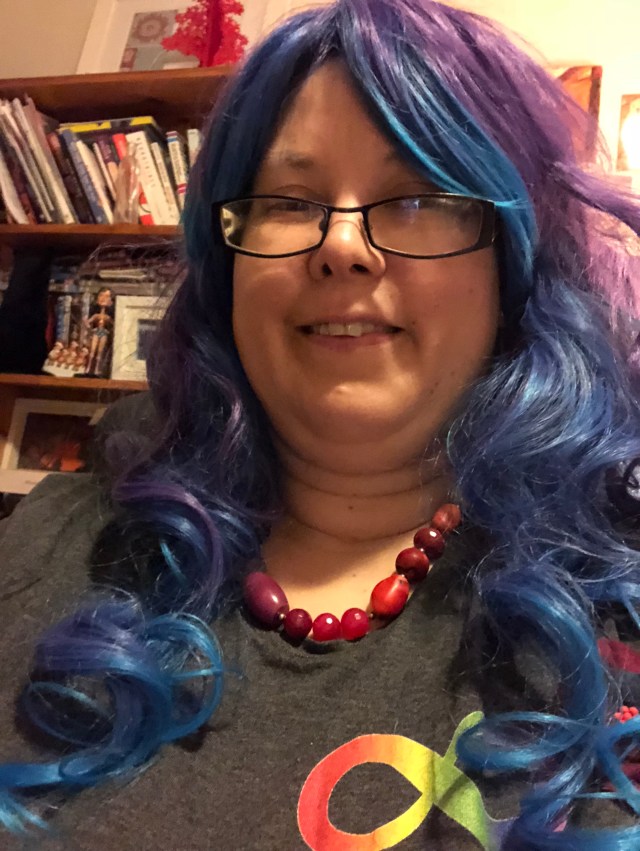
I had some interesting thoughts around my own advocacy work, identity and masking. I spent from ages 11 to about 40 masking, trying to be ‘acceptable’ to others and squash down my identity and how I wanted to express myself. It took a huge toll. It demonstrated my lack of value for myself, my fear that nobody would like such a ‘weird’ person as myself. This fear came form very real personal experience of bullying and being victimised. Thankfully I am now out loud and proud autistic, brightly coloured and big and bold. I wear lots of colourful clothes and jewellery, have several coloured wigs and other essentially ‘me’ accessories. I give keynotes in rainbow boots and cat t-shirts. I laugh a lot and am one of those extroverted types who seem a bit less common in autistic circles. I admin my cat’s Facebook page.

I worry about my expression on occasion. Sometimes I feel like everyone else is doing ‘serious’ advocacy and I’m just getting around in rainbow wigs and things and not really doing much to help anyone. I was featured in an article summing up an autism conference  that I was a speaker at a few years ago. When the journalist wrote about all the other speakers, they mentioned the topic of their presentations and some key points of their message. However, when they got to me they had a picture of me, evidently delighted to be on stage with purple hair. The information readers got about my talk was this picture and  the text ‘And Jeanette Purkis gave a very entertaining talk.’ They didn’t even say what I was speaking about. 

This is difficult. I don’t want to be known for the form not the content but my colourfulness and extroversion is not an act or gimmick. It is me being me. I discovered a few years ago that for me at least, life looks better in shiny, bright and sparkly. My Autistic Pride is bound up in my ability to outwardly express myself the way I choose. I wear rainbow and sparkly things to my public service job, I dress up at home when the only person who will see me is Mfr Kitty and I suspect he doesn’t care what I look like as long as I provide car food and cuddles. Why do I do this? Well mostly because it makes me really happy. I think that my style is the opposite of a mask. I am not covering up myself and hoping no bigoted ableists will be horrible to me. I am expressing myself with pride and celebration. It has taken me a long time to realise this. I used to think that maybe I don’t take my role as an advocate seriously but I suppose the opposite is true. The other lovely realisation I have had is that my advocacy work introduced me to a lot of other autistic people and our community. It also introduced me to a lot of new thinking and views on empowering autistic  people to be our true and so often incredibly thoughtful, kind and beautiful selves. Through this I felt that I was being supported and encouraged to be my true ‘me’. So the autistic community and my advocacy work have helped me to take the mask off and I hope that I am reciprocating that for others through my work. That is a great thing, a great strength.

And while most of the time I am not wearing the mask, I still do it on occasion, not intentionally and often not consciously but it happens. The forces at play in society and in our individual lives that drive us to mask are very real and can be very dangerous. Taking off the mask is a key part of loving and valuing ourselves and having the self-esteem and confidence to be who we are, seeing ourselves as we are – valuable, worthy, legitimate just as we are. I am glad that many autistic advocates and activists are focussing on this.  We have the right to be ourselves.

11059875_840569759357746_7298864586145982601_o

The trouble with feedback: – Responding well to criticism

I have a Masters degree in Fine Art. This means I spent a lot of time having fellow students and lecturers telling me why they did – or didn’t – like my work. In six years of study I never got used to this. Criticism is a difficult thing for many of us to handle. It doesn’t even have to be negative criticism – even constructive feedback can result in anxiety and feelings of inadequacy. There are a number of reasons why this may be the case.

Autistic people often receive a lot of very negative, blaming criticism and judgement. Even small children can experience this. It can come from variety of places – schoolyard bullies, family and other adults focussing on our apparent failings, even when they are not failings at all but just something which looks  bit different like stimming. In fact, the undercurrent which so many people have in their thinking which views autistic people as broken or deficient can result in a lot of very unpleasant criticism as we grow up and throughout our lives. Sometimes criticism is given in front of an audience (such as in the classroom). This can compound the stress significantly! We may become incredibly keen to please others and win approval almost as if to address the pervasive criticism we may have had for years.  Any kind of negative response may mentally catapult us back to times when we received harsh criticism simply for being ourselves.

We are often criticised for being sensitive about criticism!  

We can become very anxious in situations where we know we will receive criticism – performance discussions in the workplace are a key example of this. Our sense off objectivity about our performance can be limited, especially if a manger doesn’t give much feedback. While many neurotypical employees interpret no feedback as being a good thing, autistic people may benefit from a bit more reassurance along the way. If this hasn’t happened, the performance  discussion can be terrifying. It can also be terrifying foR some people who have received positive feedback from their manager.  Being in a situation  where the entire purpose is to to provide criticism of one sort or another can pose a huge challenge for autistic people. 

Facing criticism is one of those perfect storm of anxiety situations as fast as I see it. It can bring back sometimes traumatic memories, it is anxiety-provoking and can lead to catastrophising. it is made far more stressful by things like perfectionism and fear of failure and it can heighten sensitivities around appearing ‘different’ and being judged and criticised for that. Often a huge worry around receiving criticism is  how the person receiving it will respond. Will it trigger a person  to say or do something they regret? If it is at work, how will the relationship with their manager be if the discussion goes badly? I always get transported back to art school and being up the front of a lecture theatre full of my peers and teachers and being hounded about my latest project – which I was presenting. iZ received quite harsh criticism. I was absolutely devastated. Like many others, I do not experience criticism as being about something external to me asn feel like others are attacking me. I felt like everyone in that room hated me and thought I was a complete loser. I now know that wasn’t the case but it was a pretty unpleasant experience and one which has followed me for the past 14 years since it happened!

Some things to consider around this include:

  • Constructive feedback can actually be a really useful thing. It can help you to improve your understanding or performance and to change your thinking about a topic in a positive way.
  • The moment when constructive criticism occurs tends to feel very  raw and unpleasant for everyone and particularly autistic people. But in time it often sort of mellows out to a point where it can be useful.
  • There is vast difference between constructive criticism and negative or attacking criticism. It can be difficult to tell one from the other. As a rule of thumb, constructive  feedback is not personal. It is about what you do not who you are. This is a good way of ascertaining if it is helpful or not helpful feedback. Unhelpful feedback is usually personal critical of you and your character and other attributes (e.g. appearance etc).
  • To help determine what is constructive feedback and what isn’t. I tend to go off the relationship wth the person giving the feedback. If I experience them as aggressive or a bully I will be wary of their comments but if it is someone that I have a respectful relationship with I will be more open to criticism from them. It can help to view constructive criticism as a gift, helping you to do your work (or whatever else)  better.
  • Because anxiety around receiving criticism is anxiety, things which helps address your anxiety and self-doubt are likely to help you manage receiving criticism better. As with most things I find sense of pride in who you are can help address feelings of inadequacy which can drive issues around receiving criticism.
  • The response you have to constructive criticism and to attacking, negative  criticism should be very different. Even of constructive  criticism is hard to take on board, if it comes from a place of support and wishing to engage you to do things differently, that is something to be positive about,. I often thank people who have stretched me through their constructive feedback. If someone is attacking you then you would be better off defending and protecting  yourself as much as possible and if you need to set boundaries with the person doing attacking then work to do that.
  • Many people – autistic ands allistic – have similar concerns around experiencing  criticism. You are far from alone and it is completely understandable to feel that way. 

 IMG_2892

Embracing your autism (and what happens when you can’t find your tribe?)

I imagine that many of you will have heard this statement… ’Find your tribe!!’ This is a statement that autistic adults – and sometimes kids – are told. The Autistic ‘tribe’ or neurodivergent peer group is a place where you will be accepted. When you find your tribe your sense of autistic pride, self-esteem and value will increase. When you get embrace your autism your whole life will change and you will accept who you are and lots of other good things. Sounds like a very good thing, and this does seem to be what happens for many of us.

But what happens for people who do not ‘find their tribe’? What about people who are  autistic and for a variety of reasons they cannot accept it or be positive about it? What about when your memory of being ostracised and bullied makes you want to keep ‘acting’ and ‘masking’ in terror that if you are ‘out’ as autistic that bullying and abuse will get worse? For many people finding their tribe is not at all easy.

I have a personal story about this very issue. For the past 13 years I have been as very out loud and proud, visible autistic advocate but for seven years after I was diagnosed I couldn’t even entertain the notion that I might be autistic. While deep down I knew my then recent diagnosis fairly accurately described my experience, it was just too hard to imagine that I was autistic. I was diagnosed in 1994. When I was diagnosed the diagnosis was very new. Almost nobody, including many mental health clinicians, had heard of this thing called Asperger syndrome. My parents were told that Asperger’s was incredibly rare and that only one in 25 people diagnosed with Asperger Syndrome were women and girls (I didn’t know about non-binary gender then so saw myself as a kind of woman by default). I was a rebellious and very troubled twenty-something when I was diagnosed. I had spent years trying to distance myself from the ‘nerd’ tag I had been victimised because of in school. My diagnosis meant a number of things to me, and none of them were good. Consciously I thought it was my parents making excuses for my poor behaviour. I was doing my best social chameleon act in order to fit in with the world I found myself in. From the limited information I had, it seemed Aspergers was a diagnosis of being a nerd. To my mind it meant that I was destined to be a nerd all my life and there was nothing I could do about it. When I was being bullied in school, a lot of the attacks also centred around any apparently having an intellectual disability. At the time, my limited understanding of autism was that it was an intellectual disability. You can probably  understand why I felt trapped by the diagnosis rather than liberated. 

My eventual acceptance of my diagnosis was very closely bound up in my perception of myself. Twenty-something Jeanette had hated themselves. They had a very low self image and actively sought out negative things. It was somewhat telling that the moment I accepted my autism was when I was in second year of university. I had just won an award for being top of my year in a class and was feeling more confident than I ever had before. ‘Maybe I should check out that autism thing?’ I thought so set about doing so. I remember watching a video by Dr Wenn Lawson – who is now a good friend – and he was saying things about his experience which resonated strongly with me. I started what was actually quite a lengthy process of accepting and valuing myself as autistic.

I didn’t suddenly write my life story and start giving presentations on autism. For me it was still a difficult truth to accept. I spent the next few years being quite shy about discussing my autism. I felt like everyone I told would probably hate me for it. I had internalised a lot of ableism. The turning point was when I met my mentor and most positive influence Polly Samuel who encouraged and supported me to write my life story. Thankfully everything sort of aligned and when the book was released and media outlets were asking me to talk about my story I was in a good place to do so. Now I am quite likely to discuss autism with a taxi driver or a receptionist at the doctor’s office! I am very much so out loud and proud Autistic. I have found my tribe and it is good, even if it took me a bit longer to find it than most.

I suppose what people can take from this is that people have complex histories and circumstances which may make it hard to accept that they are autistic.

I have had many interactions with people who feel unable to connect with the ‘tribe’ for various reasons and many others who are taking their time much like I did when I was younger. People do not have to conform to any particular journey for accepting and embracing their autism. It is a good thing for autistic people to accept who we are simply because being autistic is a fundamental way of being but people struggling to find their tribe do not need to feel bad about this. It is not a reason for judgement or a character flaw. Life is a journey. In my journey I spent a good ten years either not accepting or being very coy about my autism and now I am doing all the advocacy work I do and hopefully promoting positive things like autistic pride. We are all at a point on our journey and that is OK, but I am very glad to have embraced who I am as it feels right. 

IMG_7139

‘I’m not being rude but I have no idea who you are!’ – Thoughts on Prosopagnosia

The title of this post is something I have said – or thought – on many, many occasions in my almost 44 years on this Earth. Most people have an innate ability to tell one human being from another. If they meet someone then they remember what the person looks like most of the time. I do not. Most human faces blur into each other and I cannot remember people I see all the time, including work colleagues and family members. When I was a toddler my mum and brother and I went overseas and left my dad behind. When we returned three months later I had no idea who this scary guy with a beard was and why he seemed to know my mum, brother and me really well! I spent my childhood, teenage and young adult years thinking that may inability to recognise human faces was unique to me. I was very embarrassed by it and thought it meant I didn’t care about people or wasn’t interested, even though that didn’t tally with my experience. When I was in my late 30s I saw an article about something called ‘prosopagnosia’ or face blindness. Apparently there were a lot of people in addition to me who struggled to recognise human faces. I was delighted to not be alone in having this rather embarrassing quirk of neurology.

Prosopagnosia is not an intrinsic part of autism. Non-autistic people also experience it but it is more common among autistic people than neurotypicals. I do not understand the mechanics of it well but I know that people with prosopagnosia use different parts of our brains to interpret faces then others do. I can recognise a few people’s faces but most people I struggle with. I recently worked out that I have the greatest difficult in recognising the faces of cis gender people – those who identify with their gender assigned at birth. However, I usually remember the faces of people who are gender diverse / trans. I have no idea why that may be.

I used to be deeply ashamed of not remembering people’s faces. It caused issues at school with bullies as I often couldn’t tell them apart which only served to add fuel to their cruelty. I would develop elaborate ways of figuring out who someone was through the context of their conversation or what they were doing. I had an exhibition at a major art gallery when I was a student in 2005. I had a twenty minute conversation with someone and had no idea who they were until I got home after the event!

Simply saying ‘Sorry, I have issues with recognising faces. I am not being deliberately rude’ would have solved a lot of my problems with prosopagnosia but my shame at forgetting faces was bound up in my shame at the time at being autistic. I have not always been an enthusiastic and very visible autistic advocate. It took me over ten years from the date of my diagnosis to me getting to a point where I accepted my neurodivergence and began to see my autism in a positive light. That shame was immense and was mostly created by bullying and being shamed by others for being somehow different. My main goal at high school was to be accepted by my peers – something that never really happened. Anything which made me seem ‘weird’ or different was bad to my mind. The fact I couldn’t recognise people was something I had never heard of before in others and definitely fitted in my view of ‘weird Jeanette things’. It was only really when I started to view myself as a proud autistic person years later that I become OK with it.

These days I tell people if I don’t recognise them and explain the reason. Not only does this make my life easier it also means if that person meets another person with prosopagnosia they will have some understanding about what it means. The statement I usually use is ‘Have I met you before?’ If they answer yes I respond with ‘Sorry about that, I have face blindness and don’t always recognise people.’ 

One peeve I have around this is when people who evidently don’t have prosopagnosia say ‘Oh, I’m hopeless with names and faces.’ I know they are probably trying to make me feel less uncomfortable, but I am actually not feeling uncomfortable so when they say that it comes across as them dismissing my experience. It’s a bit like the old chestnut ‘Oh but we are all on the spectrum somewhere!’ (We are NOT ‘all on the spectrum somewhere’. If we were, it wouldn’t be called autism it would be called ‘how everyone experiences the world’.) These sorts of statements are difficult because the person saying them often doesn’t consciously intend to dismiss and invalidate but they actually do.

I have found it much considerably easier to tell people about my prosopagnosia than pretend I don’t have it!  In fact when I started to tell people why I don’t recognise them it was like a weight had lifted. It was a liberation. For me owning my prosopagnosia is part of being an out loud and proud autistic person so I view it as part of my advocacy, given it is such a common experience for autistics. It can be a difficult thing to manage but like most things, it can be improved by applying strategies that work. It is nothing to be ashamed of – in fact being ashamed of it will make the impact of it considerably worse. It is part of how a brain can be wired, part of the neurodiversity of humanity. It is just another little part of what makes me ‘me’.

10345928_952442271503827_2389361033428212312_n

Respecting difference: Autistic people aren’t ‘speaking neurotypical’

In the course of a presentation today I did something I have never done before – I spoke to a former ABA therapist. MY heart sank as she eagerly said ‘What do you think about ABA?’ For anyone who hasn’t come across it before, ABA or Applied Behaviour Analysis is an intervention used on autistic kids. It is essentially premised on making children ‘less autistic’ and uses a system of rewards and in many cases punishments to promote compliance. Almost every autistic advocate you will meet will say how damaging ABA is, doing things like forcing kids to make eye contact and coming from the premise that autistic reality is ‘wrong’ and in need of fixing. There is growing evidence as autistics who were subjected to ABA as kids grow older, that it causes trauma. ABA pretty much stands against everything I believe in and strive for. So being confronted with this enthusiastic young person was a little tricky to say the least! I was speaking with her before my presentation began and managed to explain my significant worries about ABA and the ethos driving it. She seemed very receptive to what I said. However throughout my talk she kept offering ‘pearls of wisdom’ based in her former career, which actually  gave me a wonderful opportunity to talk about ideas of neurodiversity and the critical need for autistic people to have a positive autistic self-identity.

One thing the former ABA therapist said was that she used to do a lot of ‘work’ with cards showing emotions. I reflected that this is an approach to autism based very strongly in neurotypical experience and understanding. If you show me an emoticon, unless it is the happy, crying or angry face I have no idea what it means. Showing autistic kids pictures of cartoon faces displaying ‘emotions’ and expecting them to relate it their understanding of sadness or anger? That is never going to work! It’s like conducting an exam in a language the student is only vaguely aware of and doesn’t know any words of.

That exchange got me thinking about how a lack of understanding autistics’ experience of life and how we communicate can lead to some assumptions  which not only make our own lives hard but also colour the attitudes toward autism in the wider world. There is a long-standing myth which persists that autistic people lack empathy and even the capacity for empathy.  This was sold to us all as an evidence-based researched opinion….but I suspect the researcher in question was looking at the wrong things. An assumption about my capacity for empathy is something that happens relatively frequently: I will be talking to a person and I get a sense that I must be doing something ‘wrong’ and then after a while of conversation I realise the person I am speaking with is upset. When I know they are upset I immediately offer support and kindness and hope they feel better soon. The reason for my apparent lack of care was simply that I wasn’t picking up on their non-verbal cues. I c an only tell someone;’s non0-verbal cues if they are really noticeable. A neurotypical person might notice the person was upset a long time before me and thus they may seem to be more ‘caring‘ while I am seen as a ‘bit off.’ The difference between the neurotypical person and me is that I don’t notice or understand a number of communication cues that neurotypical people are more aware of: facial expressions and other non-verbal communication. I care just but I am not receiving the same information to alert me that the person is upset. Unless people understand that difference in the information that autistic people are receiving, it is maybe understandable why someone might think us uncaring. Once again, it is like the exam conducted in a language the student doesn’t speak.

Empathy is an odd thing because I have observed that while autistics aren’t always right in there with the caring response, when talking to a number of  neurotypical people, I have experienced a complete lack of empathy for me and my autistic experience. I often get a response along the lines of ’your’e weird so I don’t really want to get involved in whatever issue you are having. Just go away and don’t bother me.’ So while I will be agonising as to whether i have been caring and respectful, a representative of the group who are thought to have the empathy thing down pat has just demonstrated the complete opposite! I suppose people choose whether or not to display empathy and not everyone is caring.

I find it easy too see things from a divergent viewpoint but I imagine that probably isn’t the case for people who have never seen life from a divergent perspective. It is really important for us divergent folks to advocate and represent, even if it is just to state that there are so many ways of expericening the world and the people in it and these are generally OK and perfectly valid. 

And the former ABA therapist asked me to come back and do more work with the organisation I was speaking to which I was really happy about. There is that fine line of feeling the need to speak to people who are completely on the same page and it gets challenged quite often in my work. It was hard talking – and very hard talking civilly to someone who represented something so problematic but in fact I genuinely believe I changed some thinking today. It is so important for autistic people to be understood as a different culture with different ‘language’ and experience and not broken versions of their neurotypical peers in need of fixing. Our ‘language’ is as valid as any other ‘language’ and the more people know this the better the world will be for autistic people and those who work with us. 

img_0148

Autism and criminal justice: Beyond myths, stereotypes and denial

I need to preface this piece by saying I have possibly a rather different view on issues around criminal justice than many people do. Criminal justice issues are always going to be complicated and nuanced. Criminal behaviour is both an individual choice and a social issue. 

I have the perspective as an autistic person who many years ago was victimised and also was a perpetrator. I will say that my offending was definitely NOT because I am autistic although I was taken advantage of by a criminal man who was a predator and this was my initial introduction to the criminal justice system and things just sort of got worse from there.  Since 2000 I made a lot of changes in my life to be where I am now but it was  hard start.

I met Polly Samuel who I knew then as Donna Williams in 2004. My autism diagnosis was then ten years old. It wasn’t long after I met Polly that she told me she thought that I should write my life story. The reason I stopped objecting and wrote Finding a Different Kind of Normal was this: Polly told me that she spoke at parent groups and there were often parents who would sit right up the back and leave before the socialising and cup of tea at the end of the meeting. Polly told me these were the parents of autistic young people caught up in the criminal justice system and they felt ashamed and excluded and if I wrote the book it would be for that group of parents and their kids. It took me a few minutes to realise that this would include my parents too. I finished writing it in four weeks and editing it in two more. I guess I had something of an incentive!

As Polly demonstrated, criminal justice system involvement is something of a taboo with most people and seems to be even more so in the autism community. I suspect this is probably due to a very big issue which persists today – that of stereotyping and using myths about autism to justify blaming criminal behaviour on autism itself. By implication, we are all emotionless, cruel monsters who don’t know right from wrong. The  idea of autistic people ‘not knowing right from wrong’ is pervasive in this space and is particularly damaging…and totally false I might add. If not knowing right from wrong was part of autism presumably we would all be in prison! Another harmful myth is around us apparently lacking empathy. This myth has done so much damage across a number of domains and is a pet hate of mine. It seems to have started from some quite flawed research but has since taken hold in wider society. In actual fact autistic people are generally very high in empathy but we tend to experience and express it differently to neurotypical people which for people looking for things ‘wrong’ with us presumably provides something of a justification.

In some instances, including a notable recent case in Victoria, Australia, autism has been presented by media outlets as an actual reason for offending behaviour, which is not only incorrect, it is also adding fuel to the fire of people who would hate and revile autistics and it adds considerably to stigma individual autistics face in the world.

Some people in the community are so horrified by these myths around autism and criminal intent playing out that they deny that any autistic person commits criminal acts. Sadly that is not the case either. Autistic people can and do commit crimes for a range of reasons. Some of these reasons relate to us being exploited, manipulated or taken advantage of by others with genuine criminal intent. There are other similar issues – autistic people being desperate to win approval of peers or a partner, which was what put my on my own very shameful path. In other cases autistic people can be accused and even convicted of crimes which were not committed with any intent but were misinterpreted. The movie I am Khan has an example of this – and is an excellent and very moving film too! Sometimes criminal acts are committed by autistic people who have been mercilessly and continually bullied and victimised and retaliate. Autistic people also commit crimes for the same kinds of reasons other people do. It is a small minority of autistics who become caught up in the justice system but it does happen, as I am living proof of I suppose!

As you are reading my blog I imagine you have some idea of who I am and what work I do in the Autism community. I am one of those people who was swept under the rug. I was a person with huge issues around  offending behaviour yet now I am seen as a role model and a community leader. We are responsible for each act we make. 

Stereotyping and demonising autistic people is not going to address anything in the justice space or anywhere else for that matter – it will not reduce offending behaviour. What it will do is generate more prejudice and stigma. It will almost certainly confuse judicial staff, corrections staff and police. This is a huge issue as many employees in the justice system could really benefit from accurate, sensible autism training and knowledge. First responders particularly need better autism knowledge and disability knowledge more broadly as a matter of safety. And way beyond the justice system, these sorts of stigma and myths will contribute to autistic people being demonised and victimised across the board. I say no myths and no taboos – both are damaging. Let’s just help support people and work to ensure the world is a safer and more inclusive and respectful place.


Your past meme