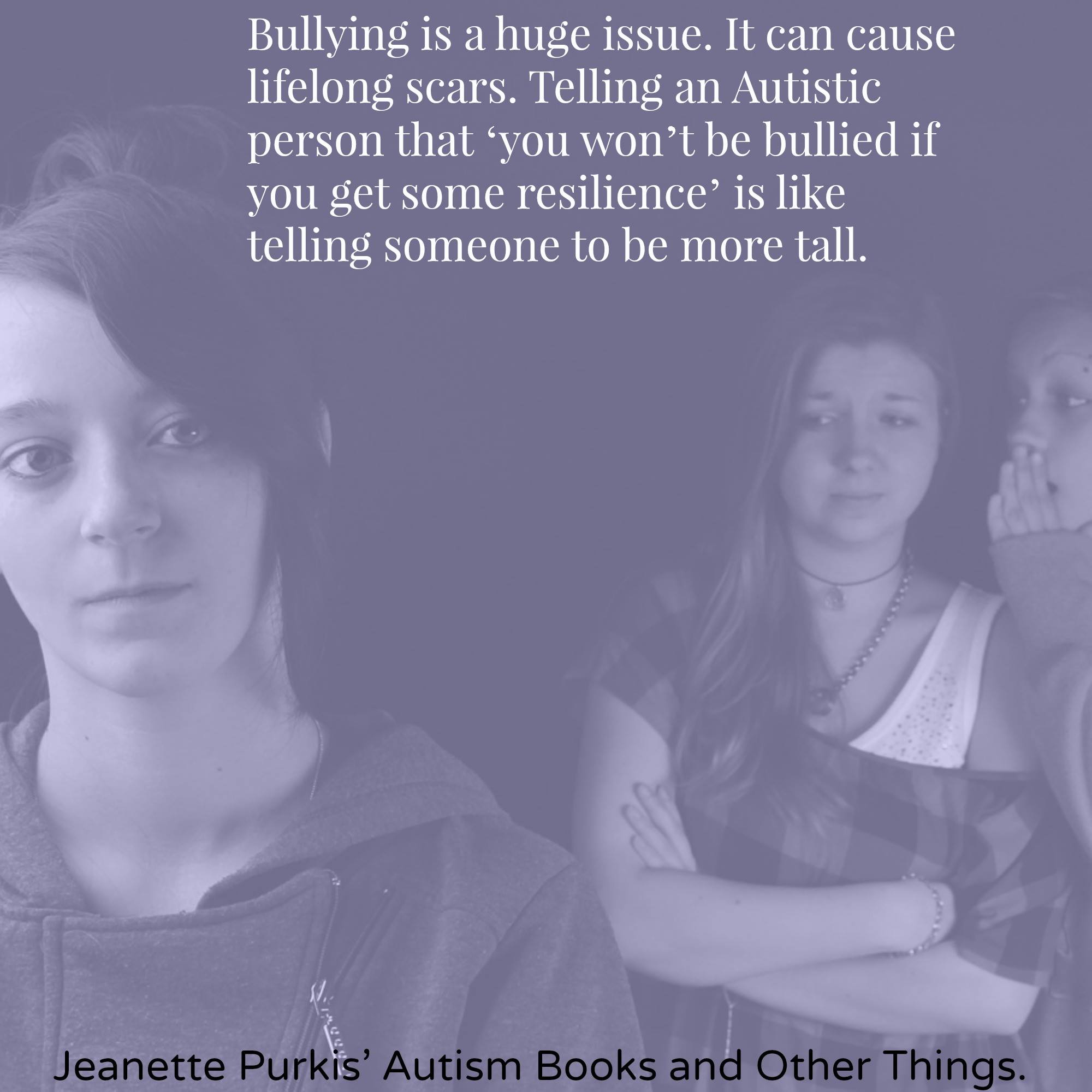
Bullying – never, ever OK

Trigger warning

There is an article doing the rounds of the internet at the moment which talks about Autistic people ‘benefiting’ from bullying. I have not managed to read this piece of misinformation as it would probably have resulted in me throwing the computer out the window in anger. From others’ responses it seems to have been – as the title suggests – an unhelpful and invalidating look at something which most of us know innately – bullying is a bad thing for everyone and especially for Autistic people – Editorial note: I spoke with a friend who advised that the article actually wasn;t too bad, just apparently inappropriately titled so I apologise to its authors, although ti gave me the impetus to write this post

This is the first blog I have written about bullying. That seems a bit odd, even from my own perspective, for discrimination, bullying and abuse have been a significant part of my history. In fact to some degree  I still experience discrimination and bullying from certain quarters.

There is a TV programme which Australian people probably know called Summer Heights High. It is a comedy set in a high school and one of the characters – Jonah – is a bully. It is an interesting programme. I didn’t find it very funny. In fact I found it quite disturbing, but the scenes about bullying told me a lot about perceptions of the experience by some neurotypical people. There is a young student who Jonah bullies because he has red hair. It is not a one-way street in that the younger boy evidently does some things to wind Jonah up and see his reaction. I think this is what a lot of people think about bullying among young people. That is, that the victim often ‘winds up’ the bully to try and get them into trouble. The first time I saw this program I was amazed. When I was a young school student experiencing bullying, I did not do anything intentionally to ‘wind up’ the bullies. It was completely one-directional attention. I just wanted to go to classes and pass exams and read books but all the time I was singled out for negative attention, teasing and even at times physical violence, There was no sense of my doing anything to invite the attention of bullies other than the fact that I seemed different and odd.

Bullying, as I’m sure you know, frequently leads to post-taraumatic stress, self loathing and a low self esteem. The worst thing about the low self-esteem is that this can lead to lowered defences against abusive and bullying behaviour, thus leading to a vicious cycle of self loathing and continued abuse.

This is a Jeanette Purkis blog so I will need to include some points from my own experience or people might doubt its authenticity (joke). Before I went to school, I was a confident, intelligent and inquisitive person. I thought I was pretty OK in terms of my value in the world. It did not occur to me to think anything negative about myself. Primary school was mostly OK and I loved art and music and writing. When I went to high school, my world changed very quickly, Within days I was the least popular child in the school. People form other year levels singled me out for teasing and violence. Within weeks I started to view myself as different. I could see that there was a popular group or ‘normal’ students and that I was not one of these. I didn’t understand why I was hated. It was bizarre. I spent years trying to be accepted with very little success. BY the time I reached adulthood I had lost all my self-confidence and personal power. I found it almost impossible to assert my rights and spent at least five years being victimised by creepy men. This of of course  exacerbated  my lack of confidence and inability to set boundaries and say no. It took me twenty years to start liking myself again. Even now I struggle with saying ‘no’ and being assertive but I am slowly improving.

Some thoughts about bullying

  • Bullying is never OK. Never.
  • Bullying is never the fault of the victim. Autistic people do not intentionally contribute to bullying. Even if there is some dynamic going with non-Autistic people between the victim and bully, the bullying relationship needs to stop There is no benefit of it to anyone.
  • Bullies – male ones at least – are overrepresented in the ranks of the unemployed, education drop-outs and the prison population. Often they are victims of invalidating backgrounds themselves. This does not excuse the bullying but it does go some way towards understanding that solutions to bullying need to be holistic and often need to be at a social as well as an individual level,
  • Bullying behaviour – like all behaviour – is a response to material reasons or circumstances. Address the reasons and you can address the behaviour. Solutions often need to happen in consultation with the parties involved.
  • Autistic people can be bullies too.
  • Building your – or your child’s – self esteem is a great way to tackle bullying. If you value and like yourself, you are less likely to care about what the person bullying you thinks of you. In my experience, bullies tend to give up if they can’t see their behaviour having a negative impact on you.
  • Some kids will not volunteer formation about being bullied. Parents may need to ask specific questions about what is going on at school or in social media.
  • Bullying can happen in all manner of situations, from school to work, social media, in relationships and within clubs.
  • Of you are being bullied, it can be hard to know where to access help. As a first step, tell someone you trust such as a family member or your partner.
  • Often bullying is an intractable, wicked problem. Sometimes the only way to address the issue is to remove yourself from it. Change schools, leave the job etc. This doesn’t mean the bully has won, it means you are looking after yourself.
  • Bullying is Never OK. Never

11154592_838683619546360_2824143390233299374_o

‘Impostor!!’ Why so many of us never appreciate our value

I wrote a foreword for a friend’s excellent book on Autism and sexuality and relationships recently. As I sent it off I was filled with doubt: “This is terrible. I’ve let my author friend down. Should I even send this?’ I sent it despite the self-doubt – I’d promised it by Sunday and didn’t want to submit it late. The next day I had an email from the publisher saying it was excellent and that they would feature is in its entirety and use bits of it for promotion. I was delighted so I sent my foreword to my mum and dad and told them how surprised I was that the publisher thought it was good. My mum  – bless her – responded with ‘Why would you think it wasn’t good? It ticks all the boxes…’ My mum was right of course – it was a well-written piece and it satisfied the brief for a foreword. If I spread my gaze broader than just that one piece of writing, it would appear that I am quite a good writer. I have two – soon to be three – published books, have contributed to three other published brooks, I have written for magazines, professional blogs, websites and journals. I have won poetry competitions and been a finalist in other literary contests. I spend more of my spare time writing than anything else and most people seem to love my writing. But I still doubt that any publisher would want my work. I do not deserve recognition or success, I tell myself.

I am not alone in being a somewhat successful person who questions their value. Many others seem to experience this too. There is a term ‘impostor syndrome’ which describes this experience. We feel that our success is misplaced and undeserved. It is a difficult thing to live with. In my case it has meant that I haven’t properly appreciated many of my achievements and have instead belittled them. I have invariable compared myself to people wildly more successful than me (in a conventional sense at least) and felt completely  inadequate.

Impostor syndrome is not a nice experience and can turn things which should make us proud into moments of self-doubt, Some thoughts on tackling impostor syndrome and self doubt:

  • Comparing yourself to others is rarely a good idea. We tend to compare ourselves to people we see as more accomplished than us so it becomes and uneven competition which just serves to make us competitive and stressed
  • When filled with self-doubt about your actions, try to step outside yourself and view things more objectively. If you are good with logic, use that.
  • If you can, avoid people who reinforce your self-doubt – people who put you down or belittle your achievements
  • Challenge low expectations – both hose you might have about yourself and those of others. Focus instead on things you do well.
  • Remember that you are not alone – many others are experiencing the same thing.
  • Tell yourself two positive things about yourself each day. Some people like to do this while looking at their reflection in a mirror.
  • Other people might be looking at you and seeing you as a successful and accomplished person even if you aren’t. Most people won’t tell you that they think this about you but there is likely to be a few of people who think this. If it helps, you can imagine others being impressed by you and what you do.
  • The range of things which society considers impressive does not encompass every impressive thing. You are almost certainly doing things which are amazing, but often uncelebrated, like raising kids, managing a significant illness or disability or caring for elderly relatives.
  • Every time you find yourself doubting yourself counter it with a positive statement. These statements can be ones you make up which work for you.
  • Look at where you were in the past and see where you have got to. It is likely that your journey has taught you some valuable things which add to your understanding of yourself and the world. Regardless of what this involved, it is almost certainly an achievement worthy of positive feedback.
  • If people compliement you for something you have done well, try to accept it. Even if you don’t agree with it, at least say ‘thank you.’

It gets tiring trying to constantly banish your self-doubt demons, In my case I do it by trying to achieve more successes constantly. After doing this for over fifteen years, I have a lot of accomplishments but I am not content and I still question the value of my work. Usually I give an example of how I have overcome something or what I have learned in these posts. In this blog post I am urging you to not use my example. Yes I am successful, I have achieved a lot but I can’t see any of it objectively and am still insecure and negative about me. Please use my example as what to avoid. I do love my successes but it would be lovely to sit back one day and genuinely reflect that I have down enough, I have nothing to prove and drink a cup of tea with no need to succeed or make an impact or anything like that.

IMG_0438

Nope. I can’t write at all! Silly self-doubt

My favourite thing… Movie night

I was in the supermarket this afternoon, gathering supplies for an event which takes place every two or three weeks in my small but comfortable home: movie night. As I saw my groceries lined up at the checkout, I realised they were all blue and yellow – from lemonade to cat food. I remarked upon this to the woman behind me. She evidently thought my brain was broken but was friendly nonetheless and commented on my bright jewellery (and yes, I had that lovely moment where it becomes obvious that Jeanette of the feeble brain is also Jeanette of the high paid job, responsibility and good taste in ‘nice things’. That moment never gets old). I mentioned to her that the soft drink and chips and things were for movie night. And that they were.

Everyone in my life seems to know about movie night. Every second or third Friday I will announce to my colleagues at work that I am taking a flex afternoon because I have to go home and prepare for movie night (read put away clothes and clean stuff).

Movie night is perhaps my favourite regular event. It has grown organically over the past twelve months or so into what it is now – a gathering of amazing Autistic woman  – and one amazing teenager – to watch movies, eat take away and share our thoughts, concerns and lives with one another. We are always completely ourselves. There is no pretence, no bickering or meanness. We support and care for one another. There are currently six of us who attend, including me. Whimsy Manor is…well, cosy I suppose, so we fit quite snugly and distributing the pizza and drinks can be a logistical challenge but it doesn’t matter. I have the gift of a flat not filled with any housemates, parents or partner and I love to have others here. I often wonder how my guests feel about visiting because I am certainly not meticulous about cleanliness. I think the last time I dusted was in about 2012. I do clean the toilet but there is often a smattering of cat little which Mr Kitty does manage to get all over the bathroom floor and which it impossible to completely capture while sweeping.

Movie night started with myself and one other, a long-term friend who regularly does battle on social media with anti-vaxers and other unsavoury types. I admire her because I find confrontation very stressful. I just provide examples and thoughts mostly. The two of us watched the first two Hobbit films and then went to the movies to see the final one last year. We then got onto the Lord of the Rings films and I think it was at that time that I invited another friend. Before long there e were six of us taking a few hours out of the wider world to spend in each other’s company.

There is a mum and daughter who come. I met them through the women’s group I facilitate for Autism Asperger ACT. The mum is very sensible and practical and very kind and thoughtful. Her daughter is uniquely talented, a great artist already and always keen to do some show and tell. I was delighted tonight when she offered to make me one of her beautiful hand-drawn bookmarks and asked what sorts of characters I like (Dr Who and Star Trek plus Mr Kitty and flowers was my response).  I love show and tell too, in fact I am often found reading out one of my latest articles or poems. I even practiced my resilience talk for the Asia Pacific Autism Conference at one movie night. I should probably lay off the Jeanette show and tell.

More entertaining than the movie at times is my little furry fella, Mr Kitty. Everyone loves him and he loves everyone. One of the women is as much a fan of the feline species as me and Mr Kitty has taken a particular like to her. She plays with him and he smooches her and her backpack. He also likes to get into anyone’s handbag and come up and sniff them to enjoy the scent of cats, dogs or guinea pigs. He really is the star of the show (and he knows it),

Movie night was not really my idea. It is something which seems to have happened quite organically, driven by all of us (and probably Mr Kitty too). I just love it because everyone is just themselves and there is no judgement. Movie night is the highlight of my fortnight. I remember a few months ago I was attending a dinner at Parliament House (incidentally with one of my movie night friends).  At the end of the same week, movie night was on. I looked forward to movie night much more than I did going to a dinner at Parliament. I’d pick my Autie friends over dinner with a bunch of dignitaries any day. I can be completely myself at movie night, surrounded by real friends who value and care for one another.

So we just finished watching the Back to the Future films. There was some talk or Star Wars for our next series which sounds good to me. Next movie night will be a birthday celebration for our youngest attendee. Movie night demonstrates to me the value of my peer group. And is also demonstrates that whatever idiot said that Autistic people don’t want friends or are deficient friends or any amount of rubbish like that has obviously never been to movie night at Whimsy Manor.

WJP_3428

The star of the show…

Abuse is abuse

Trigger warning – abusive things happening to me in the 1990s

There have been some high profile cases in the media of late around restraint of Autistic school students. Obviously this is a terrible thing which should not happen. However, a lot of the discussion is around who was responsible? There is a lot of apportioning blame and working out who to pin the bad practices on – the school, the funding body, the individual teachers? I honestly don’t know who to blame in these cases. I was not involved in the decision – either as the person deciding to restrain kids – or the person on the receiving end of the restraint. I honestly don’t know where to point my finger, I will never know what happened or why.

I do have some experience which informs thought on this topic though. I have been on the receiving end of restraint in a number of settings (although not in school). The me you see today was not always positive and proactive, employed and engaged in life. Instead I was a broken, angry, negative ‘no hoper’, prone to spending months in psychiatric hospital and years in prisons. I was not even the usual miserable prisoner of denizen of the hell of the high dependency unit in the psych ward,. I was in fact probably the person the staff of these places would be betting would be first to die. I was self-destructive, had zero self awareness and had no fear of death or injury.

My first experience of restraint came when I was 22 and in what was probably the most horrendous psychiatric hospital in Australia, the medical staff headed up by a formidable and arrogant psychiatrist who had no experience of women with a diagnosis of Autism. He had treated a couple of young men on the spectrum but was flummoxed when faced with female, Aspie (and at the time very depressed and psychotic) me. He deiced I mist have borderline personality disorder, presumably because I was self-destructive and had identity issues. He stopped all my medication for reasons best known to himself. Of course the result of this was that my already very shitty life got even worse. I was looked in the seclusion room with the small window papered closed. I couldn’t see out. I was there for a week. I was by myself, totally psychotic and locked in a tiny room. I didn’t see humans very often, When they came in I would assault them – not really wanting to hurt them but to try to get past them and into the rest of the hospital with other people. I regret to say that I behaved like an animal, but then I was caged like one, wasn’t I?

There was no help in this place. My misery was met with institutional violence. I had never felt more alone in my life. And really, essentially I was alone. Of course there was no escape from the hospital and I was sent from there to prison after assaulting the formidable chief psychiatrist.

Prison was even worse than hospital for at least a hospital claims to be there to help patients. Prison makes no pretence about its role as a brutal institution. As a very unwell, Autistic prisoner my life was about as hellish as it has ever been. I had meltdowns when I was stressed and assaulted staff. After some tweaking of the management regime for ‘Purkis’, this resulted in  five days in what (for reasons lost in the mists of time) was called the ‘wet cell’. This was where people were kept under observation if the staff thought they were suicidal. The light was on 24/7, the ‘bed’ was a concrete slab with a canvas ‘blanket’. I had to wear a canvas nightie with no underwear and there was a camera watching every action I took, including using the toilet. If I was really lucky I would be let out to have a shower once during the five day stint in this awful place.Of course the officers would watch me while I showered. I got used to this over time. Sometimes the prison staff would play a fun game and turn on the radio in the cell and leave it on all night. Between the loud radio and the fluorescent lights I didn’t sleep all night. If you want to see powerless, come and visit twenty-soenthing, prisoner Jeanette. I didn’t count how many days I endured this judicial torture bout it would certainly have equalled months of my life.

Whenever I was ‘released’ into the prison from the wet cell I was delighted. But I was still in a  tiny cell most of the time. I would pace up and down the five or so metres of my cell in a vain attempt to get exercise. I had a radio as my only home comfort and I tell you, the Triple M rock music station must have kept me sane enough to have taken the path I did when I left prison.

For me, these experiences are still difficult to think about, but that is my personal experience of restraint and being powerless. I don’t believe anyone should have to experience powerlessness like that and particularly not children. I don’t have any solutions. I don’t know how you stop people wanting to disempower and control other people. It was hard to share this but I think it needed to be written. If you need me I will be cuddling my kitty. Thank you for reading this.

OLYMPUS DIGITAL CAMERA

I couldn’t really find a suitable image for this one so this will have to do…

Those good old protective factors again….

As you may have gathered, my mental health has been misbehaving of late. The funny thing though is that this period of brain misbehaviour is very different to other periods of illness from my past. I thought it might be worth looking at those protective factors which are in place for me now which weren’t there in the past. To do this I will compare three scenarios:

Scenario 1 – 2001

I was a recently-released ex-prisoner who was trying as hard as I could to make my life more positive. I had enrolled in university at the start of the year and discovered that I was a very good student. I found out that there were things called high distinctions and I was keen to gather some more of them at assessment time. I decided that a job would also be a good thing to have given that my university colleagues were all doing part-time work and earning much more money than I did. I got a job washing dishes at a restaurant but it was never going to work. I was so stressed about my job and terrified of making a mistake that it resulted in a fairly unpleasant mental illness episode. I ended up in hospital and had to quit the job and take time off uni. The support I had was the staff and residents of a live-in mental health program where I was staying. That was pretty much it. I suffered immensely for the next couple of years, begin haunted by intrusive thoughts of violence and self-destruction and strange thinking and extreme anxiety. Time took its course and I recovered. I stayed at university during this time and some years later gained a Masters degree.

Scenario 2 – 2010

I was a published author, Autism self-advcoate and Government official with a Masters degree and a newly-purchased apartment. I thought I was invincible and cured from my mental illness. I experienced a number of anxiety-provoking events whig led to me being constantly stressed and at a high state of anxiety. This went on for some months until I started to get quite unwell. Quite unwell is something of an understatement. By the time I sought help I was thinking I was dead and that I was being punished by God. I thought there was a ghost in my house which was trying to kill me. I was too frightened to use any of the appliances at home and was only eating stuffed vine leaves from a can and pistachio Lindt chocolate. Needless to say I spent the next few years in and out of hospital. The protective factors I had at this point were my job, my family and some good friends, my own attitude and confidence and the fact that I had moved from being a socially devalued person to a middle class, respectable and respected person. It took a long time to recover but I stayed employed and I kept my house and I built my author and speaking profile very quickly after getting over the worst of it (my talk for TEDx Canberra happened six months after my most recent hospital stay).

Scenario 3 – now.

I spent eighteen months begin driven and  working on my Autism world work all the hours that God sends. A lot of people told me that I was working too hard and I ignored them, saying things like ‘but I enjoy this work!’ My illness started some months ago and I looked at changing things and seeking help as soon s a noticed. I kept getting worried about events I was attending and speaking at. I thought I would be unable to speak at things or that I would end up in hospital when an event was on. I worked through all manner of unpleasantness and misery but I stayed quite confident that I would be OK. When things got really bad I made an emergency appointment with my psychiatrist who increased my medication. This seemed to help quite a lot.  When I needed someone to talk to I did. I cuddled my lovely black cat, Mr Kitty and felt his deep purrs radiating through my chest and felt the healing power of them. I stopped working when I was stressed and watched a movie. I decided to take things one at a a time and not worry so much about the future. I was also incredibly blessed to have my wonderful Facebook family who always give me support and kindness. I have my various projects to inspire and engage me – books and talks and things. I have the wonderful protective factor of my paid job to help keep me focussed and take my mind off any nasties.

As far as I see it, the main protective factors are I have now which I didn’t have so much in the past are:

  • Being in a ‘socially-valued role’ – that is, having a position in society where I am respected and socially included
  • Having confidence that I can overcome difficulties
  • Being part of a peer group which respects and supports one another
  • Having a little black furry kitty person
  • Knowing when to access help and where to find it
  • Building self-awareness
  • Taking control over my life and my health
  • Having a job which is supportive and doesn’t contribute to any difficulties with my health
  • Being engaged in supporting other people which puts my own issues into perspective
  • Willingly accessing family support
  • Being engaged in activities which I feel are meaningful
  • Having positive feedback about my work from people I value (i.e. Autism world peer group)
  • Liking myself
  • Being strongly focussed on the future and positive things
  • Having so much useful ‘stuff’ to do that thoughts of self-destructive behaviour don’t stick around too ing

I hope some of those protective factors are helpful for you as well. Just keep going and remember how amazing you really are. If you are having a tough time (and live in Australia) and you need to talk to someone – you can call Lifeline on 131 114.

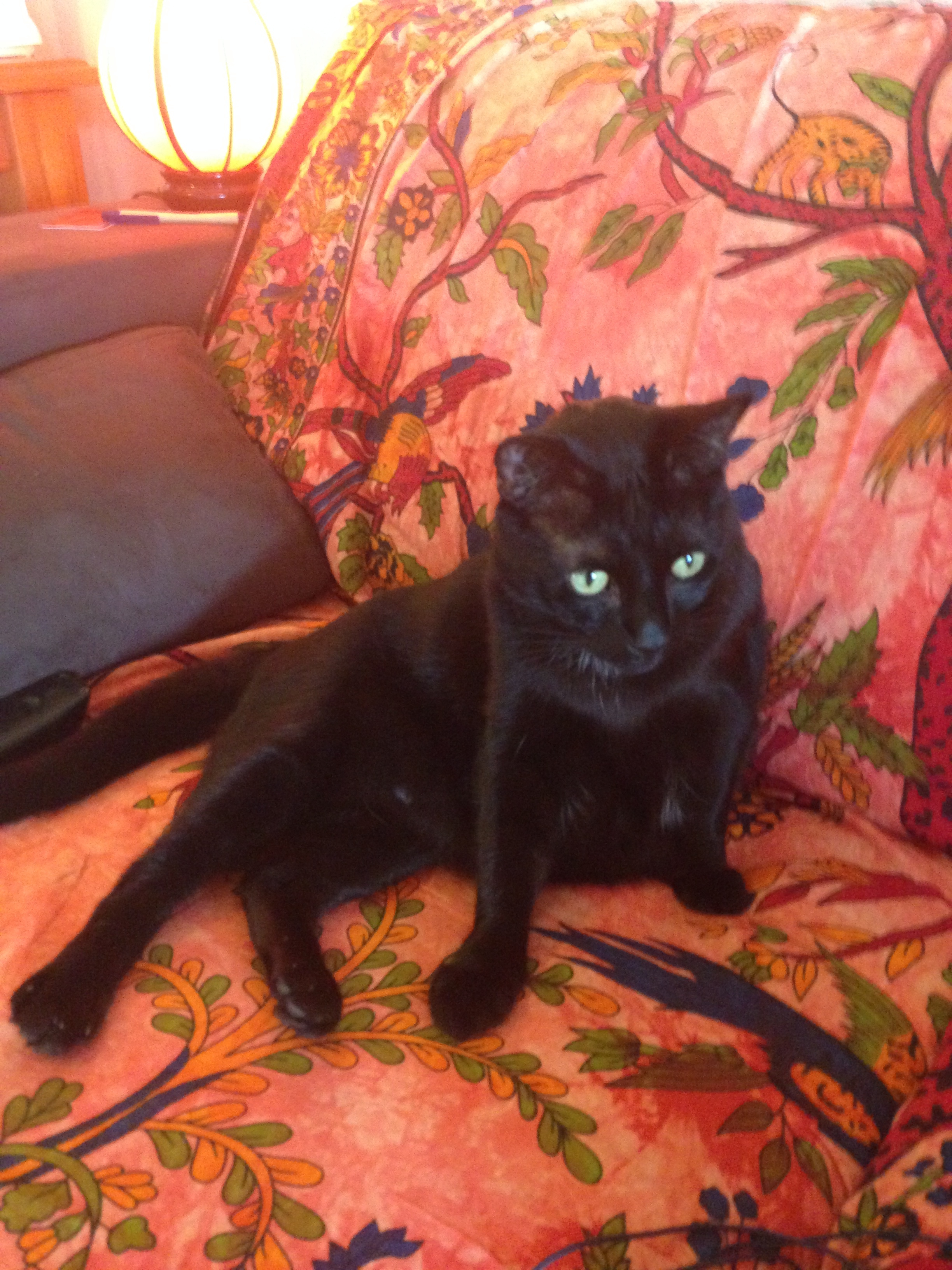
IMG_1594

My favourite protective factor, Mr Kitty

Tips and strategies for managing mental health nasties

As some of you may know, I am one of those people with an additional diagnosis to my Autism one. I have a mental health ‘label’ of atypical schizophrenia (or as I tend to view it, the ‘mental illness sampler’ as there seems to be a little bit from each of the main illnesses: psychosis, depression, anxiety, intrusive thoughts and elevated mood). My mental health issues have followed me through life for more than half the time I have been on Earth. They are like an old enemy that visits from time to time and destroys your house, metaphorically. In the past my mental illness has come as close to destroying my life as one can imagine. Being unwell is scary, demotivating, disempowering. It is an ordeal which makes me question my worth and my value and doubt that I will ever be free of the misery and suffering. I hate my illness with a great passion but I do have to accept that it is also a part of who I am. Conversely my Autism is more like a quirky friend that other people don’t quite understand and which sometimes makes a social faux pas but which essentially has my interests at heart and wants good things for me. It is also very creative and clever  – a little imp which tries to change the world just a little bit, for the better.

My illness has been visiting the last few weeks. Her presence has made me remember that I have some useful strategies for dealing with mental health nasties. I thought I should share a few with you so here goes:

  • You are in charge of your destiny. Whatever your illness or self-doubt tells you, you are the boss. Don’t let something negative like an illness dictate your actions. It won;t do anything positive. Instead, tell it that the choice in your actions is yours. I sometimes find actually saying this out loud can be helpful (although maybe not at the bus interchange!)
  • Remember that there are many people experiencing similar things to you. You are not alone.
  • Always be aware that your actions have consequences and if you do something on impulse, even if it seems the best course of action at the time, you may regret it for a very long time.
  • Mental health distress is temporary. A crisis often lasts for only twenty minutes or so. Even though it is difficult, tell yourself that how you feel during a crisis is not how you will feel in the future.
  • Seek help if you need it. There is no shame in this and it is a sign of strength.
  •  Avoid drugs and alcohol, even a small amount, when unwell. (This does not include your prescribed medication of course!)
  • Distract, distract and distract some more! Distraction helps your brain to focus on something other than your suffering and pain. Everyone has a different distraction/s that works for them. For me it is work (hence writing this blog!).
  • Pets can be great therapy.
  • Stimming can really help when we are stressed or struggling with mental health issues. I have a bunch of fidget toys and shiny things, plus the sensory wonderment of my little black kitty and his velvety fur and lovely, healing purrs.
  • Try to build your confidence and self-esteem as much as you can. This will not happen overnight but it is a great protective factor for health so view it as an ongoing project.
  • Try to spend time with positive people who support and care about you. Likewise try to excise negative and toxic people from your life.
  • Remind yourself or something you are grateful for or something positive every day. You can write these down.
  • If writing helps you to express feelings and issues, keep a journal.
  • Be ‘in the present’ – try not to dwell on the past or worry about the future. You can’t control either. Instead focus on getting through the day now. There are exercises which can help with this, including mindfulness meditation.
  • Engage in meaningful activity such as community activities, family, work, study, volunteering, Autism and/or mental health advocacy.
  • Avoid self-stigma. Remind yourself that a mental illness is not a punishment or a failing, it is just your brain chemistry and your experiences conspiring to make life difficult. Maybe think of it like this: if you had a broken leg would you not use your crutches at your workplace, despite it causing great pain, because people are prejudiced against those with broken legs and think them unreliable and accident prone? Of course you wouldn’t! So likewise, a mental illness is something that can happen in your brain which cause pain – emotional rather than physical. It is nothing to be ashamed of.
  • If you like, get involved in mental health and/or Autism self-advocacy groups. There are a lot of these on social media, These can help you to connect with other people experiencing similar things and to build your pride in yourself and self-worth.
  • Remind yourself of how well you have done to get to where you are. You can even buy yourself a little present or treat yourself.
  • Tell yourself that you can get through this and things will change.

I hope some of those tips are helpful. I’ve just finished writing a book on mental health and the Autism spectrum with Dr Emma Goodall and Dr Jane Nugent. It is absolutely full of useful information on all aspects of mental health which people on the Autism spectrum might need to know about. It is due out in mid-2016. I’ll obviously keep you updated on progress and where you can find s copy when it comes out. I suspect my dot point list doesn’t really do justice to all the helpful information that exists but it is just a quick list of some of the key things that help me.

Now I’m going to take my brain and make a cup of hot chocolate and maybe read a book.

DSC_6710

And I find looking at beautiful things like flowers and sparkly paper always cheers me up too!

When my political was personal – Autism and belonging

I am probably the most conservative person in the world who regularly listens to communist folk music. I reflected on this as I listened to a folksy rendition of the old far left standard ‘Solidarity Forever’ on the bus coming home. So why would a forty-something property-owning bureaucrat be listening to the strains of socialist hymns so enthusiastically? Socialist music transports me to another time and another place. I was a Trotskyist teenager, an enthusiastic member of rent-a-crowd, a rabble-rousing red flagger, a card-carrying member of the worker’s vanguard (well, I thought I was). My comrades were composed mostly of skinny, awkward students with a smattering of older, leadership types who had been around since the Viet Nam war. Why was fifteen year-old me hanging around with these dubious role models? They were my culture. I belonged to them. All I had to do was spout the party line – which was very helpfully expounded on every page of their newspaper. In return for my loyalty and weekly labour on the bookstall dodging insults from passers-by who did not share our views on Trotsky’s theory of permanent revolution, I got the most valuable commodity of friendship. I would do anything for acceptance and friendship after years of being ostracised and victimised at school. I don’t think socialist Jeanette was alone in the value she placed on friendship and acceptance.

Humans are a social animal. We tend to need to feel aligned or attached with others. Non-Autistic people seem to be particularly good at spotting potential friends and aligning themselves with them from a young age. School is probably the first place where people form those sorts of friendships and attachments outside of their family. Autistic kids can really struggle at this. They watch as other children make friends and join groups and they often try to be included but are rejected. I tend to think that children are similar to adults but without sophistication, so if a kid doesn’t like another kid they will met likely reject them in more obvious ways than an adult would. This can mean that children on the Autism children can take on a lot of negative messaging and think they are unlikable. This coupled with the active bullying people on the Autism spectrum often face can leave them feeling alone, ostracised, different and alienated.

Given that humans are social creatures – including Autistic humans – this alienation can leave some Autistic children, teens and adults desperate to belong to a peer group regardless of what that peer group stands for. I moved from a conservative Christian childhood to socialists to drug addicts and criminals. My self-esteem was so incredibly low that I never questioned the values of the groups I was aligning myself to – I took whatever social acceptance I could get. This is true of others on the spectrum too.

One casualty of joining any group that will accept you is that you can lose your sense of identity. Women and girls on the Autism spectrum in particular are often adept at fitting in and being a sort of social chameleon in order to be accepted and join a peer group. While this can mean they are accepted, it can be exhausting keeping up appearances so to speak and can mean they lose a little of their own identity.

Of course Autistic people shouldn’t have to try to fit in with any old peer group or deny their own identity – no person should ever have to do this. In recent years there has been an emergence and blossoming of Autistic self-advocacy, Autistic pride and people starting to value themselves just as they are, their own perfect selves. Social media has played a part in linking Autistic people from around the world and creating a place for Autistic people to meet others and build our community. This is a great thing. It would have been nice if I had this when I was young, impressionable and sad, but it is great that it exists now. I hope that the recent focus on Autistic self-advocacy and pride will continue and that maybe in the future that sense of alienation and difference that Autistic young people so often experience will be replaced with one of genuine belonging.

Some thoughts about belonging:

  • Autistic people often have as much need for belonging and acceptance as others do.
  • Belonging to a peer group can be either face-to-face or online, over the phone or any other way – whatever works
  • Some people only want one or two friends, others want a larger group,. There is no right and wrong with this. It is up to the individual
  • In my case, the views of the group belonged to were not really that important. The value for me was in being part of a peer group. This can be dangerous, especially for people with low self-esteem who may align themselves with groups engaging in negative or dangerous activities
  • Autistic people do not necessarily need to only have friends in the Autistic community. ‘Cross-cultural’ friendships are OK too, providing they are respectful
  • Auitstic people are not necessarily thoughtless, bad friends, selfish or any of the other negative stereotypes which are sometimes applied to us. We can be amazingly thoughtful and considerate – in my experience we usually are.
  • I spent years trying to be accepted with little result. When I discovered that I am Auitstic and then when I discovered my Autistic peer group, I came home.

10986674_869056119842443_8824624692818648605_o

Yep, one of my best friends is furry and says meow

“I didn’t mean to be rude!” – Communication differences and Autism

I recently attended an Autism conference. During a break I started talking to some lovely women from a Government programme who had a stand in the exhibition hall. They asked if I wanted a bag of goodies. Conscious of the weight limit on QANTAS and the size of my suitcase i said ‘No thanks. I’ve got enough crap.’ I immediately realised that I probably sounded quite rude and apologised. The women thought it amusing rather than offensive and once I discovered what was in their bag of goodies I took one. Had this not been a conference around Autism where attendees were mostly quite aware of communication differences, my comment could have caused a lot of problems. The important thing to be aware of here is that, although I sounded very rude, in fact that was not my intent.

These issues come up all the time for Autistic people. I had an Aspie friend say in conversation the other day ‘I have a genius IQ’. Once again, many people might have taken this comment as extreme arrogance but actually it was meant as a statement of fact, like having blonde hair or green eyes  – a gift of nature that my friend had inherited through no effort on his part.

The reason these misunderstandings occur is usually a differences in communication styles. Non-Autistic people and Autistic people communicate in vastly different ways. The non-Autistic style is all about meaning and nuance. They communicate using more elements than we do – tone of voice, eye contact, hand gestures, body language, layers of meaning within words and other ‘hidden curriculum’ sorts of things, Autistic folks on the other hand, tend to use a more direct communication style. We communicate facts, knowledge an information. We are honest and communicate on one level. Things like sarcasm, manipulation and multiple meanings are often lost on us. There is nothing wrong with either of these styles, they are just different.

The issues seem to arise when one group interprets the other as if they were using the same style. So a non-Autistic person thinks than an Autist is communicating in a neurotypical way when they are not. This can give rise to accusations of arrogance, rudeness, stupidity and the like. Most Autistic people hate to be considered rude or arrogant, I have met only a handful of Autistic people in my life who are deliberately unpleasant. Sadly, due to these communication differences, we are often thought to be unpleasant when we are not. It is quite common to find an Autistic person agonising over some miscommunication or misunderstanding that has left them being judged or blamed. The impacts of these sorts of  misinterpretations can be wide-reaching and affect a person’s career prospects, friendships, intimate relationships, family life and many other domains.

What needs to happen is for the world to gain a little more understanding about the differences. I often liken it to different operating systems on a computer. The Windows machine if more common. Most people have them and know how they work. The Mac is less popular and a smaller percentage of people have a Mac. The operating systems are certainly different and if you expect a Mac to behave like a PC you will be disappointed but both systems are valid and have their uses. Likewise, Autistic communication is not wrong or deficient, just different. We need to boost understanding of the differences or people like me and all my Auttsic friends and colleagues will have people thinking we are horrible when in fact we are not.

I’ll finish with one thought. I am a very kind and respectful person. The idea of upsetting or offending anyone fills me with horror. I want my impact on the world to be positive. I want to help people and make their lives better. I am respectful and inclusive to a fault. The idea of hurting anyone’s feelings appalls me. So how do you suppose I feel when through no fault of my own I say something which is deemed offensive or rude simply because I communicate differently? Well if you imagine that, multiply it by the one in 100 people having a similar experience due to Autism. It might go some way to explaining why Autistic people can be overly apologetic and socially anxious. And if someone says something you think is rude or arrogant and they are on the spectrum, hold that affronted anger at their words and consider ‘is this person being rude or do they just communicate a bit differently from me?’

11043316_802276853187037_6636589104752091030_o


A few of my favourite things….

I often hold a mirror to society in these blogs and criticise shortcomings in organisations, institutions and society. There is nothing wrong with this of course. It is a valuable function for a writer and Autism and mental health advocate to perform. I thought that this blog would be a bit different though. In this post I would like to look at things which I love, enjoy and value. I’ll write a little list…I enjoy lists

  1. My family. There’s that meme that says “I shook my family tree and all that fell out was a bunch of nuts.” In the kindest way possible, this could be said of my family, We are all a bit quirky Purky and different. This is often a good thing. My family stood by me when nobody else would, supported the broken and confused being that was me. I really appreciate that and love that I am now paying them back in joy and pride and happiness.
  2. Mr Kitty. He is filled with love and cuddles and acts like he is so lucky to have found such a hoomin mum as me. The feeling is mutual. We rescued one another.
  3. Movie night. Friends, films, Whimsy Manor and Mr Kitty come together in the most perfect evening in the world. And it happens every two weeks. Wow.
  4. Jeanette’s Autism Show  – my foray into multimedia Autistic advocacy. I love that thing so much, I get to speak to people all over the world who are just wonderful.
  5. The Internet. I can’t believe we didn’t used to have this. It’s full of lovely people who live in my phone and say nice things to me.
  6. My job and pretty much everything associated with it.
  7. Autism conferences – I get to hang out with all my friends and then get up on stage and tell jokes and occasionally get  a point across. What’s not to like??
  8. My illness. No, stay with me on this. Yes, it’s horrible and scary and makes life hard but it has also given me the opportunity to build self-awareness and understanding. Also, could you imagine a non-mentally ill Jeanette? Given my ambition and overachieving I would be absolutely unbearable. Adversity really is your friend.
  9. Alastair the MacBook Air. My little laptop friend. Reliable and attractively aerodynamic, he handles all my computing needs,
  10. All the Autism and mental health advocates who have gone before me, Big, whopping thank you!
  11. Donna Williams and her mentoring while I was writing and publishing my autobiography. I did not realise just what opportunities she opened up for me at the time but I will be eternally grateful.
  12. My motivation. I could run a country with this. Quite a large country at that! I have only once in almost nine years of full-time work woken up and thought ‘Oh, I don’t want to go to work today.’ Every other day – several thousands of them – I have leapt out of bed and enthusiastically bounced onto the bus and then into my office with a joyous smile and a positive attitude.
  13. Books – they opened up new worlds to me as a child and a new identity for myself when the first one by me came into being.
  14. My women’s group. I love it. I have met so many great friends through it. And to think, the first couple of years I missed more nights than I attended due to my mental ill heath.
  15. My peers, colleagues and friends in the Autism world.

That;s a good list of lovely things, I do try to see positives where I can. Some people might think I’m some kind of delusional Pollyanna but I’m not. I know there are sad and unpleasant things in this world of ours but I do like to focus on the good stuff. I always think that if you go through life expecting everyone will hate you and discriminate against you, that is probably what will happen. I don’t take that approach, I try to educate people who are ignorant or say ill-advised things. Sure, some of them are hostile and prejudiced but in many cases I have helped people to change their view.

I wish you all the most wonderful of good items on your own list.

11059875_840569759357746_7298864586145982601_o

The DSM 5 Autism criteria – rewritten with neurodiversity in mind

Yenn's avatarYennPurkis

As you may be aware, I am currently working on a new book about Autism and mental illness. Yesterday I had to dig out the diagnostic criteria for Autism in the DSM- 5. It made me sad, so I decided to whip out my advocate brush and give it a neurodiversity-based touch-up. I hope you like it. I’m not sure how a doctor would use it but I prefer it to the original version. The way it works is that I have listed each category of the DSM -5 diagnostic criteria for Autism in italics and underneath have redrafted it. Enjoy.

A. Persistent deficits in social communication and interaction across multiple contexts, as manifested by all of the following (currently or by history):

1. Deficits in social-emotional reciprocity

2. Deficits in nonverbal communication behaviours used for social interaction

3. Deficits in developing, maintaining, and understanding relationships

Specify current severity based…

View original post 645 more words