How to really irritate an Autistic adult in one easy step – I’m NOT a child, I’m forty

I attended a conference last year as an expert speaker. As is often the case, I was quite unwell with mental health issues. My illness always seems to take a slightly different form and on this occasion I was not depressed or confused but I was just ever so slightly more vulnerable than I usually am. I will contrast two responses to my vulnerability. Firstly, there was an amazing young woman who is on the spectrum and is now among my friends, mostly because of what she did at the conference. This woman supported me by doing all sorts of things. She helped me use the public transport in the city where I was. She realised when I needed some space and gently steered me towards the quiet room set aside for Autistic attendees. She even bought me a can of Coke on one occasion. There was no paternalism or judgement, just one woman seeing a need in another and assisting. This young woman became a positive enabler and turned what could have been a very stressful experience into something which I enjoyed. My talk was well-received and I had a great time.

In contrast, I had another memorable interaction with a conference volunteer, one which was not quite as helpful. On the first day of the conference I left partway through the first session because I found the content triggering. I was seated near the exit so I didn’t think I bothered anyone by slipping out. I went to the Autistic attendees’ quiet room and played with my phone. A little while later a couple of the non-Autistic conference volunteers came in. I had a nice conversation with them but it seemed a little odd. It soon became apparent that we were speaking at cross purposes. I was forty years old speaking to adults but they seemed to think they were adults speaking to a child. At one point one of the ladies asked ‘So Jeanette do you live at home with your parents?’ I may have been a little mentally unwell and vulnerable but I am an Autism advocate nonetheless. I responded strongly with ‘I live in a house which I own. My parents live in a different state. I haven’t lived with them for twenty years.’ But this exchange seemed to confirm something I had been aware of for some time – some non-Autistic people view adults on the spectrum as if we were children.

A lot of my adult Autistic friends also have this experience. It is very irritating, even invalidating. I have lived independently for most of my adult life. I work in a professional job where I have quite a degree of autonomy and responsibility. I have a mortgage and people seek out my opinion of issues related to Autism. I am the author of a number of books and am considered an expert in my field. I host a radio program. I have been described as a genius on a number of occasions and I have a Masters degree. How then is it possible for people to see me as a child? I have a number of Autistic friends who are parents themselves and yet they are still treated as if they need a grown up to help them do things which they have been doing successfully for years.  These people are hardly children and are rightfully annoyed when people treat them as such.

The other thing to remember is that many people on the Autism spectrum have had some very unpleasant life experiences. I know people )including myself) who have been victimised and abused, people who have been in institutional settings such as psychiatric hospitals, children’s homes and prisons. Most people who have been through such horrors are seen by the rest of society as maybe having had to grow up too quickly but Autists like me still find ourselves being infantilised, despite these things.

I do not know why this infantilising happens. I’m sure there’s someone writing a PhD thesis about it as I write (and if there is and they read this, I’d like to see that thesis :)) The fact is that it happens and it is invalidating and downright rude. For people who have experienced life as adults and have a lot to contribute to the world, being treated as if we were eleven and asked whether we live at home with our mummy is extremely irritating. People on the Auitsm spectrum do all the adult things that other people do. Things like

  • Drinking alcohol
  • Enjoying sex
  • Having children
  • Driving cars
  • Having the whole range of sexual preferences and gender identities that neurotypical folks do
  • Going to work and work in a variety of different roles, including managers and CEOs
  • Being role models and mentors
  • Studying and working as academics
  • Owning property
  • Running their own business
  • Making decisions affecting their own and family members’ futures
  • Participating independently in sports and leisure activities
  • Choosing a faith
  • Being involved in politics and civic life
  • Doing every other thing that other adults do.

If you want to irritate and be dismissive to an Autistic adult, treat them as if they were a child – you’re pretty much guaranteed to succeed in your aim. However, if you want to show respect and make the most out of our talents and skills, please treat us as responsible adults.
IMG_0129

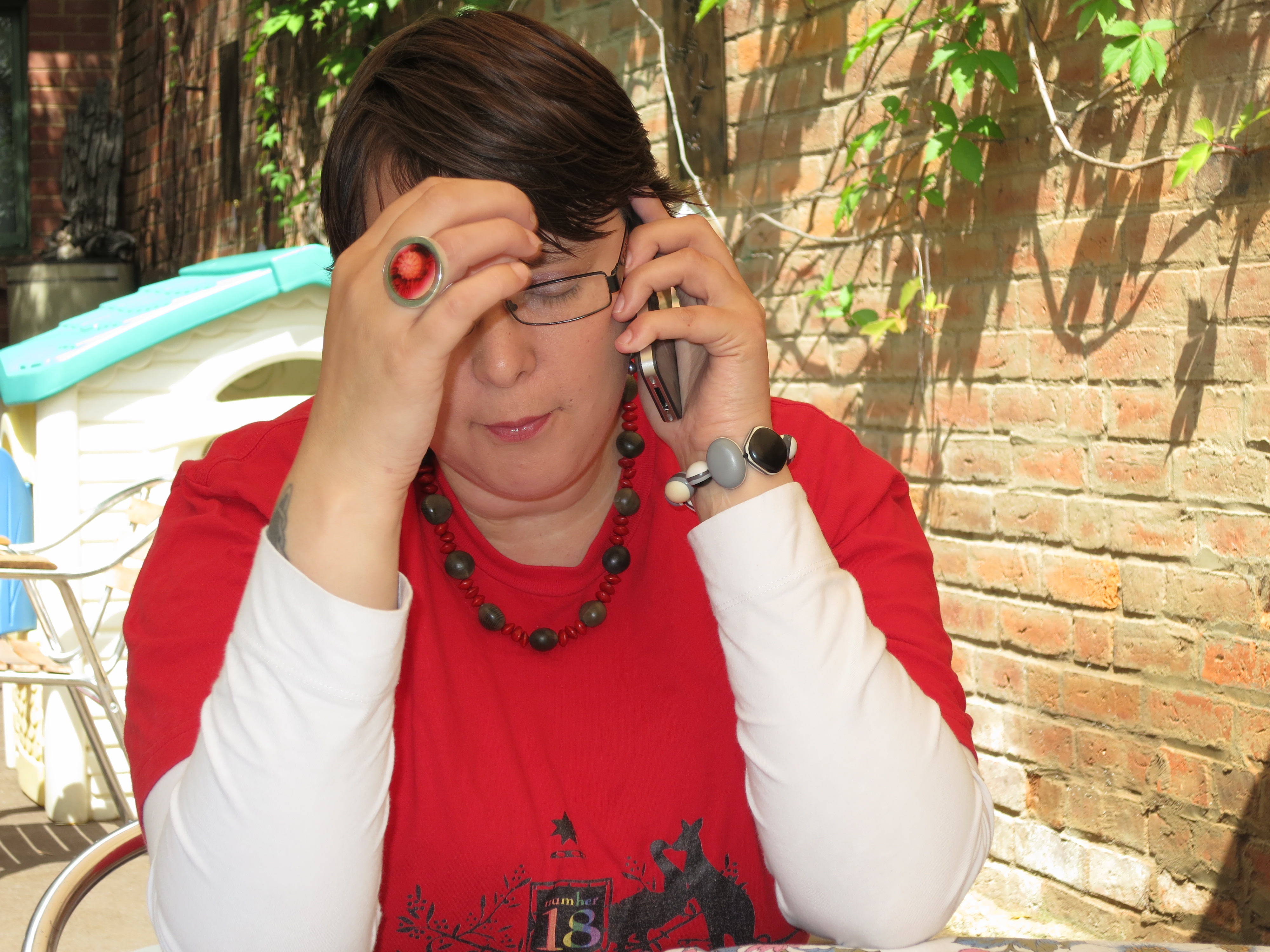
Me being, y’konw grown up. I’m probably liaising with a publisher or something…

A day in the life…. of a valuable, worthwhile, human who happens to be Autistic

I was recently asked to contribute a blog for an event challenging that oh-so-ableist and damaging group of people who call themselves Autism speaks (or as some have rebranded them, Autism $peaks). A little background…. Autism speaks starts from the premise that Autism is a ‘tragedy’. They promote ‘cures’ and basically serve to negate pretty much everything advocates like myself and so many others do to promote the value and humanity of Autistic folks. Autism speaks stands at odds with most of the things I believe in about advocacy and respect. Unfortunately Autism speaks has a broad following and supporter base, particularly in the USA. The whole ‘light it up blue’ business was initiated by Autism speaks and yet most people who aren’t in the Autism world think that the blue thing is a positive. (I will not be wearing blue on 2 April, rather I shall wear multicolours. If there’s blue in amongst them, I apologise.)

Anyway, back to the blog…I was asked to write a piece for an organisation doing a ‘flash blog’  on April 2nd to challenge the ‘tragedy/cure people’ negativity emanating from the offices of Autism speaks (and I’ve put a link in this post if you want to join in). This article is what I will be providing. It is simply description of my day as a human being who happens to be Autistic.

A day in March, somewhere in Canberra….

I woke up at 4 am and checked my Facebook – a bit of an occupational hazard for an Autism advocate in the modern era. Somebody had misunderstood one of my posts and had decided to give me a (very short) lecture on my ‘Jeanette;s Autism Books and Other Things’ Facebook page. I dashed off a rather bleary response and failed miserably to get back to sleep…until about 6am. Then I woke up with the alarm clanging at me and Mr Kitty standing in the vicinity of my nose and saying ‘MEOW!!!’. I fed the furry boy and took my morning medication.  I realised it was 7:55. I am usually safely in my office by such an hour, with life-sustaining coffee. I ran around madly and eventually was showered, suited and fed. I got to work after my supervisor, made a cup of coffee and sat down to my job as a risk management specialist for a Government department.

It seemed to be the day for people to request odd things from me, from the academic in Western Australia I had never met or heard of wanting a letter of recommendation for her research, to the CEO of an organisation wanting to attend a talk I am giving in April and do some promotional activities. I grumbled to my colleagues about al these impositions but I didn’t really mind too much.

Work kept me occupied  – there is a lot to do. I have a big spreadsheet to maintain! Seriously though, I love my spreadsheets. I liaised with everyone I needed to and by lunchtime was feeling accomplished. As I ate my beef and salad sandwich from the work cafe and lamented the overuse of seeded mustard, I saw an email from the organiser of the Autism MOOC course set to start in April which has some videos by me (an ‘expert’ apparently. Though I suspect all people on the Autism spectrum and those that love us are in fact experts. I’m just a loud Alpha personality type who gives TEdx talks and writes books and promotes myself. I’m probably no more an expert than anyone else.) The MOOC person and I exchanged a couple of emails and then I had a call from a PhD candidate I had offered to talk to about her research into post school options. What a lovely lunch break I had, speaking to this person. I returned to work energised from our exchange and made phone calls and read things – you know, all those essential elements of public servanting…

A friend rang at 4 pm. I left work at 5:30 and caught the bus. I’d forgot my Tangle fidget toy and cursed – humanity en masse in public transportation settings always warrant headphones and music and a good play with something sensorily soothing, but what could I do? It could have been worse – at least nobody got too close physically.

I bought groceries, thinking about reverse prejudice for some reason. I got the groceries home and found a little furry fellow waiting for me. Cuddles and purrs ensued. I made my dinner – the same recipe I’ve eaten pretty much every night since 2013 (It is healthy and involves many vegetables, mum :)). I watched some of the nice things on the Antiques Roadshow and then turned on Alastair the MacBook Air and here I am writing this post.

That has been my day so far. Is that day all that different from others’ days? Am I ‘broken?’ Ifs my life ‘Tragic’? Do I need a cure? No on all counts. I am a forty-something woman. The first twenty five years of my life were hard, the last fifteen were instructional. I have friends, family, work colleagues and a cat. I do not feel that my life is less valid than anybody else’s. Who would make such a pronouncement? I know I couldn’t. I can’t judge one person’s experience over another’s. I personally love my life most of the time. It can be hard but being human can be hard, whether you are Autistic or not.  Autistic people are valuable, worthy, sensitive, intelligent, interesting, good friends, good partners (and not so good for that matter). We are humans with all the range of human qualities, foibles, interests, genders, sexual preferences, values, beliefs and quirks. We are not children in adult bodies. We are not nature sprites, ‘brave’ and our experiences and lives should not be used as ‘inspiration porn’. And don’t get me started on puzzle pieces. I think I should probably stop now…. I really hope this helps.

Here’s that link to the ‘flash blog’: http://idontneedacure.blogspot.com.au

11071613_810251409056248_7748657256431855066_o

The DSM 5 Autism criteria – rewritten with neurodiversity in mind

For Emma, Jane and my new book about Autism and mental illness, I had to dig out the diagnostic criteria for Autism in the DSM- 5. It made me sad, so I decided to whip out my advocate brush and give it a neurodiversity-based touch-up. I hope you like it. I’m not sure how a doctor would use it but I prefer it to the original version. The way it works is that I have listed each category of the DSM -5 diagnostic criteria for Autism in italics and underneath have redrafted it. Enjoy.

A. Persistent deficits in social communication and interaction across multiple contexts, as manifested by all of the following (currently or by history):

1. Deficits in social-emotional reciprocity

2. Deficits in nonverbal communication behaviours used for social interaction

3. Deficits in developing, maintaining, and understanding relationships

Specify current severity based on social communication impairments and restricted, repetitive patterns of behaviour.

A (Ausome) Different ways of communicating and relating to others. This is part of the person’s basic make-up. It is not a deficit or a disability, it is just a different way of communicating. Some ways in which this might be demonstrated include:

  1. Different ways of relating and experiencing emotions. Some people may have hyper-empathy.  They may make excellent psychologists or counsellors.
  2. Interacting in different ways. Being honest and straightforward and not generally using things like manipulation or sarcasm.
  3. Approaching relationships differently to non-Autistic people. People may be very loyal and/or have strong bonds with an individual or small group of friends. Autistic people often have a great connection with non-human ‘people’ too and a connection to the natural world.

B. Restrictive, repetitive patterns of behaviour, interests or activities, as manifested by at least two of the following, currently or by history:

1. Stereotyped or repetitive motor movements, use of objects, or speech

2. Insistence on sameness, inflexible adherence to routines, or ritualised patterns of verbal

or nonverbal behaviour

3. Highly restricted, fixated interests that are abnormal in intensity or focus

4. Hyper- or hyporeactivity to sensory input or unusual interest in sensory aspects of the

environment

B (Beautiful) May be experts in a particular area, have a strong focus and determination. May have very strong interests on a topic and activities related to these interests may result in a great sense of joy and satisfaction.

  1. Innovative and imaginative use of objects. Creativity.
  2. The ability to follow a schedule. Seeing patterns in things – very useful if the person wants to work for the police as an investigator or be a mathematician or climate scientist.
  3. Passionate engagement in a particular interest. As life progresses, Autists can develop a huge general knowledge based on all the topics they may have been interested in. Very useful if the person wants to be a university professor. Also, the interests can form an excellent self-soothing tool should the person be depressed.
  4. Exceptional, accurate and perceptive sensory skills. This is highly useful in areas like catering and viticulture.

C. Symptoms must be present in the early developmental period (but may not become fully manifest until social demands exceed limited capacities, or may be masked by learned strategies in later life). 

C (Curious and Clever)

Young children may be quirky, smart and individual. As they grow older, the world can dampen their amazing spirit but do not be disheartened as Autistic people are often resilient and resourceful.

.
D. Symptoms cause clinically significant impairment in social, occupational, or other important areas of current functioning.

D (Diverse) The weight of a world which often does not value or respect Autistic people can mean that they struggle to navigate life. This is not due to their inherent deficiencies, rather it is mostly a result of a focus on some arbitrary ‘norm’.  With the right support, understanding and self-confidence, Autistic people can rise above this and be their best ‘them’. This is an area for further work.

E. These disturbances are not better explained by intellectual disability (intellectual developmental disorder) or global developmental delay.

E (Exceptional) Auties are Auties. They are amazing as is and defy this sort of diagnostic negativity through their brilliance.

Individuals with a well-established diagnosis of autistic disorder, Asperger’s disorder, or pervasive developmental disorder not otherwise specified should be given the diagnosis of autism spectrum disorder. Individuals who have marked deficits is social communication, but whose symptoms do not otherwise meet criteria for autism spectrum disorder, should be evaluated for social (pragmatic) communication disorder.

Auties should be given a diagnosis of ‘human being’ along with all the other human beings. We are all pretty much the same and just a little bit different.


A meme and a me, being Ausome and winning things…

The business of being busy – or why I work 80 hours a week and love it

My dad had a farm throughout my childhood and teenage years. When I was a young child I didn’t really get much pocket money. I got something much better – wages and business income. Now this might sound like my parents were horrible people sending their daughter out to work in the fields but it wasn’t like that at all. When I was small my dad told me that I could make some pocket money by growing a crop of tomatoes, so he showed my brother and I all the skills required to grow tomatoes. In fact I suspect most of the growing was done by my dad, but when it came harvest time, I discovered that my crop had yielded 17 pounds – a fortune to a six year old. As I grew older, if I wanted money I would do some easy but necessary tasks around the farm and through doing this learned the value of work – reward for effort. This is a lesson that I think is valuable for all children: if you want to have something, you put in some effort, be it chores or farm tasks or whatever. It is a great skills for life, especially for kids on the Autism spectrum as it can build self-worth and independence. When my brother and I were teenagers I remembered my dad telling me that any boss would be glad to have both of us given our strong work ethic. At a young age I knew the value of a hard day’s work.

When I moved out of home I got a job in a fast food restaurant and was soon promoted to junior manager. It never occurred to me to go through life without a job. I enjoyed work – it felt good and I for paid. Sadly the next few years of my life were devoid of profitable activity. A new manager came to our restaurant and started to sexually harass me. It wasn’t just offensive comments either – he would touch me and I was genuinely concerned for my safety. Being an Aspie and a young Aspie at that, I had no concept that there might be such a thing as workplace rights or that my manager was in the wrong, so I quit my job and claimed student welfare benefits, known at the time as Austudy. Thus began a dire chapter in the story of my working life. I was outside of the labour force for many years. I subsisted on welfare payments and lived a shady life with criminals and drug addicts, none of whom worked. However, I made an attitudinal change when I was 25. I decided that I wanted an ‘ordinary’ life: a professional job, an education and a mortgage. I had no idea how to do this but started by enrolling in a university course.

About halfway through my first year at university I decided I needed a job. A friend worked in a restaurant and recommended me as a dishwasher. So I began doing two shifts of work a week. It was unlike when I had worked as a child and a teenager though, for in the past I had been confident in my skills and quite commanding at work. Now I was terrified of making a mistake, It was like I was a brain surgeon and any tiny slip would result in death (rather than a dirty fork being returned by a patron, as it would actually have done). I grew absurdly anxious and the day before each shift was torture. I was so anxious I thought I would pee my pants on the tram on the way to work. Of course this thought only added to my anxiety. As had happened to me in the past, anxiety turned into psychosis and I had to quit my job.

I wondered if I would ever be able to work, but my good old determination kicked in. A year or two after my unfortunate dishwashing experience I started a volunteer job. I was far less worried as the gallery I volunteered at weren’t paying me so I didn’t feel quite as responsible. I took a number of employment stepping stones – from a small business editing video, to writing a book and becoming an author to working as an Autism consultant and then I was ready. I applied for my ‘ordinary’ professional job and soon afterwards was moving to Canberra as a graduate public servant. I was anxious about starting a new job I didn’t know how to do in a city where I did not know one person, but the change from impoverished public housing tenant to well-paid public servant was so dramatically positive it eclipsed the anxiety. I soon realised that I was a natural public servant. I loved all the hierarchy and order. I loved that I was part of something bigger – the Australian Government – and I loved that people in shops called me ‘ma’am’ and tried to sell me things rather than look down their noses at me.

The whole time I have worked as a public servant I have had a second ‘career’ gong on: that of an Autism advocate. I wrote my first book in 2005 and had a few interviews in the media and got asked to speak at a couple of things. It wasn’t a lot of work. I probably gave two lectures a year. This all changed in late 2013 when I gave a presentation on Autism and resilience for TEDx Canberra and had my manuscript of a book on employment for teens on the spectrum accepted for publication. I think what happened may not quite have been a meteoric rise to fame but I did start to find that people at conferences knew who I was and I occasionally got waylaid on the bus by people in the Autism world. The main thing that changed was my workload, and yes, as the title of this post suggests, I work around 80 hours each week, including Autism advocacy and paid work.  I don;t mind a bit.  Things have come full circle and I”m like my younger self wanting to please my dad and earn extra pocket money. I pride myself in my work. I don’t think of most of it at work anyway, more as interesting and diverting activities which I sometimes get paid for. Once again I am a confident and accomplished employee. Since joining the public service I have always said I feel like I died and went to work heaven, and I think I must be in advocate heaven too.

Work is an excellent thing. Humans are programmed to work. Being unemployed can be soul destroying. If you can work – even if it is volunteer work or just a couple of hours a week – do it. You don;t know where it will lead you.

Here is a link to my book ‘The Wonderful World of Work: A Workbook for Asperteens’  (activity book about work to start preparing teens on the spectrum to join the workforce. It;s good, I promise): http://www.jkp.com/uk/the-wonderful-world-of-work.html

IMG_1322

Me, talking about work

You can’t say that! – Autism, advocacy and some very rude people

Being an autism advocate can be a funny old life. I am a person with lived experience of autism who is proud, vocal and has lots of self esteem. However, I live in a world that devalues the experience and very existence of people like me. So while I don’t care how ‘normal’ I might appear and am proud of my various Aspie quirks, I live in a world where being different – particularly being the autistic brand of different – is seen as shameful and ‘weird’. My job – or at least one of my jobs – as an advocate is to address this issue and make the world a better place for people like me to live in. To build acceptance and inclusion, to make the way easier for others on the spectrum.

This has not always been the case. I spent so many years wanting with all my being to be like everyone else – whatever that meant. I had low self-esteem. I didn’t want to be different. I wanted to be one of the ‘cool kids’. Something happened when I was 30 that made those things kind of impossible – I wrote a book about living with Asperger’s syndrome. The funny thing was that I didn’t do the sums and prepare myself for the thing to be published, but it was. I suddenly become an accidental advocate. I was thrust into a world I hardly understood. Worse still, people I didn’t know seemed to value my opinion about things I felt I didn’t know anything about. I was torn between being excited about my new-found recognition and thinking a sincere and heartfelt ‘what the hell?’ when confronted with yet another thing I had previously been unaware of. I’d tell a room full of autism world folks how I hated discrimination and thought everyone should be able to be as openly Autie as they chose while at the same time worrying whether friends at uni thought I was ‘weird’.

As time went on, I grew in confidence – both as a human and as an autism advocate. Before long I really was a proud and confident advocate who valued and liked myself just as I was. I suddenly started noticing that some people said really inappropriate things to me, either about me or about other autistic people.I was horrified. Had this been going on all my life and I just hadn’t noticed? What was wrong with these people? Things people said that I noticed included such gems as ‘You don’t have to say you’re an Aspie Jeanette. You could pass as ‘normal’, ‘Are you like that lady that thinks like a cow?’ (Presumably they were speaking of Dr Temple Grandin who I’m fairly certain thinks like a person, not a cow!). Other nuggets included ‘You don’t look Autistic’ and ‘can you find a friend for my daughter. She does’t have any friends! ‘ (Said daughter was standing right next to her mum and me at the time. I could only conclude that her mum wasn’t much of a friend.) I came across people who had worked as teachers and thought it was perfectly OK to manhandle young Aspie students to make sure they looked them in the eye, people who saw us as deficient, broken, alien and worthless beings. While some of the quotes above are rather amusing, I don’t entirely mean for you to be amused. I would prefer some horror or disbelief as a response as well.

Put simply, we are different, not less.  I do not see disability when I view myself, I see difference. I suppose it’s not an exclusively autistic issue. People from other ‘disadvantaged’ groups have to deal with all these sorts of prejudices. The thing that worries me most is the level of power and superiority that it denotes. On one end is the concept of use being mentally deficient, less than human, even worthy of death. One the other end there’s pity and paternalism, tokenism and condescension. Both ends of that spectrum are destructive, disrespectful and damaging.

So I suppose I should be glad that I became an accidental advocate back in 2005, because there is so much work to be done. I don’t really want Autism awareness, at least not in isolation. I want autism understanding, respect, value, inclusion, communication. Basically some neurodiversity would make the world a better place for us all.

I constantly remind myself that if I am negatively impacted by discrimination and ignorance, me – a proud Autie who values and likes myself just as i am – how much more negatively will it impact on those who do not have confidence and self-esteem. We all need to work towards making a difference here. If someone says something disrespectful or prejudiced, I know I will be calling them on it.

TEdx pic 8

Me doing my bit to promote neurodiversity 🙂

‘Human Being on the Spectrum’ – reflections

I just got home after attending an Autism conference in Brisbane. The theme was ‘Human being on the spectrum’. It was organised by Asperger Services Australia – an organisation which has been around for 21 years and whose entire staff – including the director – are volunteers. I have spoken at one of their events before.

I love a good Autism conference. I get to hear interesting speakers and catch up with people I don’t see very often. These days I am usually a speaker at these things too.  There are some practical considerations (for example that I have no sense of direction at all and can’t read a map so finding my way to hotels and conference venues can be tricky). The main practical consideration at the conference I attended this week was the weather.  As the concierge at my hotel reliably (and strangely rather enthusiastically) informed me, there was a tropical cyclone whirring around off the Queensland coast. The weather was the backdrop to the event. One of the speakers who I really wanted to see got cut off by floods. It rained the entire time I was in Brisbane and most of the conference delegates arrived each day a little soggy. There was talk amongst interstate attendees of being unable to fly home, but that did not happen for me.

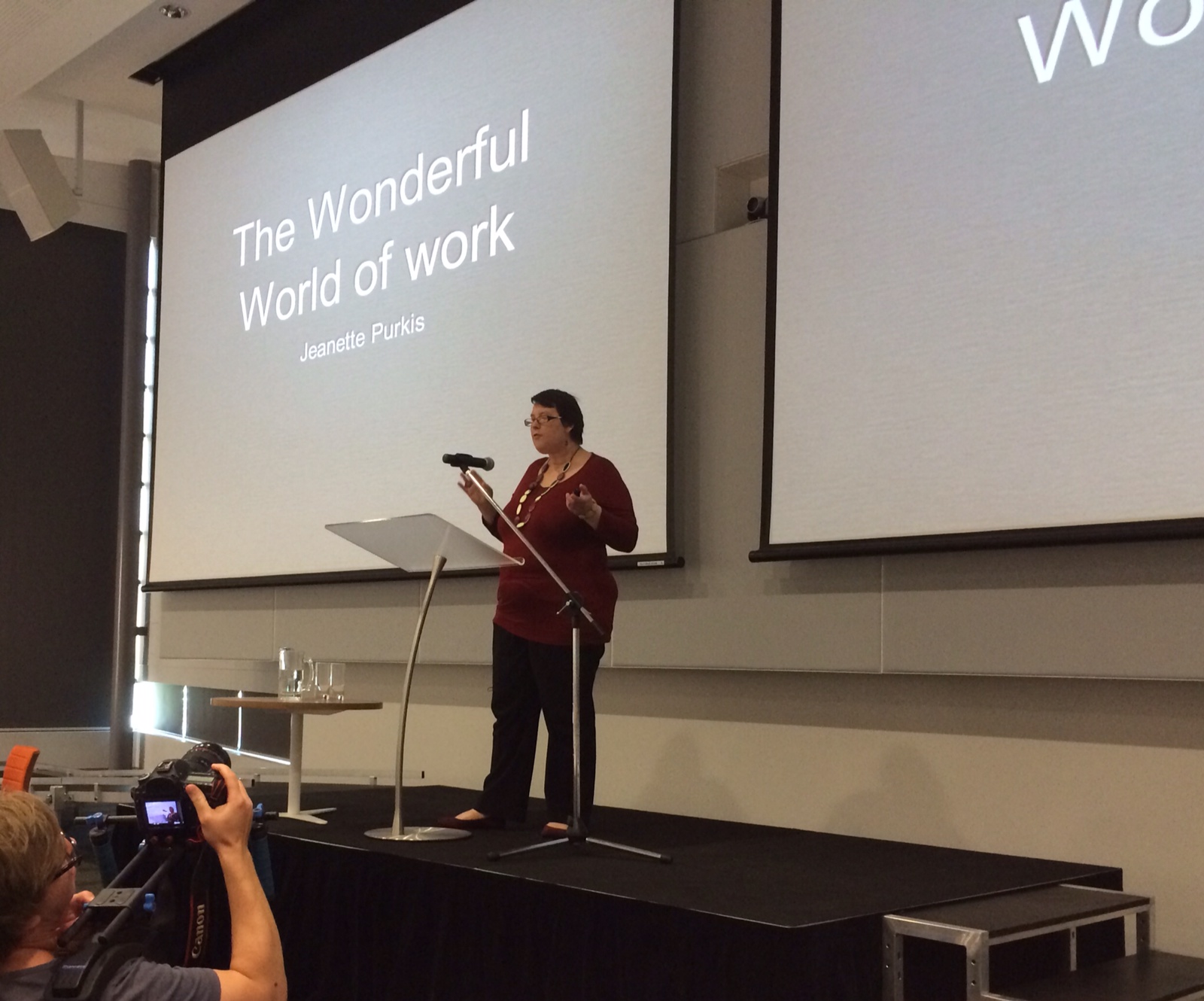
My presentations were about resilience and employment. The resilience one was in the main auditorium. I always have mixed feelings about being in he big room, for while it’s wonderful to stand on stage with your PowerPoint slides projected on a massive scale behind you. if it is a small event (or there is a more popular speaker on at the same time) you may be speaking to a smattering of people in a huge room, which is off-putting. This did not happen to me though and I had a great crowd.

I caught up with some wonderful people – and met some more. I also met my two coauthors for my new book in person. They were as lovely as i expected and I am now even more inspired to get on with writing the book. I caught up with Wenn Lawson, who I was featured in a documentary with in 2010 and is one of my favourite people in the world. He really is a great role model and leader for our community. I hosted a radio show from my hotel room. Conference delegate Berinda Karp and keynote speaker Katharine Annear very kindly participated in the show, which was great.We talked about a range of topics including the responsibility leaders – and conference speakers – have. We were all sitting on the bed in my hotel room, hoping that the hotel WiFi or Skype didn’t give out half way through.

By the time I flew home I was exhausted and overwhelmed – often a response to these things – but it was a wonderful week. It is so good to be among my Autistic peer group and better still to be among my peer group of Autism advocates. It will take me a while to process everything I heard but I am so glad i went. Oh, and other highlights were that  met Graeme Simsion, author of the Rosie Project who signed my copy, Tony Attwood came to my resilience talk (I’m not sure what he thought be he smiled and nodded in the right bits) and I discovered fidget toys.

Here is the podcast of the radio show we did:

http://www.blogtalkradio.com/positivelyautistic/2015/02/20/positively-autistic–jeanettes-autism-show

10958216_10205428864696464_8866715541256938060_n

Me speaking about resilience

Never deny hope – we all deserve a chance

Trigger warning: references to suicide and police violence

Yesterday in Sydney, a young woman was shot dead by police. She was on the Autism spectrum and she was at imminent risk of self-harm or suicide. Presumably the police went to ‘help’ her and ended up ending her life considerably more quickly and effectively than she probably would have. A response which was supposed to protect someone vulnerable ended up with them being dead. I read about three of the comments posted about the news item on social media and came to the conclusion that there are a lot of very uncaring people out there. One comment which stuck in my head read ‘if you don’t want to be shot, obey the law.’ While it beggars belief that anyone would think – let alone write – such a thing, I am not writing this post to talk about idiot trolls on social media. Well not so much at least.

The tragic – and I suspect largely avoidable – incident yesterday really had an impact on me. Not just because I’m an Autism advocate, or a person with Autism or a caring human being who would hope that if someone is suicidal they get help rather than death. No, what really affected me was that some years ago, I was – essentially – quite similar to that young woman. From 1994-1999 my younger self was a criminal, a drug addict and a very unwell person. I spent years wanting to die and did a whole load of very dangerous and stupid things which may well have resulted in my death. Of course they didn’t, but I understand how close I cam to not being here.

I want you to imagine 20-something me – or someone very like her. Picture being on a suburban train and this skinny young girl with bright purple hair hops on the train. She’s talking to herself. She’s jumpy and fidgeting and playing with her hair. She’s wearing a T-shirt and you can see what you’re pretty certain are scars from self-harm. She catches you looking and stares back defiantly. She really doesn’t seem to care what you think. In fact you wonder if she’s actually quite proud of her scars. You think about your own daughter and hope she never ends up like this woman. The girl stinks of cigarettes…no, wait…marijuana. She pulls out a small bottle of tequila and takes a few swigs. You probably want to get as far away from this crazy lady as you possibly can. A couple of bored-looking ticket inspectors get on the train. The purple-haired girl looks anxious for a second, then angry. Apparently she doesn’t have a ticket. It figures, you think. She doesn’t even argue with the inspectors but when they write the fine she screws it up and throws it at their feet.  They escort her off amid swearing and struggling. You’re just glad she’s gone.

You probably wouldn’t expect the purple-haired young Jeanette to do anything worthwhile with her life. If she died, maybe it wouldn’t be such a loss.

However, twenty-something, dope-smoking, alcoholic, self-destructive, authority-hating, unemployable ‘loser’ Jeanette became me. I work full-time and earn more than most. I have a good education. I own property. I even go to church (although not a scary conservative one). I have every outward trapping of conservative, middle-class existence. I also volunteer around 30-40 hours each week of my time to advocate for Autism and write blogs like this. So while I should have dies all those times in the past, and most people who knew me back then may have thought ‘well, she den’t have much of a future’, in fact, in my case they would have been completely wrong. I’m actually a happy and accomplished human being.

So this isn’t really a nice story about how I overcame adversity. I don’t need to write that – it’s already in my autobiography. This story is me trying to come to terms with those haters on the news sites who victimise the victim and see only negativity. Any death – and particularly any suicide or shooting of someone who needed help rather than death – is a complete tragedy and I believe, is avoidable. We do not know the potential of anyone. Even if someone is miserable and drug-addicted and desperate and may seek death, in fact their life can  improve.  I am devastated at the death of any young person in this way and especially one of my Autistic sisters or brothers. My heart goes out to her family and friends and our amazing community that has to deal with death and tragedy perhaps more often than could be the case. And those internet haters…I have no words for them but I suppose they must be in their own kind of negative hell.

img108

You don’t know who she will be. She is precious whatever her path

Gifted? No. Just my way of communicating

There are many things that I enjoy doing. I am good at some of them and less good at others. There are two things in my life though that I have never learned how to do but which come as easily and swimming does to a large goldfish. These things are writing and public speaking. Obviously as an author and autism advocate they are quite useful skills to excel at.

As a child I struggled to know anything about the people around me, especially children of my own age. Adults were safer. I could understand adults because they gave dear instructions: ‘Jeanette, don’t do that to your brother!’; ‘Jeanette, clean your teeth!’. No subtleties or nuances there. Nobody was trying to confuse me or manipulate or tease me using such horrible things as sarcasm. Children were horrible as far as I was concerned. You never knew if they liked you. Even if they said they liked me one day they were just as likely to hate me the next. As a teenager it was even worse. I was this open, honest Aspie girl in a world or bitchy, fickle teenagers. At least if the boys bullied you they’d be upfront about it – pull Jeanette’s hair, chase Jeanette with a spider, call Jeanette names. There was a strange logic to it in which I had a clear – if not very edifying – role. The girls however, were a totally different story. I still don’t know how teenage (non-Autistic) girls operate and feel anxious in their company.

So what did little honest, open Jeanette do to feel she belonged? I read. And read. And read.  Books were my friends. The characters within them my peer group. The characters in books made sense. The author was usually kind enough to explain their motivations and some kind authors even explained what was going on with such strange and alien things as facial expressions and eye contact. Oh how I loved those authors.

As I grew older and gained an Asperger’s diagnosis I discovered that I did not ‘get’ about 80 or 90 per cent of the message when people spoke to me. I felt cheated. Neurotypical people understood a whole load of information that I was missing. And I could’t learn how it worked, no matter how many times I watched ‘Lord of the Rings’ and focussed on the actors’ facial expressions. Somewhere along the line I wrote a book – My first serious piece of writing ever and it was accepted to be published. ‘You’re gifted’ said people. People told me how clearly I communicated through my writing. I joined the public service. ‘Your emails are fantastic Jeanette’ said a boss. ‘You communicate so clearly. I wish the other graduates were as good as you.’

Some time – and more books – later, I realised that my apparent ‘gift’ of writing was simply my way of being clear through writing so I didn’t need to talk to people face to face and know that I wasn’t communicating the way most people did. My public speaking was the same. If I were to only get 10 per cent of the meaning of conversations, I was going to make sure that everyone understood what I was saying. I have learned over the years to convey meaning through what I write and what I say without the need to eye contact, facial expressions or body language.

So no, I’m not gifted. I’m just Autistic, my childhood friends were authors and I want to communicate with you. Which I suppose is a gift of sorts.

OLYMPUS DIGITAL CAMERA

‘Don’t play with those Catholics!’ – embracing the ‘other’

I read an interesting biography of Scottish Comedian Billy Connolly a few years ago. The author – Billy Connolly’s wife Pamela Stephenson – describes Billy playing with some kids in the street when he was about five years old. The playmates’ mother apparently stuck her head out the window and yelled ‘don”t you play with those Catholics!’, giving the future funny man a fairly stark view of ‘othering’ and prejudice.  People do this so of things with every possible attribute or quality, be it religion, ethnicity, cultural background, gender identity, sexual preference, disability, employment status, social class or even musical taste. We humans tend to form groups and exclude others. We look out at those who are not like us and see them as different, as ‘other’ to us. This exclusion can lead to extreme behaviour in some cases, such as racial vilification, violence or extremism.

As a child I didn’t really know much about these things. Like many children I saw myself as essentially the same as others. My best friend in the first years of primary school was from a Jamaican background. She had beautiful brown skin and amazing curly hair. We both wanted each other’s hair  – apparently my straight blondish locks were as thrilling to my friend as her tight curls were to me. I never had any concept that my best friend was not the same as me in any fundamental way. We both enjoyed drawing and chasing each other around the schoolyard. We had the same accent, lived in the same English village and loved making up games together. Sometimes my classmates – usually the older kids – would call my friend names. They said she was ‘black’. I told them that this was silly. I really had no concept of prejudice based on someone’s physical attributes such as skin colour. To me, my friend was no more ‘other’ than my own family were. She was my friend.

When I got older, I found myself becoming the other, for while primary school had been relatively benign, at high school I learned that apparently I was different. People picked on me, teased me for everything I did and said and was and bullied me. I was the least popular kid in the school. I wondered what was different about me. I couldn’t pick it out. I didn’t hate the kids who hated me. Surely I was just like all the other kids, but no. I was told that I was a swot, nerd, weirdo, and worse. I was teased for sexual things which I didn’t even understand. I didn’t know how anyone could tell that I was a ‘slut’ when I had never had sex. Life as the other was not very fun.

Years after the hardship of school, I discovered that I had Asperger syndrome. The reason I had been seen as ‘other’ at high school was almost certainly related to this. Being Autistic was amazing. I had an identity. There were people like me. Suddenly I was in a group that made sense. One thing troubled me about my new identity though and that was that some people ‘othered’ non-Autistic people. Not in a bullying or aggressive way but most certainly in terms of ‘us and them’. These people talked about ‘neurotypicals’ – people without a diagnosis of Autism. At first I thought this was great but then I started to wonder. For ‘neurotypical’ just means non-Autstic. That is, lacking in just one quality or attribute. The idea that neurtotypicals were a privileged group, as some people implied, seemed very foolish. I mean, one can not have Autism but have schizophrenia, or be homeless or unemployed. The main difference between them and me is that hey don’t share one single attribute – that of Autism. Certainly Autism is a fairly significant part of who I am but I would prefer to focus one what I share with others rather than what makes us different.

I prefer to see our similarities and what we share rather than the things which ‘other’ us from other people. It’s all very well to own one’s identity with a sort of fierce pride – thats fine and I understand it and do it myself from time to time. But I don’t want to exclude people because they are different or minimise their experience. Young children as much less likely to ‘other’ one another I find. Those differences that adults often fixate on are unimportant. Kids can teach us a lot in this regard. And people who have different attributes to us can broaden our horizons and open up new worlds of knowledge and experience. We’re all people – let’s ignore otherness for a while and listen to different viewpoints.

I spoke at a conference last year and one of the keynotes was an awesome fellow called Patrick Schwartz. Patrick talked about working with people with different conditions and disabilities. Instead of saying ‘Michael is Autistic’ or ‘Trey has cerebral palsy’ he would say ‘Michael has as an attribute Autism’ and ‘Trey has as an attribute cerebral palsy’. Maybe we can look at others like that and see things which make them different from us as simply attributes. Works for me

DSC_6817

We’re all essentially the same and just a little bit different