When I was a chameleon…. Autistic Identity and social ‘acting’

When I was fifteen I went from being a fundamentalist Christian one week to a revolutionary socialist the next. This is probably quite an unusual and swift about face in terms of beliefs and identity. I didn’t do it because I was confused about who I was. I did it to be accepted and have a peer group to belong to. I was at school some years before the Asperger’s diagnosis became available where I lived so had gone through school as the loner, the ‘weirdo’, the target of apparently every single bully in the place. While as a small child I was confident and liked myself, years of bullying and harassment at school taught me I was stupid, worthless, ugly and everything else. I thought it had to be true or why would so many people say it about me? I didn’t think anyone would want me to be their friend with my evidently deficient personality so I joined a peer group where all I had to do was toe the party line and agree with what everyone else said. To this purpose, a group with clearly described and stated  beliefs was quite easy to join – hence the revolutionary socialists. (I was brought up in the Christian group so that was sort of my default peer group or ‘culture’ from which I joined the socialists.) In order to be accepted with the socialists – or anyone really – I took on a persona which fitted with their views. I was like an actor studying a role. I observed my new peer group,saw what they did and how they spoke and took it on as part of me. I had in fact ben doing tis at high school for some time already. In school I had tried to be inconspicuous and avoid detection but it was about was effective as trying to hold back the tide!

I left home at 17 and became an independent adult. I worked so I took on the role of ‘good employee’ when at work. I had the odd experience of being probably the only revolutionary socialist ever to win Worker of the Month! When I was at work I put on my diligent employee ‘hat’ and at protests I was radical Jeanette complain gin about ‘the bosses’ and saying rude things about politicians.

It is probably evident to you that this would have affected my sense of self, my identity. It did but teenagers are not always the most self reflective of people and I simply didn’t see it. I was unaware of this part of me. It became second nature.  ada[ted to whatever setting I was in. It was like putting a chameleon on a rainbow t-shirt!

All this was unhealthy but it got worse. Regular readers of my various things will know I spent time in prison in my twenties I am not going into detail about hat here. It is easy enough to find information about that  and a blog post needs to be reasonably short! Anyway the day I went to prison I put my acting skills to effect. This was a world I was only vaguely aware of and I wanted to ensure I didn’t get anything ‘wrong; socially. I realised as soon as I got there that this was essentially high school but the bullies would do more than call you names if you messed up. My effectiveness at turning from middle class leftie student to criminal in a space of days, and the fact that in the over three years I was there that I was never physically assaulted by the other women, amazes me. I always talk about doing what works and in that situation I somehow did what worked for me to stay safe (at least from other people). This was great in terms of my personal safety in a very dangerous place but in terms of my identity it was a disaster. I took on my criminal role so effectively it took some years to move past it. My act even fooled me!

In 2000 I found myself wanting an end to the world I knew as a criminal. I hated who I was – negative violent, self-destructive, disrespectful of others, socially devalued and alienated form all that was good. I had the amazing privilege to get to attend a residential therapy program which, while its target audience was those wth a misdiagnosis I had acquired, was in fact very helpful. While doing this course I realised I didn’t know who I was and didn’t really like what I saw in terms of my behaviour and attitudes, I decided to change.

I am someone who came from a dark place and was filled with remorse and shame at who I had been. I had a blank canvas. I got to decide who I would. be. A scary and empowering proposition. As soon as I accepted my Autism diagnosis I started heading in the right direction. I had never accepted that little ‘A’; word and I think that was because I was not comfortable being myself. Autism to me was like an insult, something not to mention in polite company. My new self was comfortable with her Autism – although not so much as I am now.

Over the course of a few years I built my new ‘me.’ It didn’t mean I stopped taking on mannerisms of people around me. One of my public housing neighbours thought I was ‘fake’ because he heard me talking to one of my university lecturers on the phone and my speech and use of language were different I was in fact unaware of that occurring – chameleons apparently take some time to change back to there regional green! These days I have a very strong sense of who I am. I don;t do so much ‘acting’ and think if someone doesn’t like me because I’m a bit quirky that it is their loss. Identity can be hard but I ended up with a ‘me’ that I quite like.

Here are some thoughts ardour this issue more generally

  • While the social chameleon is often seen as a descriptor of the female Autistic ‘type’ that is not always the case. We need to be really careful when using those Autism and gender ‘types’. Gender identity is not just sis gender male and female. Gender is a much more complex and nuanced thing than just male and female. A large percentage of Autistic people identify as trans, non-binary and other genders which makes a static notion of male or camel Autistic ‘types’ quite problematic.
  • Often people ‘acting’ do not realise they are doing it.
  • While it can be a useful way of avoiding being singled out for unwanted negative attention, ‘acting’ can come at the cost of a sense of identity to varying degrees.
  • For a lot of Autistic people identity is complicated by a number of factors such as how they view their Autism, the peer group they mix with or their other, intersectional identities, such as Aboriginally or sexuality.
  • Many Autistic people feel a great sense of belonging within their own Autistic community. For quite a few of us this happens after a diagnosis in adulthood.

IMG_3534

Home at last – My journey from homeless to home

A place to call home has been a challenge for me for a number of reasons over the past 25 years or so. I was brought up in my parents lovely home in England and then in rural Victoria when I was a teenager. It was stunningly beautiful place. Naturally I hated it. This was not due to me lacking an aesthetic, it was more about what the country meant to me – bigotry, narrow mindedness and bullying. Needless to say I moved out straight after high school.

At 17 I moved in with a socialist comrade in Melbourne and got a job. At that point I had no Asperger’s diagnosis and these things seemed to be what one did. Share houses were confusing. What worked in my parents’ house did not work in a shared house. Over a two year period  I lived in five different places.

When I just turned twenty I met some one who changed my life in a very negative way – ‘Dave’ the violent criminal. That wasn’t how he presented himself to me and by the time my trusting, naive self had worked out he was very bad news, I was in far too deep. Regrettably I was too scared to leave him and so went along with some of his crimes and went to prison. I went through five years of primary and secondary homelessness, plots of stays in prison and the psych ward. I lost any confidence I may have had, hated myself. I figured my life would be as it was – institutionalised, insecure and scary.

What changed? I never truly know the moment it happened. My last prison sentence ended on 5 February 2000. One of the officers said he bet me a carton of cigarettes that I would be back within a month (helpful,  know!!) From prison I went to a live in therapy service and there things changed.I was treated as an equal, worthy human being for the first time in forever. My parents who had always been supportive were so happy and encouraging. It all combined to change how I saw myself in the world.

Sadly poverty and disadvantage don’t magically disappear just because you decide to change your life. Housing was  a huge issue. I went through several years of having no choice in where I lived. Some of the places were unpleasant, some were downright dangerous. I ended up being assessed as the top priority category for public housing as I had lived in over forty addresses over the preceding few years, I don’t remember all of them and none of the addresses. It was like I was a little lost ghost floating through unpleasant boarding houses and supported accommodation. My last supported housing place was in lager block of public housing flats. As a priority list tenant I had to accept the first property I was given. You have no idea how disappointed I was when I saw the tiny concrete box I had to live in. There was constant damp actually running down the walls. All my art was ruined. I soon gained a scary stalker – a woman who gave me no peace and who was a violent alcoholic.

What I’ve missed here is what I was doing to change this. I was an aspirational Jeanette, going to university to gain a degree and hopefully score a graduate job if any company would have for me. I sat in my bedroom with my slightly broken desk and looked longingly at real estate online. For some reason I thought i would buy a flat for $200,000. I had nothing to base that on.  It was odd.

There is a great mental health saying that ‘you alone can do it, but you cant do it alone.’ Thankfully I was not alone. I had my parents always there and in 2004 I met someone whose influence I can realistically say resulted in everything I have now. She was my resplendently wonderful mentor. You will know her perhaps and know that she is no longer with us here which is hard for me to write, Her name was Polly but I knew her then as Donna Williams. Polly suggested I write  my life story which I did. I will be grateful every day from now to eternity. The book was published. Within a year of its release I  was offered a graduate job in the Australian Public Service. I moved to Canberra and started a new life, including living in a very lovely rental property which I could scarcely believe.

The rental came with a difficult housemate. While the house was wonderful, the housemate was less so. I was miserable there within a short space of time and oddly surprised that middle class people could be controlling!  As soon as I had a minuscule deposit saved I bought the cheapest apartment I could which was near public transport (as I don’t drive). I was frightened for the first few weeks. I was alone. I had lived by myself in the past but there were away neighbours or friends nearby, Here it was just me. Because I rushed to buy my flat and it was the only one I could afford I saw it as a compromise. As with many older houses there were maintenance issues. The worst was the shower which leaked and I had to replace. This was a descent into darkness for me. My anxiety was off the scale and I looked at every inch of my flat expecting it to collapse at any moment. I genuinely wanted to live at work and sleep under my desk! If I went away overnight I would expect to come back and find my house robbed, burned down or somehow gone.

My anxiety, as can unfortunately happen for me, turned into psychosis and I spent terrifying months communing with ghosts in a sort of waking nightmare. By the time I got help it was very late and I suffered for some years. I hated my flat and felt it was my enemy,

Then something happened which was as much a catalyst as any of the main change points in my life, A young black cat who I called Mr Ronnie and not long after Mr Kitty, came to live with me, Within a few months my flat seemed a lot more friendly. I came home to a friendly purring kitty person, delighted at my existence and the promise of cat food and cuddles. I tentatively started to branch out with the art and hung as many visually interesting things as I could everywhere there was a space. My house gained the name ’Whimsy Manor’ which has kind of stuck. And today was another of the transition points, at least in terms of my thinking – I love my home, I really enjoy being here. It is a reflection of me. I finally came home. I have within me security and pride in my space. I would never have thought that possible to have a home where I am comfortable and belong. One very grateful Jeanette here. “Welcome to Whimsy Manor”

IMG_5553

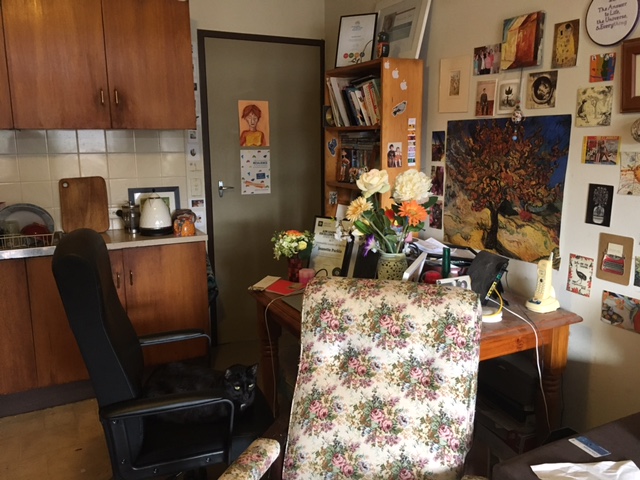
A corner of Whimsy Manor complete with Mr Kitty

‘Do women with autism suffer more than men?’ Addressing an odd question

Generally, if you use the term ‘suffer from autism’ a lot of Autistic people – myself among them – will react negatively. The idea that Autism of necessity causes suffering doesn’t quite align with ideas of Autistic self-advocacy ad neurodiversity. The other day a colleague asked me the question which is the title of the piece: ‘Do women with Autism suffer more than men?’ I get asked a lot of odd questions from neurotypical folks who I understand do not share my detailed and nuanced understanding of all things autism – I mean, why would they? So while my instinct in relation to this question was to get into argument mode, in fact I found myself stepping back and trying to understand there the question came from and what information would be useful to convey in response.

I answered my colleague as best I could, trying to convey the Autism is a different approach and not a tragedy. But the question got me thinking about autism and suffering, not in an ableist sense which might suggest parents of autistic children should just give up on their child now, or the idea that if autistic people do not behave or communicate in the way neurotypical do it must be some ind of tragic failing. Instead I turned it in on my own experience of forty-two years as an Autistic person. Do I ‘suffer?’ If so how? Does Autism itself result in suffering or is it something added by others who have no understanding of me or my autism?

These are some of the conclusions I reached:

  • My autism is neither negative nor positive in any absolute sense. It is simply an attribute. The perceived negatives and positives around my autism are things which are strongly influenced by the responses of others to me. In its essential state my experience of face blindness (which while not exclusive to Autistics is experienced by a lot of us) is neither here nor there. I can’t remember faces and I can’t remember the ISBN numbers for my books. On paper these are both things I simply can’t remember but in a world full of people who expect me to remember their name and their face, then face blindness becomes a negative. It also makes me anxious around seeing people and worrying I will not recognise them and be ostracised for being considered weird or highly rude. What makes my inability to recognise most faces a deficit is that it is different form most other people, and any suffering attached relates to difference between others and me  rather than an innate flaw.
  • Before Is started school I was confident. I liked myself and thought I was a good person. Thirteen years of being bullied and excluded in places where education was supposed to occur left me not only lacking confidence but also filled with negativity and self-hatred. I still suffer from the insecurity and anxiety when I am around groups of  school children, over twenty-five years after I finished school. I didn’t do anything ‘wrong’ at school but I was singled out as being different and I definitely suffered as a result.
  • I am naive. As a teen and young adult this was dangerous. My naivety was not a deficit in the scheme of things and the only reason I suffered from it, and suffered greatly, was that predatory people took advantage of me.
  • I am a perfectionist. There is certainly suffering within that. But dig beneath the surface of my perfectionism and it comes fro a fear of failing after I lived through high expectations as a child. Perfectionism for me also came  from a place of needing to prove myself in a world which evidently didn’t think much of me. It was  also a way of controlling the more unpredictable nature of the world and those inhabiting it. If I could control how well I did on an exam it seemed to help me address that uncertainty around the other things going on in my life.
  • I have spent much of my life high anxious and fearing things – the supernatural, fire, nuclear war and severe phobias like spiders and unaccompanied dogs. Fear has been a constant, unwanted  companion my whole life. My first memory is of a recurring nightmare and in my childhood I spent hours each week praying to God not to have a nightmare. The unpredictable nature of my nighttime brain was almost as horrifying to me as  the nightmares it could produce. As I went through childhood I was given messages from all sorts of places that my fears were meaningless and I was being annoying. ‘The spider won’t hurt you Jeanette.’ ‘Don’t be silly ghosts aren’t real. You’ve been watching too many scary movies.’ those sorts of things. I found that having my anxieties and fears invalidated made them considerably worse as I felt I had to manage them all alone. After a lot of adults dismissing my anxieties an fears I gave up telling anyone about them. This contributed to an unhelpful attitude towards seeking help that I still have today. Had adults understood the nature of my fear they might have helped me manage it rather than being dismissive.

I’m sure you have noticed something among these ‘sufferings’ related in a greater or lesser degree to my autism. They were either created or exacerbated by the actions and words of people who wanted to take advantage of me, hurt me or just plain didn’t understand my approach to life.

There is a flip side to this rate negative picture of the world: If you look at my own life and the suffering involved, consider what might have happened if bullying had been effectively tackled or if predatory people hadn’t abused and damaged me. A world where I felt confident enough about myself to not be bothered by failing at something or needing to be a perfectionist? I believe that world to be possible and it is the focus of a lot of my advocacy to help create a supportive world where Autistic people do not have to bear this huge load of discrimination, dismissiveness and invalidation. Most of the suffering we experience as Autistic people navigating the social world can be seen as  preventable. To address it maybe we can widely promote the notion that our Autistic different is not less, help Autistic people to value themselves and fight discrimination with pride and knowledge and to encourage the structures in society to be Autism competent and confident. Suffering for Autistic people is far from inevitable. Yep, let’s do the changing the world thing.

IMG_0449

“Call the doctor!” – Speaking to clinicians about Autism and mental illness

I am at Melbourne airport, waiting for my delayed flight to leave for home. I just had to get a replacement boarding pass and handed mine in to get a new one for the cancelled flight. The flight attendant said ‘Doctor Purkis?’ and I replied ‘Yes’ quite confidently – this fib was easier than explaining why I was incorrectly titled as a doctor.

The reason  for my undeserved Doctor-ing was that last night I spoke at a conference for paediatricians and psychiatrists who work with people with ADHD and Autism. The events company organising the conference must have just thought all the speakers were doctors, hence the mix-up.

The presentation was one of the best talks I think I have done – not so much due to my delivery or even the content of my slides. The beauty of my talk yesterday was the audience of around 150 psychiatrists and paediatricians. I did a rough calculation that if each of the 150 or so medicos at the event were treating 10 neurodivergent children, then my presentation would have an indirect but probably significant impact on 1500 people. In fact the true figure is probably larger. The reach of my presentation yesterday could be some kind of fractal expansion of advocacy….(OK, I’m getting a bit silly, but it is a big reach.)

Anyway, enough self congratulation. I was actually very anxious before giving this talk. I wondered if one of the more difficult psychiatrists from my past would be up the back of the theatre, heckling me and saying I didn’t have Autism. Of course no such rudeness occurred. Deeper anxiety was about how well my message would impact on the crowd, I had been given a huge opportunity to influence change and I wasn’t sure whether I was up to the challenge. My self criticism threw around such thoughts as ‘Oh, are you going to do a little talk about being crazy and hope the actually important people care?’ Thankfully my self critical side was voted down and the event went well.

My brief twas to give an after dinner presentation on ‘patient advocacy’. I don’t do a lot of mental health-specific talks so thought this would be a great opportunity to think about mental health advocacy linked with Autism advocacy. I had twelve slides – mostly my memes or images illustrating the content. I spoke on the topic of my own mental health and issues I have had accessing assistance, and then on what I felt needed to change in psychiatry to support people well. Then I talked about attitudes and attributes clinicians should encourage in people accessing their services and finally I spoke on things clinicians can do to improve their competence an confidence around assisting people who are neurodivergent and have a mental illness. I even included my quite new dot point on the reason Autistic women are so frequently misdiagnosed with borderline personalty disorder (I actually ran this past my psychiatrist at a recent appointment to make sure I wasn’t just making things up!)

Yesterday’s presentation was very much within the framework of advocacy I call gentle power – working with not fighting against. I recognise sometimes getting bolshy is truly useful but I’m actually not very good at it! Bolshy or not, I had the audience the whole way through. There was no talking up the back and no looking at phones. At the end there were heaps of questions despite the fact that dinner was being served. I had a number of the clinicians come up and say how much they enjoyed my talk and they took my business cards. The oddest and perhaps most disappointing response as when a few of them commended me for doing this ‘new’ work. I have been doing advocacy for over 12 years and others were doing it before me. It is far from ‘new’ so it worries me how the message isn’t getting through to the doctors. This is evidently a new area of work for my advocate colleagues and me to work on.

Some of the points I made in the presentation were:

  • It is important that clinicians and those they are treating / parents of those they are treating view themselves as being on the same team, aiming for the same goal.
  • Don’t be scared of advocacy. Whenever I am sent the evaluation sheets for a talk I am delighted if they say ‘five out of five. Jeanette was awesome’. That is lovely but it doesn’t teach me anything! Much more useful when someone gives me constructive, critical feedback. Feedback like that enables people to improve what they are doing.
  • People with mental illness – particularly those in public health care – need more respect. It is not OK to put up a huge great screen to separate clients from reception staff at a clinic or to keep doors to consulting rooms locked from the inside when there is nothing dangerous in there. Certainly some people with mental illness are violent, but look at it this way: people who drink alcohol excessively are often violent. Imagine if you went to your local pub on a Friday night and found a huge big screen separating you from the bar staff in case you were violent. Pretty offensive and would almost certainly get one of those tabloid shows like 60 Minutes doing a strongly worded piece about the ‘nanny state.’
  • I also mentioned how service failures tend to be based in a lack of understanding, knowledge or clear communication. For clinicians knowing more about Autism and neurodivergence generally is a really good idea because knowledge = power with these things and understanding could reduce misdiagnoses and damaging ‘treatments’ and counterproductive interventions.
  • I also talked about social value – the idea that our attributes and activities can result in us being socially valued or socially devalued and how this impacts on our view of ourselves and mental health. An example of social roles would be ’Jeanette is an author’ versus ’Jeanette is a criminal’. These self-perceptions and the perceptions and judgements of others based on our social roles are crucial to address when trying to get out of disadvantage which so many people with mental illness experience. I told the doctors that they had some responsibility to help their clients on the path to building their social value. Clinical practice is not just about addressing symptoms of illness or a health condition.

The presentation was a pivotal moment in my career I think. And gee I love what I do! ‘Doctor’ Jeanette had a lovely trip to Melbourne and looks forward to cuddling her little black kitty therapist when she gets home.IMG_5465

Doing what works – shifting negative to positive

This post is actually a narrative from my life which I wanted to share and hopefully draw some thoughts and learnings from.

You may have seen me write about by ‘dubious’ past and maybe find criminal, drug using self-destructive, negatively-focussed Jeanette a little incongruous with my current self. (Well, I hope you do!). For me, the transition from negative positive came in the space of about eight months around eighteen years ago. On 5 February 2000 I was released form prison and went to live in a residential therapy program for people with borderline personality disorder – a misdiagnosis I had gathered in my travels through the Hell that was my life in my early twenties. The service was called ‘Rainbow’* and was a new thing indeed. I figured out after about two days of living with the other residents  that they were all quite similar to each other and quite different to me but I didn’t tell any of the staff my misgivings about my diagnostic label as the program was rent-free and, unlike my most recent previous ‘home’, there was no violence or threats from the other residents.

‘Rainbow’ had clear rules. It used the dialectical behaviour therapy (DBT) skills manual as its basis and the days were structured – a bit like going to school or work. My world was in a state of confusing flux. The other women were friendly though, if rather sensitive. There was a woman who was very timid and had a personal history filled with horrors which had haunted her. She was just lovely and a fan of astronomy. When here was a lunar eclipse I drew a landscape with a red moon and gave it to this gentle person. We kept in touch for some years.

The program was non-judgemental and very supportive. Anyone with borderline personality disorder will attest that mental health services have a habit of being very harsh with people with that diagnosis and there is often discrimination. This was not the case at Rainbow. I didn’t see those attitudes even once during my time there.

The school-like format worked very well for me. It was basically an eight hour day of therapy and skills training form the DBT manual. Most of my time there I lived in the large communal house which always had a support worker in attendance, all day and night. We would have meals together. There were about ten different support workers, all women. I loved the support workers and enjoyed talking to them. We would go on outings together. I saw a world of positives and possibilities.

When I fist got to Rainbow I was living in a community care unit and had my own support worker. We would do anything I wanted – driving to the beach or the lovely forrest with the huge mountain ash trees which stretch so far into the sky you have to lean back to see the tops of them. I was very anxious about my future and had finally worked out I didn’t want a negative and destructive life. But this didn’t mean I necessarily wanted a positive life. I was in bit of a limbo state and would make lists of what I liked about being in the ‘real’ world. Brewed coffee featured quite heavily and one of my first purchases was a coffee grinder and plunger. My link to the future was pretty tenuous but  as months went by I grew in confidence and positivity.

Transitions are hard and I moved from the beautiful house at Rainbow to a dingy boarding house with residents ranging from a rather irritating older lady to one of the women I had been in prison with who was extremely angry and unpredictable. In the past I would have committed a crime to go back to the relative predictability of prison but this time was different. I applied for university courses and I asked my mental health case manager to help me find somewhere nicer to live, which she did. After two months in the awful boarding house I moved to a crumbling mansion which was a psycho-social rehabilitation program. It was still unpleasant but a much lower magnitude of unpleasant than the boarding house. I was offered a place at Monash University studying visual art and my life changed form negative and destructive to a closer approximation of my attitudes now.

I spent the next five years  building my confidence in myself. In 2005 I wrote my autobiography. The evening I launched it alongside my family, friends and my wonderful, generous mentor Donna / Polly, that evening was my point of no return. From then on, negativity was banished from my mental playlist. My motto became ‘let’s do this thing, let’s change the world!’

My thoughts around these events include:

  • I am exactly the same person I was. I like to think I am some miraculously changed person. However it is actually quite liberating to see me now as me then. The kernel of author and advocate me was there all along. I guess that’s how I managed to change my attitudes,
  • Take support and kindness where you can.
  • Being shown on outings with support workers that life could have good things in it like beautiful trees, salty sea air and good coffee had almost as much impact on my direction than my own attitudes. If you have spent a long time being denied access to beautiful things it can impact on your engagement with others and the world. Sensory, intellectual and emotional pleasure can be very strong motivators.
  • Trust is a huge motivator for change. Imagine if we all started form an initial position of trust – within reason – rather than suspicion.
  • A few things intersected to change my outlook. These included being in a place where I was treated as a human not  a number, meeting women who were victims of violence and relating that to my own aggression and thus not wanting do it and not having my aspirations dismissed as well as seeing that there are lovely things in the world as well as dark ones all sort of combined to build my positivity
  • Having goals and aspirations was not something I experienced for many years, For me, the future consisted of Friday (or Sunday if I was feeling optimistic). Having support workers encourage my goals and aspirations was incredibly helpful.
  • I used what I understood at the time to be a misdiagnosis as a support because I could see that the course at Rainbow was good for me. Misdiagnoses are usually very unhelpful but n this case it wasn’t. I suppose the moral of that is simply to do what works best in the circumstances. I had my showdown with the misdiagnosing psychiatrist some time after Rainbow which resulted in me leaving the service he managed and finding an amazing private system psychiatrist who was an expert in Autism and women and bulk-billed. Yup, do what works.

*name changed

11046731_802262049855184_5926989556036969386_o

What the water gave me – finding a use for adversity

I was talking with some of my colleagues at lunchtime yesterday. I have an amazing workplace and my colleagues and I get along very well. My supervisor has a young son and she was relating a story where she  was telling her son about a cassette tape she used to have with laughter on it. She said to her son that when you hear laughter it makes you laugh. Without thinking I sad ‘Oh no! I hate hearing laughter.’ I went on to explain to my colleagues that in an environment with any people – even those who I know like me – when I hear laughter I become very anxious. When I was a a child and teen when I heard laughter it was almost always coming from bullies and their supporters laughing at me for, well, daring to be myself. My colleagues were horrified by this. It was actually a nice moment because their reactions demonstrated that they really care for me. In fact one of them said she would try not to laugh. I reassured them my rather visceral reaction is always followed up by my (mostly) logical brain reminding me that nobody is laughing at me. The conversation was one of those moments where I am reminded that my experience is a bit different to that of many others.

This post is about what the world gives and what we can do with it. I’m not sure if people know Mexican artist Frida Kahlo but she was an amazing painter who used themes from her own difficult life in her work. She has one called ‘What the Water Gave Me’ (pictured), painted from the perspective of what she can see in her bath. Instead of a plastic tug boat and a rubber ducky, the water is full of memories and experiences from her life. I have loved this painting since the first time I saw it when I was about 16. Life gives all of us things, some good, many not. The positive ones often get overlooked, particularly when they are eclipsed by struggle, misery and abuse. My first thought is that that some of things life gives are lasting and will stay with us forever.

My second thought is that while those damaging experiences may well follow us for our whole life this doesn’t mean we have to be enslaved to their influence. One thing I really struggle with is school kids on the bus. If I get on the bus and find myself surrounded by high school kids or even near a couple of them, I am in a heightened state of anxiety and expect them to bully and ridicule  me. I cannot change this. I finished school 26 years ago so I think that reaction is here to stay. But when I am asked to speak to hugh school groups, I will usually say yes. When I am on stage at school assembly talking about my experiences as an Autistic student, I am filled with the same sort of anxiety as when I am on the bus with the school kids or indeed, when I was a school kid myself. But instead of letting that defeat me, I use it to reach out to kids who might be being bullied and I suppose that I  probably reach out to kids who are bullying as well and tell them how trisection felt. It is a difficult thing to do but I use the anxiety and damage done so many years ago to hopefully help others avoid having to go through what I did.

My final thought is possibly a challenging one. It is taken directly from my experience – which is what I know best. This is a difficult thing but I am far from the only person to achieve it. Adversity, suffering, misery and defeat can become the anchor point from which a better life emerges. It is hard, it requires support form others and courage and sheer determination but it can be done. I did it. And I am not really any more or less special than anyone else. For everything I did to address my past there was a motivating factor and somebody supporting me – most often my parents and a cat or two.

Twenty years ago I was a desperate person. My home was prison and it really was my home. I was terrified in the outside world. I didn’t know what to do without the rules of the institution and the other, probably more stringent set of rules which governed interactions between the inmates. I hated my life but it was safety of sorts. My limited world or four walls and the sound of keys and women yelling to each other from locked units was what I chose, several times.  At 23 my life was gone. The seeds of my wretched existence were sown though bullying right through school, sexual assault and my own anxiety and self-hated, but also my own negative world view. My isolation and alienation from the ordinary world drove poor behaviour and bad choices much in the way my passion for positive change drives my choices today.


The journey from there to here was not a clear trajectory. I had setbacks and made mistakes and found myself looking into the abyss many times. I mark my life in terms of the years since my release in February 2000. It is like my own personal Year Dot. When governments talk about Year Zero it is never good but for me having the opportunity to clear out everything I knew and start form scratch was so beneficial. I am not so much an exceptional person but a very determined one. I refused to allow myself back into he world of crime and drugs.

At this point it leaves me reflecting that while I did nothing good and my life was harmful to myself and others, what that dark time in my journey gave me is now of value. It has become a launchpad for who I am now. My life is like night and day. While that awful time in my twenties is something I am ashamed of and wish had never happened, I can now derive some positive value from it. I have gone from being unethical, violent and disengaged to being consciously ethical and kind. I know exactly how I want to be because I have had to make a conscious choice about what I wanted my ‘new’ character to look like.

So I guess with these things even the most appalling experience can be of some value if it is a motivation to support and care for  yourself and challenge those who would hurt and destroy you. It is that concept of using adversity as something to learn and grow in spite of. It doesn’t make the adversity OK, it doesn’t excuse people who mistreat or invalidate you or your own poor choices. It is more about accepting something awful has happened but instead of just leaving it to be horrific, you can add value to those horrors to help you on a path to a better understanding of yourself and hopefully an improved life.

Happy Mothers’ Day – why I love my mum and her ‘different not less’ parenting

I am not usually big on celebrations like Valentines Day and Mother’s Day. They seem a little bit arbitrary and a reason to sell things to people – sort of making love commercial. However a lot of people find meaning in these things so it’s not really my place to belittle the meaning they experience/ Lots of people have asked today if I will call my mum for Mothers’ day. In fact I am unable to call due to her rarely using her phone and being on holidays in Borneo with my dad and their friends. I will send an email tonight and hope she gets it at some time in the next little while.

Mother’s Day has had me thinking about all things parenting, and particularly my work in the Autism community. If people don’t mind a non-parent reflecting on things relating to motherhood than please read away – and don’t worry, I don’t do judgement! In fact judgement is one of the concerns Autistic parents face (and let’s face it probably most other parents too). Just yesterday I read a post on social media saying parents should punish their Autistic kids for having a meltdown. How many bystanders have judged – either internally or vocally –  parents of Autistic kids because the kid is having a meltdown? Judgement is so easy to do also very unhelpful. What happens if a meltdown is punished? Well as the kid almost certainly didn’t want to have it and it was a response to overload, because at the moment where overload turns into meltdown they could not control it, it wasn’t a  choice and it was certainly not poor behaviour. If something like that is punished as if it were naughtiness, then the child will probably internalise a lot of self-doubt and be more anxious – and maybe more liable to being overloaded and having more frequent meltdowns. Punishing child for a meltdown is like punishing a child for vomiting –  each process is unpleasant but needs support and love not blame and punishment.

Back to Mothers’ Day. My mum is an Autistic parent of at least one Autistic child. When I was was little I was always aware of my mum’s anxiety around parenting. She was insecure and never said anything nice about herself. As I grew older I noticed how my mum was treated by some of the other parents. Even relatives would recount apparently inappropriate things she had said and done when I was a child. In my early adult years when I was struggling to even exist, many women told my mum such unhelpful things as ‘I would have been a better mother for Jeanette’. That statement has always sat very uncomfortably with me. I can only begin to imagine what my mum and dad went through when I was my troubled former self. Surely that was bad enough without random women wanting to take me from my mum?

My mum, for the record, was the very best parent I could have had. I have seen presentations on parenting but Autistics and my family seemed to fit quite neatly into the sort of parenting style.  Like everyone else, Autistic parents tend to do some things well and find others more challenging. Autistic and non-autistic parents share this. One is not better or worse than the other, at least in any general sense. Autistic parents tend to be a great confidante and supporter for their Autistic children but they are often judged by other parents because their parenting looks ‘wrong’. Things like cognitive rather than emotional empathy and love can apparently look like they are not close to their kids. There is that other thing where parents are judged on the behaviour of their children. So if a child has ‘odd’ or difficult behaviours, the parent can be blamed, even if the behaviour isn’t negative but just looks a little strange to non-autistic eyes.

When I was a child, ‘parent’ was always a noun. Parenting wasn’t really a ‘thing’ like it is now. I can only imagine the misery my mum would have gone through these days with so many people considering themselves a parenting ‘expert.’

So here is list of some of the wonderful parenting things my supposedly ‘deficient’ mum did:

  • Listening  without judgement to me. For many years, I would watch my mum ironing – which she loves (that gene evidently  wasn’t passed on to me!). We would stand there for ages even night, me talking through stuff going on in my life and reflecting on things I had done and thought recently. There was no judgement ever.
  • When I was in my twenties and a drug addled homeless prisoner person, my mum  – and my dad – stood by me and supported me the whole time. This was not some anomaly or once-off event. This time in my life went for almost five years and my mum and dad were always, ALWAYS there for me.
  • When I was little my mum would explain what she knew of people’s motivations and social conventions which I wasn’t quite sure about.
  • When I was unwell with mental illness between 2010 and 2013, my mum came and stayed with me several times. She was just beautiful. I remember hearing her talking to the crisis team and saying ‘I am so hopeless on mental health stuff’. I then heard the voice on the other end of the phone saying ‘no, you’re doing really well.’ I suppose my mum thought she was doing badly at supporting me because she hadn’t fixed my issue but she was doing the best job just sitting with me and being there.
  • At around that time, I was i the  surgical ward of the hospital having had surgery. I was very helpless and was also having a horrible time with my errant, mentally ill  brain. One of the nurses was bullying me. I couldn’t speak but I had my phone and texted my mum to say what was happening. She came up to Canberra right away and advocated for me. When I went home she wrote  a letter to the CEO of the hospital and the outcome was that staff on that ward were sent to do mental health first aid training. My mum says if anyone is horrible to her kids she turns into a mamma tiger. I love tigers!
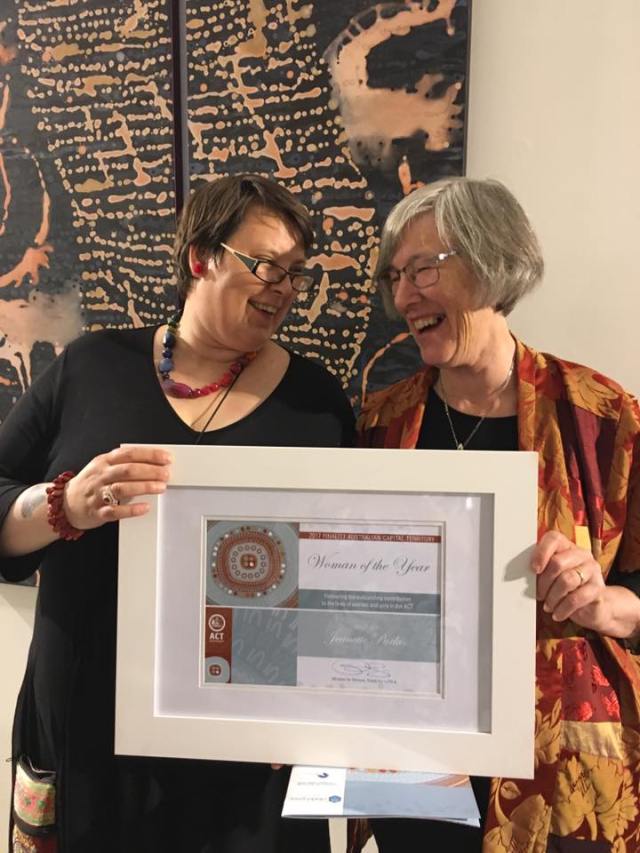
  • Earlier this year In invited my mum to the ceremony for the ACT Woman of the year in which I was a finalist. Having her in that audience was amazing. I don’t want to descend into schmaltzy cliches, but my mum has always been my strongest supporter and great friend.

It would seem that Autistic parenting is different not less. Thanks mum for being you. Happy Mothers’ Day.

17190871_10156021025188747_8474802866973622721_n

With my lovely mum at the ACT Woman of the Year awards this year

Finding your Why? – The value of motivation

I have spent the last few days having a wonderful time giving presentations about Autism and resilience, education to work transitions and mental health and Autism to a variety of audiences in Adelaide, South Australia. I had the absolute privilege to meet some students in a transition centre. They were there because they had become disengaged from education. They had struggled to stay in school and were at a critical point in in their life journey -would they became disengaged from society as adults or would they work towards a life where their full potential was reached – whatever that may be? My audience yesterday was about eight young men. I think they were all Autistic. With presentation to kids and teens I am acutely aware of the fidget factor – you can tell when you start to lose them to boredom and at that point it is best to either change the format or to stop altogether. I had prepared a bunch of content but didn’t think I was going to end up using much of it.

It turned out I had assessed this situation a bit pessimistically. The young people were a wonderful audience and they participated and listened for at least a hour – although some took attention breaks for a bit, which was fine. Most of them asked questions and as I only presented a little of the prepared material, most of the session involved a conversation  on employment and further study driven by the teachers and me. At the end, three of the boys wanted a copy of my employment workbook. I have never had teens wanting my books at events. It is usually their parents who buy a book and then presumably convince their kid to look at it. I was told that one student got on public transport from his school and travelled to the centre to attend my talk, despite not having been there before and knowing none of the other students. That is a big feat for any kid but for an Autistic student who was experiencing difficulties at school, that demonstrated a high level of commitment to a talk which (hopefully) would impact his future.

The purpose of this rather lengthy reflection is to frame the concept of a ‘why’. These students who were at risk of not completing school demonstrated a very strong motivation to see a presentation from an Autistic adult who works full-time in a professional job but has come from some very difficult and dangerous places prior to that employment journey. The teachers I spoke to afterwards were all incredibly impressed by this response from their students. Having given a lot of school talks I am aware the level of engagement at the presentation yesterday was quite unusual. So what makes people do something out of the ordinary like that? I would suggest that this was based i a sense of ‘why’ or as it is often called, motivation. These students may not have had that strong why to do their usual classes but an Autistic adult speaker presumably piqued their interest.

Motivation is a topic which interests me, mostly because I have a ridiculous amount of it. I have worked in my current workplace for over ten years. Apart from when I have taken sick leave, I have never – not once in ten years – woken up and thought ‘oh, I don’t want to go to work today.’ I ALWAYS want to go to work. I literally jump out of bed and get ready and go and when I am waiting for the lift in my office building think ‘gee, I am the luckiest person in the world to have this job.’ My motivation in Autism related things is also quite significant. I have made a daily meme for social media most days since 2014, I write at least one blog post a week and often some additional  articles, I have a radio show, I am writing three books at the moment – and possibly soon to be four – I do a lot of media activities, I facilitate a womens group and host a movie night, and this year I have already given a bunch of presentations and have more to go. I work full time as well. And that isn’t everything I do. For me a holiday involves giving presentations in an interesting city!

I think i have a handy combination of motivation, positive attitude and energy. Like everyone who is motivated, I have a basic ‘why’ – a driving passion which propels me to do all that I do. My current why stems from meeting a young Autistic man who lacked independence and resilience. I was horrified to see how his life was so limited, If this is what getting an early diagnosis meant, I thought, we need to rethink how that works.

Not many people know this, but before I met this your man I had not been very interested in Autism advocacy. I wrote my autobiography in 2005, under the mentorship of the magnificent Polly Samuel / Donna Williams. I was enthused when the book came out but over the next few years not much happened in terms and my work in the Autism community,  By the time I met the young man who spurred me into a need to change the world just a bit, I thought I would always be the author or a good but little known book about navigating a bunch of challenges as an undiagnosed Autistic woman. I had no great wish to be an advocate for an activist. Was was the point? I had a nice job and an apartment filled wiht art. I had overcome many of my demons. I was actually quite surprised at how enthused I became to  change things after meeting the young man.

Within months of my adopting my ‘why’ of advocacy things started to shift in terms of my work in the Autism community. I might even say that without that motivation, the kind of work I do would be impossible, We need our whys if we want to get things done!

Here are some thoughts on motivation and ‘Whys’:

  • Autistic passionate (‘special’ ) interests represent a pretty significant Why for most Autistic people. This is almost always a good thing
  • A why should not be viewed as an obsession. That denigrates it to something negative. It also makes the person whose Why it is feel bad about doing their great love and passion, which isn’t very helpful
  • I don’t think anyone can instil a ‘Why’ in another person except maybe be modelling it and the person becoming inspired
  • If young person is not interested or motivated to pursue a course or a job, they are unlikely to do well at it, or do it at all. So those students at the transition centre were told about my presentation by their teachers but if they had not been motivated to attend their level of concentration and engagement would have been completely different
  • Your Why is the point from which the motivation comes. It is less a case of ‘I want to make this thing happen which will be good because…’ and more ‘I absolutely LOVE this. In order to make it happen I will do this, that and those…’

11046672_799347450146644_6699124159241493091_o

I’m dismissed! Where invalidation comes from and what to do about it

When I was about eleven I apprehensively went up to tell the teacher i was being bullied by some of the boys in my class: ‘Miss, the boys are chasing me and calling me names.” Miss thought for a fraction of a second and said ‘Just ignore it, And stay away from them’. ‘But they can find me!’ Miss went on to apparently more important things and I was all alone.

When I was 22, a skinny kid in hippie clothes with a faded streak of purple in my messy hair, I was in England with my parents. I was a visual artist at the time, and made the most incredible, soulful drawings. I went to a shop in the town where we were staying to buy some pastels and a can of spray fixative. I went up to pay for these things and the woman behind the counter looked at me and said ’Where did YOU get a fifty pound note?’ ‘The bank’ I said and left.

When I was 38 and a public servant, published author and home-owning middle classy sort of person I was in hospital. I apprehensively went up to tell the nurse the toilet in my room was running and I couldn’t use it. I told him four times over a period of three hours – by which time I was busting! Each time he dismissed my concern until finally coming into my room for a different reason and seeing the broken toilet. That example might seem a little incongruous  until I tell you it was a psychiatric hospital and I have a mental illness with apparently negates all the socially valued roles I have.

These three examples of essentially very poor behaviour relate to instances of my concerns – or my own self – being dismissed and my ‘me’ being invalidated. In each instance this was done by a person in a position of authority of sorts. Each represents a time I felt the power imbalance between myself and others in the world and felt ashamed and powerless.

The first example is probably a combination of the teacher / student dynamic and also discrimination about my ‘difference’ (there was no Asperger’s diagnosis in Australia in 1985). The second example is a class privilege sort of thing and maybe also some ageism and the final was clearly discrimination on the basis of mental illness. These invalidations go on all the time and for people from various backgrounds – Autistic people, disabled people and those with mental illness, people from certain ethnic groups and faiths, Aboriginal and Torres Strait Islander peoples and other First Nations peoples, some older people, some younger people, trans people, those who identity as Lesbian,Gay, Bisexual, Intersex, Asexual, and / or Queer, …there is a long list, but a dynamic of invalidation and discrimination exists for a lot of people.

Invalidation means treating someone as if they don’t matter, their opinions don’t count and they have no rights or say in their future. Invalidation has a number of effects on people. It can result in feelings of worthlessness, trauma, self-hate, self-destructive behaviour and things like suicidal thoughts and self injury,

I tend to think invalidation comes out of prejudice People doing it don’t see the person as deserving of respect or kindness. They really don’t matter in the eyes of the person doing the invalidating. There are different magnitudes of invalidation but it all starts from a perceived or actual power imbalance I think, a sort of dynamic privileging one person’s experience over another.

Is there a solution to this sort of thing? I hope there is. In fact there are a few ways to come at this. One approach basically entails addressing power imbalances between people and promoting respect and understanding of people from all different groups in society. This is a very large task! There are subsets of this approach happening all over the place though. My writing this blog post is a very small action to address these issues. I’m pretty certain it won’t single-handedly fix the issue of discrimination and invalidation but it will join a bunch of other writings and talks about addressing these issues. Another way to address it is to implement measures to change the culture  in institutions which are known to invalidate those under their care. This is actually quite a good way of addressing it but once again, would involve a lot of effort to get to staff members in every psychiatric ward etc. My favourite way of addressing invalidation is actually a lot less resource-intensive off the previous options. This one is also potentially highly effective. Here’s how it works:

Just in terms of Autism, think of every autistic adult, and child, every parent, partner and supporter  for those people, every ally and coworker who values their Autistic colleague. That is quite a lot of people, and probably cuts across other demographic groups as well. What if all those people were empowered to see invalidation and say ‘No! We will not have this!’ Every time invalidation was an issue those people would speak up and support one another to speak up. This is a big part of what advocacy is for. It is often hard to speak up for yourself so those in our community supporting one another  can address this invalidation is about making people feel alone and isolated, like they don’t matter. But we do matter. Clearly demonstrating our worth through advocacy so that at each moment of invalidation someone speaks up and asserts their value would turn invalidation on its head. And one person speaking up will be seen by others, hopefully empowering them to do so too.. The empowerment through advocacy can flow to other parts of life. And you know what? This is already happening. We are starting this journey together.

Noble franchise meme

A passion for passion – why Autistic interests are important

This is a post about passions and motivation for Autistic people and why our passions are so important to us.

When I was thirty I wrote a book. Writing the book was actually one of the best ways in which I could address my challenging past. My motivation to write that book was immense. I was driven to write it because it was a catharsis, a means of putting the awful things from my earlier life into a useful format and exorcising those demons. Drafting the book took four weeks and editing it took two. It almost took the publisher longer to send me a ‘we are sending you a contract now Ms Author’ email than the book had taken to write!

After I wrote the book my motivation turned to other things – getting a professional job among them. While I was strongly motivated to do these things, they were not a passionate interest.

For a few years after i wrote my book I had no clear motivation. I was a poor sad person  without an interest or driving passion. I had some vague notion that my book wold be discovered and I would have a bigger audience, that I would be asked to speak at conferences and things. My mentor writing my autobiography was author and all ‘round legend Donna Williams. Emulating her professional life seemed like a nice thing to do. Donna was always getting emails form overseas and being asked to do things. ‘That’s really nice’ I thought but it was not a passion. You cannot manufacture a passion – it is either there or it isn’t.

In 2012 I met a young Autistic man who was so lacking in independence it horrified me. Anyone who has seen one of my resilience or employment presentations would know this young man. I call him’Adam’ publicly. When I told Adam that I worked for the public service, had written a book and was autistic he told me flatly that I was a liar. Apparently my life was impossible for an Autistic person. I realised that the Autism diagnosis – which  i had always though led to positive things for those diagnosed – in fact could lead to an unintended consequence of Autistic people lacking confidence and feeling unable to join the world in the best way for them.

Adam and his situation stirred in me that dormant passion. I didn’t care whether I was well-known, wrote books or anything else but I was going to make it my mission to support Autistic young people to aim for their potential and hopefully reach it, whatever it may involve. Within weeks of meeting Adam I had starting drafting what would become my second book, The Wonderful World of Work. This book is aimed at teens on the Autism spectrum to build their understanding and confidence around employment/ It emphatically places the idea in the world that Autistic people can and do work and with the right supports and understanding from employers and colleagues the workplace can be a positive place for us. That book was also completed in a short space of time and accepted almost without amendment. It was at around the time I wrote this book that I noticed a change in how my work was perceived within and out of the Autism community. I was approached to audition for a TEDx talk in 2013, invited to all sorts of conferences and events.

After six years of being a little-known Autistic author, the direction of my work changed. I went from having some vague notion of sharing my message on autism without really understanding what that meant to being filled with a fire, a drive to actually change the world in whatever small way I could.

After a few years my passion is as strong as ever. My love is my advocacy work and writing. People ask me how I do all the work I do. I always answer ‘because it isn’t work.’ I like to imagine an Autistic child who loves My Little Pony (or whatever) in relation to my passion.  Picture that child and their love for MLP, their encyclopaedic knowledge of that world. Then transfer ‘My Little Pony’ for ‘Autism advocacy’ and ‘child’ to ‘Jeanette’.

I suppose that brings me to crux of this post. Autistic children’s passions are often called obsessions and seen as a distraction at best or an annoying waste of time. Their obsession with a topic is often greeted with adults telling them to stop talking about their interest. Sometimes kids are kept from their interest. Calling something  an ‘obsession’ sort of sets up a semantic issue where that thing is devalued from the outset. Last year I was named ACT Volunteer of the Year all because of my ‘obsession.’ People tell me all the time that my work has helped them or their kids. But why does my interest get to be valued and respected when it is as much an ‘obsession’ as the more esoteric interests of children and adults? My passion was fed by my passions as a child. In my early life I had some interesting passions – cats, fungi, space exploration, Dr Who, the Cold War and Trotskyism. Wen I was a child and teen I was often told to stop focussing on my interest. So let’s have a quick look at the jobs my ‘obsessions’ might have led to had I kept them up:

  • Botanist / mycologist
  • Author
  • Actor
  • Veterinary surgeon or veterinary nurse
  • Astronomer
  • Physicist
  • Historian
  • Academic in one of a number of fields

For Autistic children – and adults – their passion is a key part of their enjoyment of life. Taking away their interest actually may mean taking from them the one pleasurable they have in a hostile and unpredictable world. Certainly if interests relate to dangerous activities this requires attention but most of our interests are harming no-one and helping us to enjoy our world.

FB_IMG_1448685707519

Me getting a standing ovation for obsessing and talking about my special interest for a whole hour! 🙂